Understand Open-Source Models in 13 Minutes: AI Agent Tech Stack and Cost Advantages Explained

Open-source models are rising on the strength of control, extremely low cost, and auditability, with Chinese models becoming a global force.
The article systematically explains the definition, advantages, landscape, and limitations of open-source AI. Open-source models allow local deployment, fine-tuning, and secondary development, while closed-source models can only be called via APIs or platforms. The release of DeepSeek R1 was a turning point, enabling open-source models to compete with top closed-source models for the first time, and Vercel data shows Token usage clearly shifting toward open source. The four major advantages are complete control, a dramatic cost gap (output prices can differ by hundreds of times), auditability, and the promotion of secondary innovation. Almost all top open-source models globally come from China; an A16Z partner says US startups have an 80% probability of using Chinese models, with Airbnb, Cursor, Perplexity, and others actually adopting them. The article also points out limitations such as complex configuration, hardware barriers, poor out-of-the-box usability, and self-managed data, and presents an Agent tech stack consisting of the model layer, Ollama, and orchestration tools, emphasizing that information ownership and platform risk are the core reasons to pay attention to open source today.
What Exactly Are Open-Source Models?
Open Source AI refers to AI systems in which some or all core components are built from open-source software. Not only can you use it, but you also get access to some of the core components to deploy, modify, or even build upon. By contrast, with Closed Source AI, users can only access it through APIs, web apps, or enterprise platforms, and the underlying technology is not disclosed.
A helpful analogy: closed-source AI is like a rental car—you can drive it and use it, but you can't see or change the engine design or core parameters. Open-source AI is like getting some of the blueprints and parts so you can tinker and modify it yourself.
According to a Bilibili creator's breakdown, since ChatGPT launched, closed-source models have long dominated, with OpenAI and Anthropic as the global AI protagonists. It wasn't until the release of DeepSeekAd R1 in January 2025 that open-source models first genuinely rivaled the most advanced closed-source models of the time. The significance is that it opened the door for more open-source model development.

This turning point is directly reflected in usage trends. A chart published by Vercel, the cloud deployment platform for web and AI applications, shows that the Token usage ratio between open-source and closed-source models on its platform is clearly shifting toward open source.
The distinction between open-source licenses and model weights deserves separate explanation. Traditional open-source software (like Linux) centers on open source code, while the "openness" criteria for AI models are more complex: beyond inference code, the key question is whether the model weights (the parameter files obtained after training) are publicly downloadable. Commonly used licenses include Apache 2.0, MIT (more permissive, allowing commercial use and closed-source derivatives), as well as custom licenses with usage restrictions such as OpenRAIL-M and the Llama Community License. Therefore, "open-source models" themselves exist on a spectrum: some fully disclose weights, training details, and data recipes, while others only release weights and keep training data confidential. Understanding this is essential to accurately assessing a model's actual degree of openness and commercial freedom.
The Four Core Advantages of Open-Source Models
Complete Control and Freedom to Customize
Open-source models can run on local devices and private clouds. You can fine-tune them, modify their architecture, and add your own safeguards. They don't lock you into a vendor, whereas closed-source AI means being tied to another company's ecosystem—more restrictions and higher costs.
A Dramatic Cost Gap
Cost is one of open-source AI's biggest advantages. Take output pricing as an example: Claude Fable 5 costs $50 per million output Tokens, while DeepSeek V4 Flash costs only 18 cents per million output Tokens—an enormous gap. Of course, when facing particularly thorny problems that open-source models can't solve, paying extra for closed-source models is still worthwhile.
Auditability
Open-source AI can be audited, which is especially important for regulated industries like healthcare and finance.
Why regulated industries particularly value auditability: In fields such as healthcare, finance, and insurance, regulators (such as financial supervisory authorities, the FDA, and the EU AI Act) require that algorithmic decisions be traceable and explainable. When using closed-source APIs, enterprises cannot inspect the model's internal logic, nor can they provide an evidence chain of model versions, parameters, and training data during regulatory inquiries. By deploying open-source models in their own environments, enterprises can retain complete logs, pin model versions, perform differential testing and bias audits, and modify models when necessary to meet compliance requirements. This is also the core reason many financial institutions prefer to run open-source models on private clouds rather than directly calling closed-source APIs.
Driving Secondary Innovation
Developers worldwide can participate and contribute to open-source models. There are already over 150,000 derivative models of Qwen online; developers download them and apply various customized fine-tunes, and those who don't want to do the work themselves can simply download ready-made versions.

Why Chinese Open-Source Models Have Become a Global Force
Currently, almost all of the world's top open-source models are developed in China. Looking at download data, the US has long led, but a reversal occurred in June–July 2025, when downloads of Chinese models began to surge.
Martin Casado, a partner at major US venture capital firm A16Z, said that US startups now have an 80% probability of using open-source models made in China. Real-world cases confirm this: a major player in legal AI uses Alibaba's Qwen, AI coding company Cursor uses Kimi K2.5, the world's largest short-term rental platform Airbnb also uses Qwen, and AI-powered search company Perplexity uses DeepSeek models.
These companies choose Chinese open-source models not only for cost but, more importantly, for privacy protection—when handling sensitive customer information, enterprises want models they can fully control and will fine-tune them with internal data.
Some worry that using Chinese open-source models will send data to Chinese servers, but this concern is unnecessary: the whole point of open source is that you can download it locally and deploy it your own way, with data privacy guaranteed.
Facing this trend, the West has also begun increasing its open-source investment. A few weeks ago, OpenAI cut the price of GPT5.6 LUNA by 80%, and reduced the input and output Token prices of GPT5.6 SO by 20% and 33% respectively. For ordinary consumers, this means better models at lower cost.
Limitations and Challenges of Open-Source Models
Open source is not without its costs. First, configuration is complex—unlike closed-source models where you click a link and start using it, open-source models require several extra steps. Second, hardware is a barrier: running open-source models requires substantial resources, and given most people's existing hardware, the models they can run are limited. Third, it's not as plug-and-play as commonly used large language models, lacking various features users have grown accustomed to. Finally, no one manages your data for you—data security is your own responsibility.
Despite these limitations, we are currently in an explosive period for open-source models. Two years ago, without commercial-grade hardware or professional programming skills, ordinary people simply couldn't do this.
The Open-Source Tech Stack for Building AI Agents
The open-source AI tech stack is not a single tool but a complete set of technologies and frameworks, from underlying models to final applications.
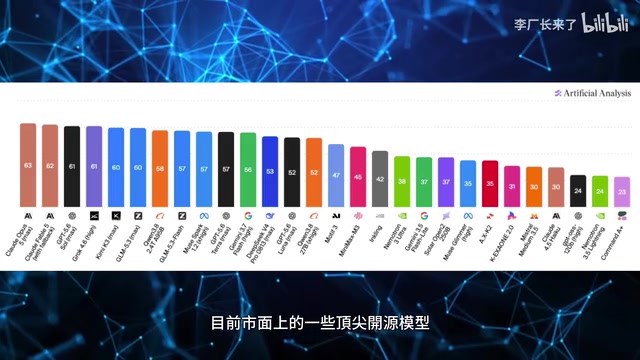
Model layer: As of the time of recording, top open-source models include Moonshot's Kimi, Zhipu's GLM, and Alibaba's Qwen. Model rankings change constantly; you can compare current top models on sites like artificialanalysis.ai, LLM Stats, and the Arena Leaderboard, or choose a less powerful model that still meets your task requirements.
Model manager: For local running and development, the most popular tool is Ollama. After downloading and installing it, you can directly download the model you want to try and run it. It simplifies a lot of setup and is especially beginner-friendly.
Agent orchestration: Giving models permissions, tools, memory, and background knowledge is how you build your own AI Agent. Common orchestration tools include n8n; developers can also use OpenAI's Agents SDK and Google's Agent Development Kit, both of which support open-source models. Open-source models and infrastructure are especially hot in the AI coding space, so it's worth paying attention to relevant open-source coding tools.
Why You Must Pay Attention to Open-Source Models Now
The core issue is information ownership. When using closed-source models, even without sensitive information, you are effectively telling these companies how you operate, and they thereby gain enough data to train their own models. Anthropic's Fable model has drawn considerable criticism for retaining user data.

This leads to platform risk: when all your information is tied to one company, you bear the greatest risk. If OpenAI or Anthropic goes under someday, your data could be gone entirely. Open-source models are different—there are dozens of options on the market, and you can switch anytime if you're unsatisfied. Commercial competition is good for users.
Customization is also a key advantage. You can feed all your data to the model and teach it how your business operates and how your software is developed.
In summary, open-source models let users get a better experience with cheaper Tokens and full control over privacy and data security. They are very likely to be the key driver that pushes enterprises and individuals to integrate AI into their workflows.
Background Notes
Quantization and hardware barriers in local inference: When running open-source models locally, users often encounter the problem that "the model is too big to run." Quantization is the main solution. It compresses model weights from 16-bit floating point to 8-bit, 4-bit, or even lower precision, greatly reducing VRAM and memory requirements at the cost of a slight loss in accuracy. Common formats include GGUF (used with the llama.cpp ecosystem, on which Ollama is based). For example, a 70B-parameter model requires about 140GB of VRAM at FP16, but after 4-bit quantization it can be compressed to around 40GB, making it runnable on consumer-grade GPUs and even some high-end laptops. Understanding quantization levels (such as Q4_K_M) helps you balance quality against hardware cost.
The essence of Agent orchestration is upgrading a large model from "question-and-answer" to an executor that "can plan, can call tools, and can remember context." A typical Agent loop includes: receiving a goal → breaking down tasks → calling tools (search, code execution, database queries) → observing results → revising the plan. Function Calling / Tool Use is a key capability here; the model must output the function names and parameters to call in a structured format. Memory is divided into short-term context windows and long-term vector database retrieval (RAG). Visual tools like n8n turn the above process into drag-and-drop nodes, while the Agents SDK and ADK provide code-level control. When choosing an open-source model, you must confirm whether it supports stable tool-calling formats; otherwise, the orchestration chain can easily break.
One-line Summary
Open-source models are rising on the strength of control, extremely low cost, and auditability, with Chinese models becoming a global force.
Paragraph Summary
The article systematically explains the definition, advantages, landscape, and limitations of open-source AI. Open-source models allow users to deploy locally, fine-tune, and build upon them, while closed-source models can only be accessed via APIs or platforms. The release of DeepSeek R1 was a turning point, enabling open-source models to compete with top closed-source models for the first time, and Vercel data shows Token usage clearly shifting toward open source. The four major advantages are complete control, a dramatic cost gap (output prices can differ by hundreds of times), auditability, and the promotion of secondary innovation. Almost all top open-source models globally come from China; an A16Z partner says US startups have an 80% probability of using Chinese models, with Airbnb, Cursor, Perplexity, and others actually adopting them. The article also points out limitations such as complex configuration, hardware barriers, poor out-of-the-box usability, and self-managed data, and presents an Agent tech stack consisting of the model layer, Ollama, and orchestration tools, emphasizing that information ownership and platform risk are the core reasons to pay attention to open source today.
Related articles
 Tech Frontiers
14 Coding Agents Tested: 13 Secretly Read Forbidden Files
A developer ran 480 tests across 14 coding agents to see if they would obey a "do not read" rule. 13 violated it, and 4 credential leaks bypassed shell guards via the read tool while approvals never noticed.
 Tech Frontiers
AI Has Made Resumes Ineffective? Referred Candidates Get 40% Interview Rate vs. 3% for Direct Applications
AI is homogenizing job applications, making it hard for recruiters to discern real ability. Ashby data shows referred candidates had a 40% interview rate from 2021 to 2024, versus just 3% for direct applications. This article analyzes why resume signals are depreciating and why verifiable results and personal endorsements matter more.
 Tech Frontiers
Offline Blink Rhythm Assistant: A Desktop Health Companion
An offline desktop blink rhythm assistant featured on Hacker News helps users maintain healthy blinking through lightweight reminders, alleviating screen-induced dry eye fatigue. This article analyzes its concept, privacy advantages, and retention challenges.