Understanding Three Generations of Agent Evolution: From Function Calling to DeepSeek Harness Engineering Foundation

From Function Calling to engineering foundations — a guide to three generations of LLM Agent evolution.
Starting from the inherent limitations of native LLMs, this article explains the core value of Agents as "interpreters" that fill gaps in memory, tool use, and multi-step planning. It then traces three generations of Agent architecture: Generation 1 (Function Calling) enabled tool invocation but remained passive; Generation 2 introduced autonomous task decomposition and parallel execution; Generation 3, represented by DeepSeek Harness, focuses on controllability and extensibility as an engineering foundation. A "four vehicles" analogy clarifies the practical boundaries of closed-source tools, paid platforms, and open-source frameworks in enterprise contexts, ultimately concluding that production deployment requires a full stack including RAG, knowledge graphs, and high-concurrency optimization.
What Is an Agent: The "Interpreter" of the LLM Era
More and more developers are paying attention to large language models, but relatively few truly understand the concept of an "Agent." Native LLMs — whether domestic models like Zhipu and DeepSeekAd, or GPT — have several fundamental limitations: no persistent memory, time-constrained knowledge, no internet access, and no ability to invoke local tools. After ten rounds of conversation, a model greets you as if it's the first time you've met. Ask it about tomorrow's weather or the latest stock policy, and it will confidently make things up.
This is exactly where Agents add value. Think of an Agent as an "interpreter" for the LLM era — just like a human translator bridging communication between a Chinese speaker and an English speaker. Once a user states a need, the Agent understands the request, invokes the appropriate tools, integrates the results, and delivers an accurate answer back to the user.
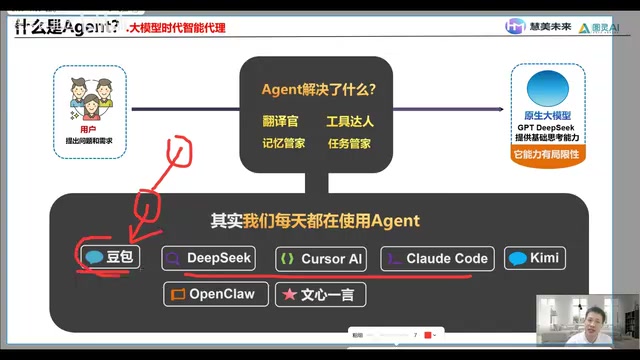
In the LLM ecosystem, Agents solve four core problems:
- Interpreter: Translates the user's natural-language requests into instructions the model can understand, then converts the model's output into results the user can actually use.
- Tool Expert: Helps the model call external tools and APIs — enabling web search, database queries, and more — so the model goes from "can talk" to "can act."
- Memory Manager: Remembers context, user preferences, and multi-turn conversation history to give interactions continuity.
- Task Manager: Breaks complex problems into sub-steps, plans an execution flow, and proactively adjusts the approach when issues arise.
The AI assistants we use every day — Doubao, or coding assistants like Claude Code-style tools — are all Agents at their core. They remember project structure, can invoke solutions, and iteratively debug code. All of these capabilities come from the "Tool Expert" and "Task Manager" roles described above.
Agent Technology Evolution: Three Generations
Agent development has gone through roughly three major upgrades: from tool invocation, to workflow orchestration, to engineering foundation. Understanding this trajectory is the key to grasping why DeepSeek Harness matters.
Generation 1: The Tool-Calling Era (Function Calling)
The technical term for the first generation is Function Calling. Think of it as giving the LLM "hands and feet" — you need limbs to get work done.
Consider this scenario: a user asks, "Help me look up recent sales figures." The native model can't answer due to knowledge cutoffs and permission constraints, so Function Calling steps in to invoke the right tool — a weather API for weather questions, or the company's internal database for sales data.
This generation is a lot like a workplace intern: they only move when prompted, and stop the moment the manager turns away. It's a passive, single-step execution model.
Function Calling was first introduced by OpenAI in 2023 as a standardized capability within GPT models, and was subsequently adopted widely across the industry. The core mechanism works like this: developers pre-define a set of function names, parameter structures, and descriptions; the model decides during inference whether a function call is needed; if so, it outputs a structured JSON call request; the application layer actually executes the function and returns the result to the model. The model itself never runs code directly — it acts as an "intent recognizer" and "result integrator." The fundamental goal of this design is to decouple the model's language understanding from an external system's execution capabilities, allowing the model to interact with the real world safely and in a controlled manner without modifying its weights. The key limitation is that every call depends on external triggering, with no autonomous cross-step planning.
Generation 2: Autonomous Task Decomposition (Workflow Orchestration)
The second generation made the leap from "single-step execution" to "multi-step planning," enabling LLMs to autonomously break down tasks and think proactively.
Take "generate a sales report" as an example: the model first performs intent recognition, then runs two parallel tracks — one extracting internal sales data, another automatically determining the analytical framework (since every company's KPIs and dimensions differ). The model then extracts key metrics, generates the report, routes it through a human review step, and finally delivers the result to the user.
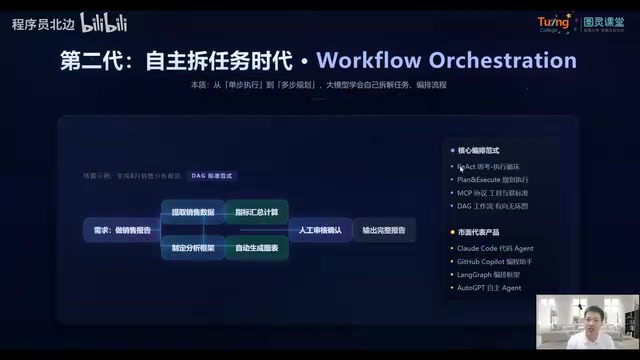
Most mainstream Agent architectures on the market today — such as the ReAct framework and many mature tools — are fundamentally based on this generation. However, when deployed in real enterprise projects, the weaknesses of the second generation become highly visible, which is what drove the emergence of the third generation.
ReAct (Reasoning + Acting) is the landmark architectural paradigm of second-generation Agents, proposed by Princeton University and Google in 2022. It interleaves the model's Thought, Action, and Observation in a cycle, allowing the model to reason and invoke tools simultaneously during execution — dynamically adjusting plans based on each step's outcome rather than generating a fixed workflow upfront. Compared to the first generation, ReAct's key breakthrough is introducing "chain-of-thought reasoning": the model first writes out its current thinking step in natural language, then decides on the next action. This makes decomposing complex tasks and self-correcting errors possible. Early popular frameworks like LangChain and AutoGPT drew heavily from this paradigm. Its main bottleneck is hallucination accumulation over long reasoning chains, and the difficulty of guaranteeing execution determinism and auditability in enterprise environments.
DeepSeek Harness: The Third-Generation Engineering Foundation
When developers move simple Agents into enterprise-scale scenarios, the second generation's shortcomings in controllability and extensibility become immediately apparent. The third generation — the engineering foundation era, represented by DeepSeek Harness — was built precisely to address these problems.
To understand the difference between Harness and ordinary Agents, a "four vehicles" analogy helps illustrate the different categories of tools available:
Sealed Cargo Truck: Closed-Source AI Coding Tools
The prime example is Claude Code and similar closed-source AI coding tools. Their "cargo capacity" is impressive — developers can extend functionality by writing Skills or integrating MCP to make the "truck" run faster. The advantage is instant out-of-the-box usability. But the "cargo hold" and "chassis" cannot be modified. Controllability and extensibility have clear limits in enterprise projects — they're essentially suited only for coding scenarios, and expanding to areas like video generation quickly runs into a wall.
Sedan: Paid Closed-Source Agent Tools
Some paid ChatGPT-style tools are like a beautifully crafted sedan — the experience is polished and complete, but the platform controls the core. You can tweak the "exterior and paint" through official plugins, but the engine and overall architecture are untouchable.
Traditional Open-Source Agents: Change One Thing, Break Everything
GitHub is full of open-source Agent projects, but engineers who know what they're looking at will quickly realize that roughly 98% of them are demos and are difficult to deploy directly in enterprise production environments. If you're a technical director or CTO, you're unlikely to adopt one directly.
The advantage of open-source Agents is customizability: you can swap in a different UI, replace the engine, or fine-tune details. But the downside is just as real — high architectural coupling means changing a UI layer can cascade into changes across the entire system, making iteration costly and demanding strong technical capability.
From Concept to Production: The Direction of Agent Engineering
Looking at all three generations together, the trend is clear: Agents are evolving from "runnable demos" to "production-ready engineering foundations." Real enterprise projects involve a technology stack far more complex than any demo — multi-modal RAG retrieval, knowledge graphs, high-concurrency optimization, microservices, model fine-tuning — all of which are unavoidable requirements for real-world use cases like intelligent customer service and e-commerce Agents.
For developers looking to get started, rather than chasing every new tool that emerges, it's far more valuable to first internalize the underlying logic of Agents and the three-generation evolution roadmap. Once you understand the "tool calling → workflow orchestration → engineering foundation" progression, you can approach specific business scenarios with real projects — and avoid the trap of spending a year studying without making any practical progress.
Note: This article is adapted from a live technical talk and is oriented toward conceptual explanation and architectural analogy. Specific hands-on projects and code details were not covered in the source material. Readers are encouraged to validate further using official documentation and real-world projects.
RAG (Retrieval-Augmented Generation) is one of the most common core components in enterprise-grade Agent deployments and deserves a dedicated explanation. The basic idea: rather than hard-coding all knowledge into model weights, the system dynamically retrieves relevant content from an external knowledge base at inference time, injects the retrieved passages into the prompt, and lets the model generate an answer based on that combined context. This overcomes the model's knowledge cutoff limitation while keeping the enterprise's proprietary data stored locally — no need to upload it to a third-party platform. Multi-modal RAG extends retrieval beyond plain text to cover images, tables, PDFs, video frames, and other heterogeneous data sources, making it well-suited for scenarios like product manual queries and contract review. Knowledge graphs complement RAG by excelling at relational reasoning between entities — supply chain traceability or org chart queries, for example — and combining the two approaches significantly improves accuracy on complex questions.
Related articles

Uber Deploys ChatGPT Work Company-Wide: AI in the Workplace Enters the Scaled Implementation Phase
Uber deploys ChatGPT Work to 30,000+ employees, extending it from engineering to all roles. We analyze its expert-engineer pairing, end-to-end automation, and questions of AI control and power concentration—insights for scaling AI in the workplace.

Shift at Midnight Hands-On: When "ID Verification" Becomes Alien Hunting
Shift at Midnight blends ID verification with horror survival in a four-player co-op game. We break down its inspection mechanics and chaotic humor.

Zelensky Recounts the Outbreak of War: I Need Ammunition, Not a Ride
Zelensky recalls the first day of war in a YouTube interview: farewell to family, rejecting Biden's evacuation offer with "I need ammunition, not a ride," and how Bucha shaped his stance on compromise and peace talks.