UniEvo-VL: How Self-Distillation Training Enables Multimodal Models to Self-Evolve

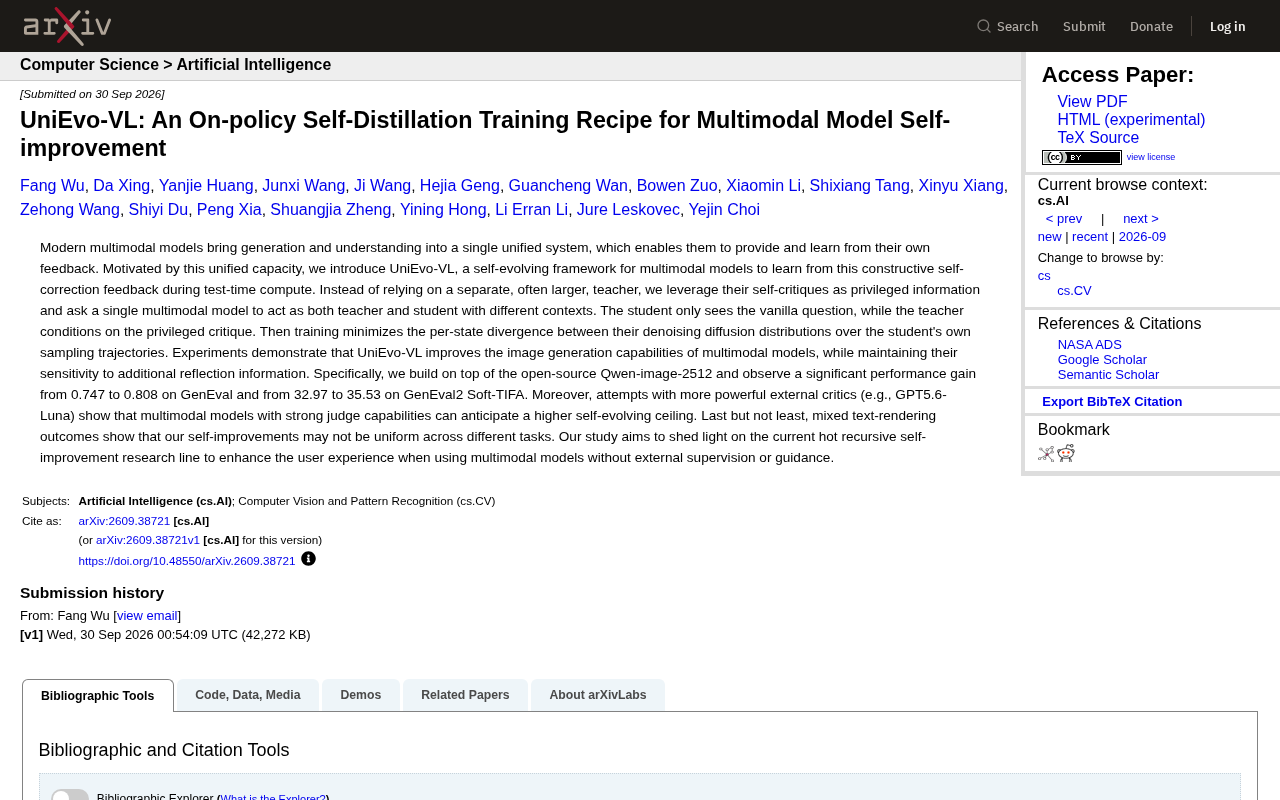
UniEvo-VL explores self-distillation to help multimodal models self-improve, trading compute for costly image-text annotations.
UniEvo-VL is an early-stage vision-language model project centered on using self-distillation training to enable self-improvement, reducing reliance on expensive human-annotated image-text data. Its core mechanisms include output consistency constraints under different augmentations, pseudo-label generation from high-confidence model outputs, and EMA weight smoothing for stable teacher signals. Given the high annotation costs in multimodal AI, this compute-for-data trade-off has real appeal — but the approach faces known risks like error accumulation and performance saturation. Full technical validation awaits a complete paper and benchmark results.
When Multimodal Models Start "Teaching Themselves"
In the training pipeline of large vision-language models (VLMs), high-quality annotated data has always been the most expensive bottleneck. A project called UniEvo-VL proposes a new approach: enabling models to improve themselves through self-distillation training, reducing reliance on external supervision signals.
It's worth noting that this project currently appears only as a brief entry on Hacker News, with very limited public information and no accompanying technical paper or benchmark results. This article explores the core proposition of self-distillation training as a technical approach, rather than serving as a comprehensive evaluation of UniEvo-VL itself.
What Self-Distillation Training Actually Does
Traditional knowledge distillation typically requires a larger, more capable "teacher model" to guide a "student model." The key distinction of self-distillation is that the teacher and student can be the same model — or outputs generated by the model itself at different training stages or from different perspectives.
Core Mechanisms
In multimodal settings, self-distillation typically takes one of several forms:
- Output consistency constraints: The model is trained to produce consistent predictions for the same image-text input under different augmentations (cropping, masking, paraphrasing), thereby improving robustness.
- Self-generated pseudo-labels: The model first generates answers for unannotated data, then feeds its high-confidence outputs back to itself as training targets.
- Cross-stage distillation: An earlier or smoothed version of the model (e.g., using EMA weights) serves as the teacher to stabilize the training process.
The appeal of this approach lies in bypassing the need for massive human annotations, theoretically allowing performance to compound on top of the model's existing capabilities in a "snowball" fashion.
EMA (Exponential Moving Average) weight smoothing is a common technique in cross-stage distillation. The idea is to set the teacher model's parameters as a weighted average of the student model's historical weights, rather than directly copying a snapshot at any given moment. This effectively suppresses training noise and stabilizes teacher model outputs. Self-supervised visual representation methods such as DINO and MoCo v3 rely heavily on EMA teacher mechanisms, and have demonstrated their effectiveness in preventing training collapse. In multimodal settings, where image-text alignment introduces additional uncertainty, a stable teacher signal is especially critical — making EMA an indispensable design choice in self-distillation frameworks.
Why Multimodal Models Need This Path
Training vision-language models requires not just images, but also aligned text descriptions or question-answer pairs. Compared to pure text data, high-quality image-text pairs are significantly more expensive to obtain and tend to be noisier.
There are three reasons why self-improvement training has attracted attention in the multimodal domain:
- High cost of data scaling: The marginal cost of manually annotating image-text pairs remains steep; self-distillation offers an alternative that trades compute for data.
- Accumulated model capability: When the base model is strong enough, its high-confidence self-generated outputs carry meaningful teaching value in their own right.
- Easing the modality alignment challenge: Through consistency constraints, the model can reinforce semantic alignment between vision and language without introducing new annotations.
However, this path carries well-recognized risks — if the model's own errors are repeatedly reinforced, it can lead to "error accumulation" or even performance collapse. Reliably filtering trustworthy self-supervised signals is the critical question that determines whether this approach is viable.
Error accumulation is a well-studied problem in self-supervised and semi-supervised learning. When a model uses its own erroneous predictions as training targets, those errors compound across iterations, ultimately causing continuous performance degradation — a phenomenon known as "model collapse." Research in large language models (including a 2024 Nature paper) has shown that repeatedly fine-tuning on a model's own outputs systematically erodes tail information from the original data distribution. Common mitigation strategies include: applying confidence thresholds to filter low-quality pseudo-labels, mixing in a fixed proportion of real annotated data as anchors, and using reward models or verifiers to screen self-generated content. This is also one of the core dimensions to watch when evaluating the technical maturity of UniEvo-VL.
Potential and Limitations of This Technical Approach
Self-improvement has become a hot topic in the large model space — from self-play and self-reward in language models to its current extension into multimodal settings — all driven by the same motivation: reducing dependence on external supervision and enabling models to continuously evolve.
UniEvo-VL combines "self-distillation" with "self-improvement" in the context of vision-language models. The name itself (Uni + Evo, for Unified + Evolution) hints at the design goal: building a unified multimodal framework capable of autonomous evolution.
Based on what's publicly available, however, several key questions remain to be verified:
- Is the improvement from self-distillation sustainable, or does it plateau after a number of iterations?
- Compared to simply scaling up high-quality data, is the compute cost actually more favorable?
- On complex multimodal reasoning tasks, can the quality of self-generated signals support effective training?
Answers to these questions will require the project to release more complete technical details and benchmark results.
Self-improvement in pure language models already has several concrete implementations to reference. DeepMind's Self-Play Fine-Tuning (SPIN) trains models to distinguish their own generated text from human text, thereby continuously improving output quality. Meta's Self-Rewarding Language Models have models play both generator and judge simultaneously, iterating through self-scored reward signals. A common prerequisite for these approaches is that the model's discriminative ability (identifying good vs. bad outputs) must lead its generative ability — otherwise, self-evaluation itself lacks reliability. This prerequisite is even harder to satisfy in multimodal settings: the criteria for evaluating visual understanding are far more difficult to formalize than text fluency, which represents a deeper challenge for UniEvo-VL.
Closing Thoughts: A Direction Worth Watching
Despite the limited information currently available, the self-distillation and self-improvement approach that UniEvo-VL represents does address a core pain point in multimodal model development. For practitioners tracking frontier research, this is a technical signal worth following. The ultimate judgment, however, must rest on the experimental data and reproducible code that the project makes public.
Related articles

Free Unlimited Claude Code Solution: Agnes AI + CC Switch Setup Guide
No paid subscription needed — pair the free AI platform Agnes AI with the open-source tool CC Switch to provide a backend for Claude Code, enabling unlimited free calls to text, image, and video models. This guide covers the full setup, test results, and usage boundaries.

A Complete Zero-Cost Guide to Getting Started with Claude Code for Beginners in China
A beginner's guide to Claude Code for users in China: two installation methods (command line and IDE plugin), full configuration steps for replacing the official API with the free domestic LongCat model, and a hands-on demo of building a small tool with natural language, plus tips.

When the NSA Gets Involved: The AI Supply Chain Crisis Behind Open-Source CVEs and API Key Hijacking
Multiple open-source projects disclosed severe CVEs in one day, PHP flaws alarmed the FBI, and Railway and OpenCode were breached with API keys stolen. This article breaks down the vulnerability window, AI-accelerated exploitation, and the AI supply chain crisis behind the API key black market, with a developer defense checklist.