United Airlines Rejects AI Agents Booking Tickets: Dual Concerns Over Privacy and Regulation

United Airlines bans personal AI assistants from booking tickets, citing privacy and regulation—highlighting the difficulty of AI agent adoption.
United Airlines has made clear it will not allow personal AI assistants to book tickets on its platform, citing privacy and regulation: AI agents need access to sensitive identity, payment, and itinerary data, increasing leakage risk; and liability for booking errors and refund disputes remains unclear under current rules. United says it has not observed many users attempting AI agent bookings, consistent with DoorDash and others, showing low AI agent penetration in real transactions. The article argues this reflects industry-wide caution: to enter sensitive areas like air tickets and finance, AI agents need compliance and trust frameworks via official API authorization, responsibility division, and transaction insurance, and in the short term will remain limited to information queries and itinerary suggestions.
United Airlines Says "No" to AI Agents
As more consumers try to use AI assistants to handle everyday tasks, airlines have drawn a red line. According to a Wall Street Journal report, United Airlines has made clear it will not allow personal AI assistants to book tickets on its platform, citing concerns over both privacy and regulation.
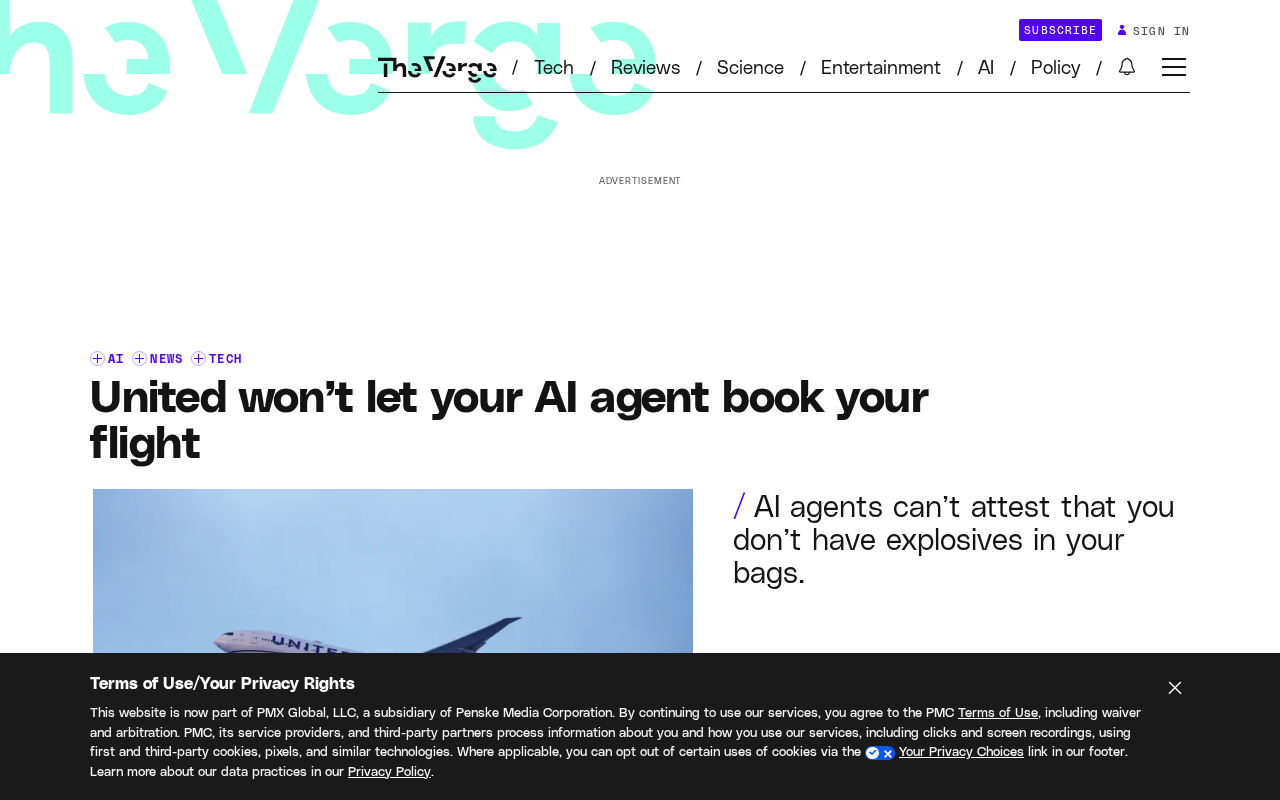
This decision stands in contrast to the openness of some merchants. United Airlines noted that it has not yet observed a large number of users attempting to book flights through AI agents, consistent with observations from companies such as DoorDash. In other words, demand has not yet reached scale, but the airline has already staked out its position in advance.
Privacy and Regulation: The Dual Logic Behind the Refusal
United Airlines' concerns are not unfounded. On the privacy side, for an AI agent to complete a booking, it typically needs access to the user's identity information, payment credentials, and travel preferences. These sensitive data flow between third-party AI systems and the airline's platform, increasing the risk of leakage and misuse.
On the regulatory side, airline ticketing involves complex consumer protection rules, fare transparency, and liability attribution. When a transaction is initiated by an AI agent, if booking errors, refund disputes, or price disagreements arise, it is unclear whether responsibility lies with the user, the AI developer, or the airline—and existing regulations provide no clear answer. United Airlines choosing caution before the rules are clear is essentially a risk-avoidance strategy.
An AI Agent refers to an intelligent program that can autonomously execute multi-step tasks under user authorization—for example, automatically filling out forms, completing payments, and comparing prices to place orders. Unlike chatbots that only offer conversational suggestions, it needs to directly call third-party platform APIs or simulate user actions to "handle things on behalf of" the user. This capability relies on access to user credentials, payment information, and behavioral data, so it naturally shifts data control from merchants to third-party AI systems. For airlines, this means the transaction chain originally confined within their own apps is penetrated by external programs, making it difficult both to audit data flows and to trace the operating entity in the event of a dispute. This is the technical root of United Airlines' emphasis on privacy concerns: it is not opposed to AI itself, but to letting external agents touch core transaction data in the absence of controllable interfaces.
From a regulatory perspective, airline ticketing is subject to a series of consumer protection rules—for example, fares must be presented completely and transparently, refund and change rules must be clearly disclosed before purchase, and erroneous fares and overbooking have specific compensation standards. These rules assume transactions are completed by the traveler themselves or by a qualified agent in a controllable interface. When an AI agent operates on the user's behalf, who is responsible for "whether the disclosure was sufficient," and who bears the loss when distorted price information scraped by the agent leads to damages—current regulations have no corresponding provisions. The ambiguity of liability attribution translates directly into compliance risk and potential compensation costs for merchants, so before the rules are clear, airlines tend to keep transactions firmly within channels they can supervise.
Industry Observation: AI Agent Adoption Is Far Slower Than Imagined
United Airlines' statement reveals a reality obscured by a heavily hyped concept: the penetration rate of AI agents in real commercial scenarios remains very low. Although technical demos keep emerging, users who actually use AI agents to complete complex transactions are still a minority. Observations from platforms such as DoorDash corroborate this—early adopters exist, but it is far from mainstream behavior.
This gap of "hot technology, cold application" stems in part from caution on the merchant side. Transaction-intensive companies such as airlines and food delivery platforms must weigh the improvement in user experience against increased risk-control costs when opening APIs to AI agents. United Airlines' refusal may be just a microcosm of the industry's collective wait-and-see approach.
In demos, "AI agents" often appear as long-chain tasks that can continuously complete search, price comparison, form filling, and payment. But in real commercial environments, the degree of API openness, anti-automation risk controls (such as CAPTCHAs, device fingerprints, and behavior detection), and payment verification steps all significantly raise the interruption rate of agents. Part of the reason for the so-called "hot technology, cold application" is that merchants widely deploy anti-scraping and anti-automation mechanisms. AI agents are either blocked or need to bypass risk controls, which in turn raises compliance controversies. Therefore, the low penetration rate is not simply because users are uninterested, but because the supply-side infrastructure is not yet ready for agent-based transactions.
Implications for the AI Agent Ecosystem
United Airlines' decision is a signal to AI agent developers: technical capability alone is not enough to close the commercial loop; compliance and trust-building are equally critical. If AI agents hope to enter highly sensitive areas such as air tickets and finance, they may need to establish more formal cooperation frameworks with merchants—for example, through official API authorization, clear division of responsibilities, and transaction insurance mechanisms.
For ordinary users, the idea of using AI assistants to book tickets in the short term remains difficult to realize. Until airlines explicitly open up, the role of AI agents in travel booking will remain mostly at the level of information queries and itinerary suggestions rather than directly completing transactions.
One-line Summary
United Airlines has banned personal AI assistants from booking tickets on its platform, citing privacy and regulation—a reflection of how hard it is for AI agents to be adopted.
Paragraph Summary
United Airlines has made clear it will not allow personal AI assistants to book tickets on its platform, with reasons centered on privacy and regulation: AI agents need access to sensitive data such as identity, payment, and itinerary information, increasing leakage risk; and when AI agents initiate transactions, liability for booking errors and refund disputes lacks clear definition under current regulations. United Airlines says it has not yet observed a large number of users trying to book tickets with AI agents, consistent with observations from platforms such as DoorDash, indicating that AI agent penetration in real transaction scenarios remains very low. The article argues that this statement is a microcosm of the industry's collective wait-and-see approach. If AI agents are to enter highly sensitive areas such as air tickets and finance, they need to establish compliance and trust frameworks through mechanisms such as official API authorization, responsibility division, and transaction insurance. In the short term, their role in travel booking will remain mainly at the level of information queries and itinerary suggestions.
Related articles

How Do Cursor, Devin, TRAE, and Copilot Compare on Price? Calculate Your Credits Before You Compare Monthly Fees
Side-by-side comparison of individual and team pricing for Cursor, Devin Desktop, TRAE, and Copilot, breaking down credit rules, third-party model inclusion, overage billing, and practical methods for measuring usage before paying, setting spending caps, and choosing the right tool.

Copilot Retires Three Models: Pro Users Left With Only One Alternative
GitHub Copilot retires Claude Opus 4.8, Claude Opus 5, and GPT-5.6 Tera on Nov 16 across Chat, code completion, and Agent mode. Pro users have only GPT-6 Luna left; Legacy annual plans miss Opus 5.5; admins must enable replacements manually.
Gemini 4 Carbon Arrives: The LLM Race Enters the Era of Million-Token Context and Trillion-Parameter Open Source
Google launches Gemini 4 Carbon and multi-agent tool Swarm; Anthropic debuts million-context Fable 5.2 and Mythos 5.2; OpenAI releases security-focused GPT-6 Cyber; Mistral and Kimi open-source trillion-parameter models — the LLM race accelerates across the board.