Unpatchable Hardware Vulnerability Discovered in Apple Chips, Reopening the Jailbreak Door for Older iPhones

Unpatchable Apple chip flaw exposes older iPhones to permanent jailbreak and security risks.
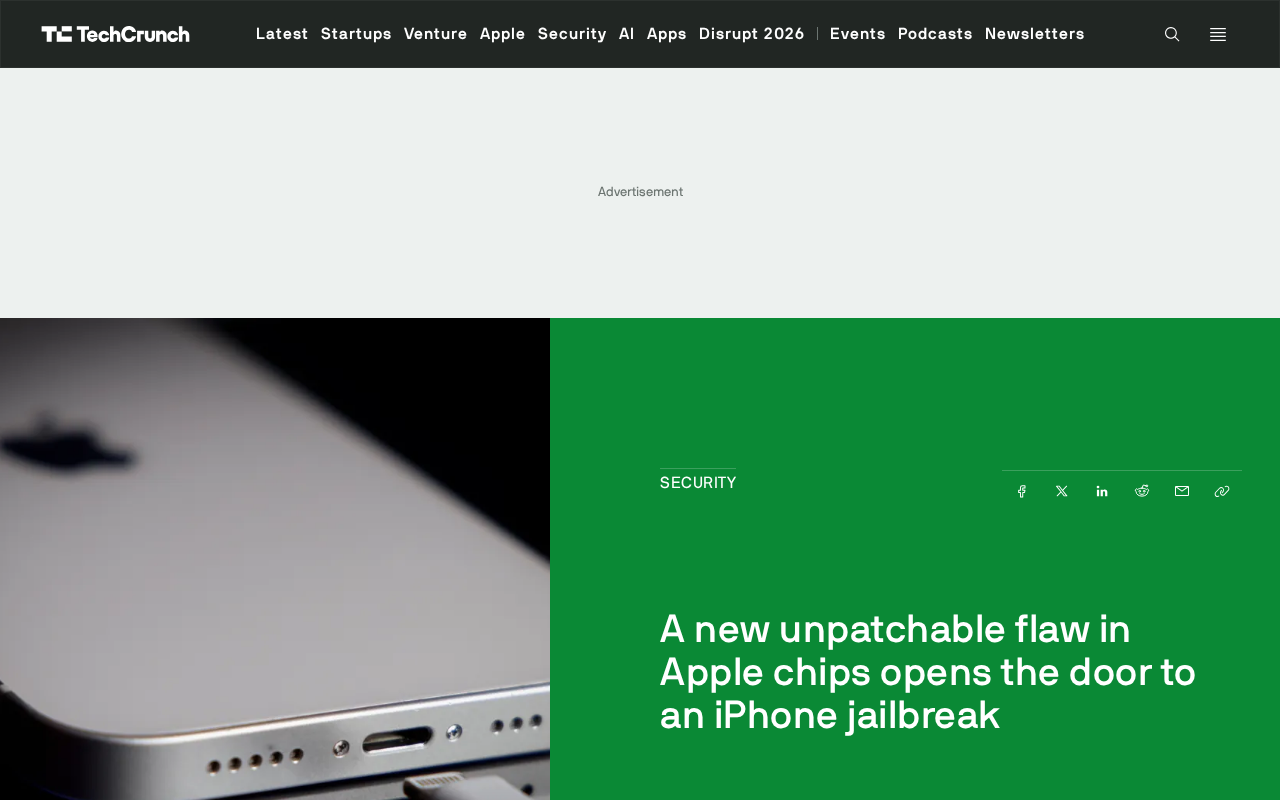
European offensive security firm Paradigm Shift has disclosed a hardware-level vulnerability in Apple chips that cannot be fixed through software updates. Affecting older iPhone devices, the flaw is embedded in the chip's physical design, making it permanently exploitable. The discovery reopens jailbreak possibilities for affected devices while raising concerns about physical-access attacks by malicious actors and forensic firms.
Event Overview
European offensive cybersecurity firm Paradigm Shift recently publicly disclosed a hardware-level vulnerability in Apple chips, along with detailed technical methods for exploiting it. This discovery opens a new door for hackers to unlock and compromise older iPhone devices.
An "Offensive Security Firm" refers to a security research organization that specializes in simulating real attacker behavior and proactively discovering system vulnerabilities. Unlike traditional defensive security companies, these firms help clients identify potential security threats through penetration testing, vulnerability research, and reverse engineering. Europe is home to several well-known companies in this field, with a relatively active industry ecosystem.
Core Vulnerability Characteristics: Unpatchable at the Hardware Level
Why Hardware-Level Flaws Are So Severe
Unlike software vulnerabilities, this disclosure involves a flaw at the hardware level of Apple's chips. This means Apple cannot fix the issue by releasing iOS system updates or firmware patches — the vulnerability is embedded directly in the chip's physical design and will persist permanently unless the hardware is replaced.
To understand the severity of hardware-level vulnerabilities, one needs to understand the Chain of Trust mechanism in modern processors. When an iPhone boots up, the first code executed is stored in Boot ROM (Boot Read-Only Memory) — a piece of code permanently written during chip manufacturing that is responsible for verifying the integrity of each subsequent software layer loaded. If the Boot ROM itself contains a vulnerability, attackers can inject malicious code at the lowest level of the trust chain, bypassing all higher-level security mechanisms. Since the physical nature of ROM (Read-Only Memory) means its contents cannot be modified after manufacturing, such vulnerabilities are fundamentally impossible to fix through software updates.
These "unpatchable" vulnerabilities are extremely rare in the security field and have far-reaching implications. A historically similar case is the checkm8 vulnerability discovered by security researcher axi0mX in 2019, which existed in the USB DFU (Device Firmware Upgrade) mode implementation code within Apple's Boot ROM — essentially a use-after-free memory management error. checkm8 affected multiple generations of devices from the A5 (iPhone 4s) to the A11 (iPhone X) chips, covering hundreds of millions of Apple products sold, and is still widely used by the jailbreak community through the checkra1n tool today. The vulnerability was discovered nearly a decade after the first affected chips were released, demonstrating that hardware vulnerabilities can remain dormant and undetected for extended periods.
Scope of Affected Devices
Based on currently disclosed information, the vulnerability primarily affects older iPhone devices. While the specific affected chip models and complete device list have not been fully clarified, it is certain that all devices using the affected chips will face permanent security risks.
Notably, Apple's chip architecture has undergone significant design evolution across generations. Starting with the A12 chip (2018), Apple introduced hardware security mechanisms based on Pointer Authentication Codes (PAC) and continuously strengthened the isolation capabilities of the Secure Enclave processor in subsequent chips. These architectural improvements may protect newer chips from this specific type of vulnerability, but the exact security boundaries await more detailed technical analysis reports.
Impact on the iPhone Jailbreak Community and Security Ecosystem
New Opportunities for the Jailbreak Community
For the iPhone jailbreak community, this is undoubtedly major news. iPhone jailbreaking refers to exploiting security vulnerabilities in iOS or hardware to gain root access to the device, thereby breaking through Apple's restrictions on app installation, system customization, and file system access. The jailbreak community has been active since the original iPhone launched in 2007, evolving from pure software exploit techniques to hardware-level exploitation.
In the classification of jailbreak techniques, those based on hardware vulnerabilities are called "hardware jailbreaks" or "BootROM jailbreaks," which are fundamentally different from "software jailbreaks" that rely on software vulnerabilities in specific iOS versions. Software jailbreaks typically become ineffective once Apple releases a system update, while hardware jailbreaks have cross-version persistence, making them the most prized resource in the jailbreak community.
Hardware-level vulnerabilities mean:
- Persistence: The vulnerability can always be exploited regardless of what iOS version the user upgrades to
- Reliability: Not dependent on exploit chains for specific software versions, resulting in higher success rates
- Irreversibility: Apple cannot close this entry point through remote updates
These characteristics enable security researchers and developers to perform deep system analysis on the latest versions of iOS, which is of significant value for understanding Apple's operating system internals, developing security tools, and conducting academic research.
The Dual Nature of Security Risks
However, the same vulnerability could also be exploited by malicious attackers. Once an attacker gains physical access to a device, they may be able to:
- Bypass device lock screen and encryption protections
- Extract sensitive data from the device
- Install persistent malware on the device
This has significant practical implications for law enforcement agencies, intelligence services, and cybercriminals alike. In fact, device forensics using hardware vulnerabilities is already a mature commercial market. Israeli company Cellebrite and American company Grayshift (now under Magnet Forensics) have long sold iPhone unlocking services to law enforcement agencies worldwide, with their technical foundation largely relying on similar hardware-level vulnerabilities. In the famous 2016 "FBI vs Apple" case, after Apple refused to help unlock the San Bernardino shooting suspect's iPhone, the FBI ultimately unlocked the device through a third-party security company, reportedly using hardware-level exploitation techniques.
Paradigm Shift's decision to publicly disclose rather than privately sell the vulnerability information has itself sparked a new round of the long-standing security industry debate between "Responsible Disclosure" and "Full Disclosure." In the gray market for vulnerability trading, a reliable iPhone hardware-level zero-day vulnerability could be worth millions of dollars.
Apple's Response Dilemma
Facing a hardware-level vulnerability, Apple's options are quite limited:
-
Software-level mitigations: While the root vulnerability cannot be patched, Apple can add extra security checks at the software level to increase the difficulty of exploitation. For example, Apple could strengthen the independent verification mechanisms of the Secure Enclave Processor (SEP). The SEP is an independent security coprocessor in Apple devices with its own cryptographic engine and secure boot chain, responsible for handling the most sensitive operations such as Touch ID/Face ID biometric data, device passcode verification, and encryption key management. Even if the main processor is fully compromised, the SEP's isolated design can theoretically still protect the most critical user data — but this depends on whether the current vulnerability also affects the SEP's root of trust.
-
New hardware iteration fixes: Fix the flaw in subsequent chip designs, though this does nothing for devices already sold. Apple's chip design team typically requires a 2-3 year development cycle to complete a chip generation from design to mass production, but security-related fixes may be integrated into existing designs through metal layer modifications (metal fix) in a shorter timeframe.
-
Issue security advisories: Remind users to pay attention to the physical security of their devices and avoid letting devices fall into others' hands.
Apple's security architecture employs a "Defense in Depth" philosophy, where even if a single security layer is breached, other layers still provide protection. This includes hardware root of trust, secure boot chain, kernel integrity protection (KPP/KTRR), sandboxing mechanisms, data protection encryption, and multiple other layers. While a hardware-level vulnerability breaches the lowest line of defense, upper-layer defense mechanisms may still limit the actual damage an attacker can cause.
Industry Implications and User Recommendations
This incident once again reminds us that even a company as renowned for security as Apple cannot completely avoid flaws in hardware design. As chip complexity continues to increase — modern mobile processors contain tens of billions of transistors and tens of millions of lines of RTL (Register Transfer Level) design code — the importance of hardware security auditing is becoming increasingly prominent.
Current chip industry security verification processes primarily rely on automated methods such as Formal Verification and Fuzzing, but these approaches still face insufficient coverage when dealing with complex hardware interaction logic. In recent years, academia and industry have begun exploring the application of machine learning to hardware vulnerability detection, though this field is still in its early stages. Companies like Intel, ARM, and Apple are all continuously expanding the size of their hardware security teams, reflecting the industry's growing attention to this issue.
For ordinary users, if you are using an older iPhone, it is recommended to pay extra attention to the physical security of your device and avoid handing it over to untrusted third parties. Additionally, upgrading to devices with newer chips is an effective way to reduce risk. It should be emphasized that exploiting such hardware vulnerabilities typically requires physical contact with the device and operation through a USB connection, with extremely low probability of remote exploitation, so the actual risk facing ordinary users is relatively manageable.
While public disclosure of offensive security research may pose short-term security risks, in the long run it helps drive the entire industry to improve security standards — this is the value behind Paradigm Shift's decision to make this discovery public. In the cybersecurity field, this approach follows the philosophy that "sunlight is the best disinfectant" — forcing vendors to confront problems through openness and transparency while enabling the security community to collectively research defensive solutions, ultimately making the entire ecosystem more secure. This philosophy is aligned with the spirit of Bug Bounty Programs, and Apple has had its own security bounty program since 2016, offering rewards of up to $2 million for researchers who discover critical vulnerabilities.
Related articles
Understanding GitHub's Availability Report: Platform Stability and Developer Response Strategies
Deep dive into GitHub's monthly availability report: analyzing service degradation impacts, CI/CD fault tolerance, and platform dependency risk strategies for resilient development.

OpenAI's Claim of Solving a Millennium Prize Problem Sparks Academic Controversy
OpenAI claims its AI solved a Millennium Prize Problem, sparking debates over attribution, verification, and AI's role in reshaping mathematical research.

Ledoit-Wolf Covariance Shrinkage in Practice: 57% Lower Turnover + 10x GPU Acceleration
Learn how Ledoit-Wolf covariance shrinkage reduces portfolio turnover by up to 57% and how cuML GPU acceleration cuts backtest time from 1.5 hours to 9 minutes.