Unsloth New Release: Run Qwen-Image-2.1 Locally with Custom Agent Skills Support

Unsloth now supports local Qwen image generation, Agent Skills reuse, and broader hardware compatibility.
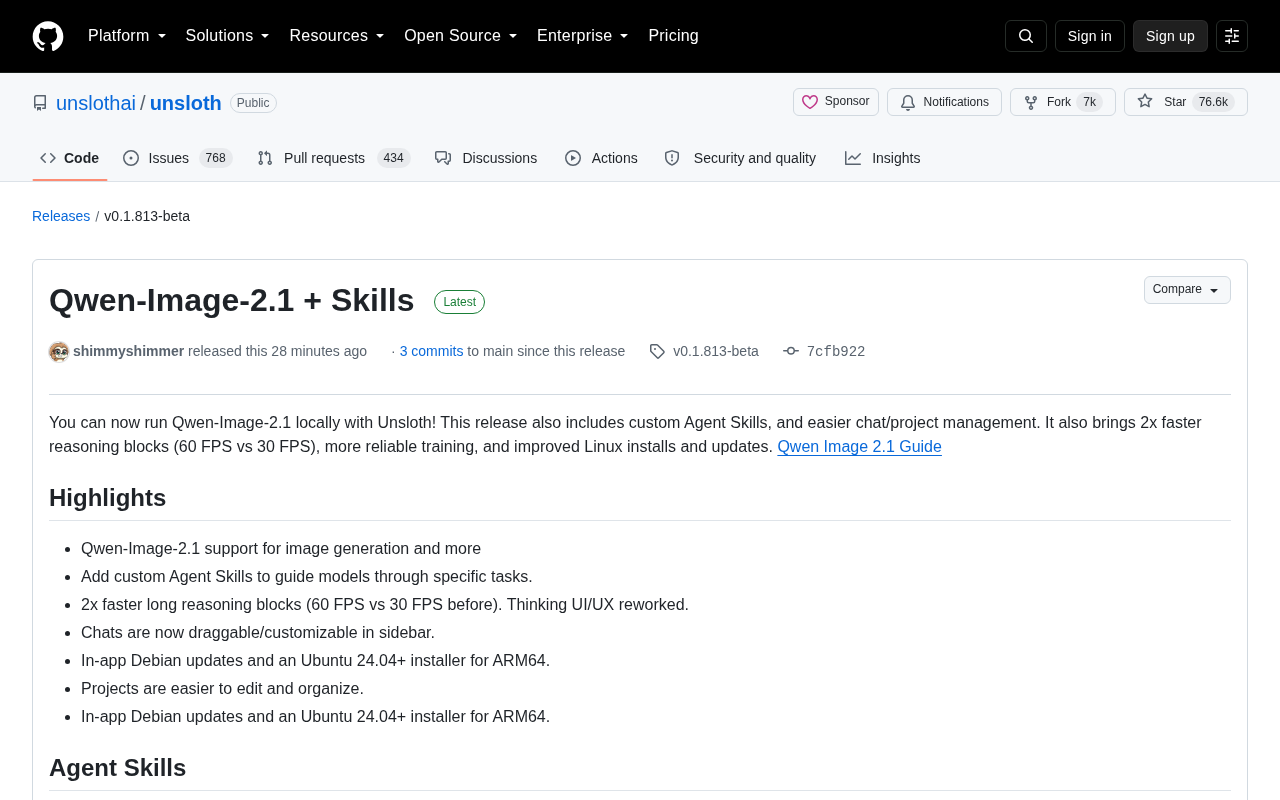
Unsloth v0.1.813-beta is a wide-ranging update across multiple dimensions. The headline feature is local support for Alibaba's Qwen-Image-2.1 image generation model, eliminating the need for cloud APIs. A new custom Agent Skills mechanism lets users reuse existing Claude Code and `.agents` folder configurations, invokable via `@` in chat. Performance-wise, long reasoning block rendering jumps from 30 to 60 FPS, while training resume and Hugging Face dataset support are more reliable. Hardware coverage expands with a new AMD ROCm Docker image, native ARM64 `.deb` packages, and improved AMD GPU access under WSL2.
The open-source fine-tuning tool Unsloth has released version v0.1.813-beta. The headline update is local support for running Alibaba's Qwen-Image-2.1 image generation model, alongside a new custom Agent Skills mechanism. The release also delivers systematic improvements to inference performance, training reliability, Linux desktop experience, and hardware compatibility. This update spans image generation, model training, UI interactions, and hardware support — making it a noteworthy iteration for developers deploying AI models locally.
Running Qwen-Image-2.1 Locally
The most prominent new capability in this release is local support for running Qwen-Image-2.1 through Unsloth for image generation. Qwen-Image is part of Alibaba's Qwen model family, with the 2.1 version offering improvements in generation quality and instruction following. By bringing it into Unsloth's local runtime, users can complete text-to-image tasks on their own hardware without relying on cloud APIs — particularly valuable for privacy-sensitive use cases or scenarios where reducing inference costs matters.
An official Qwen Image 2.1 usage guide is available to help users get up and running quickly. Vision model support has also been expanded — Vision models can now directly read images returned by MCP tools, enabling smoother multimodal workflows.
Unsloth is an open-source framework focused on efficient large model fine-tuning. Its core technology uses hand-written Triton kernels and computation graph optimization to significantly reduce VRAM usage and speed up LoRA/QLoRA fine-tuning — typically cutting VRAM consumption by 50–70% and more than doubling training speed compared to native Hugging Face. Before this update, Unsloth was primarily known for fine-tuning and inference on text and multimodal language models. Adding support for image generation models (diffusion-based) marks an important step in expanding its ecosystem. Qwen-Image-2.1 belongs to the text-to-image diffusion model family — sharing the Qwen brand but with a different architecture — and can generate high-quality images from natural language descriptions. With local runtime support, the entire pipeline from prompt to image runs entirely on the user's own hardware, without passing through any third-party servers.
Custom Agent Skills: Reuse Your Existing Skill Library
This update introduces an Agent Skills mechanism that lets users add custom skills to guide the model through specific tasks. More practically, it can directly reuse your existing skills from Claude Code and your .agents folder, avoiding redundant configuration.
In practice, users can manage these skills centrally in settings and quickly invoke a specific skill during chat using the @ symbol. This design maintains compatibility with Claude Code's skill system, lowering the barrier for migrating from other tools. For developers who want to distill common workflows into reusable modules, Skills provides a lightweight organizational approach.
Agent Skills are essentially an encapsulation mechanism for prompt templates or tool-call workflows — similar to "macros" or "preset workflows." Users save commonly used task instructions, tool combinations, or context configurations as a named skill, then inject it quickly in conversation via @skill-name, avoiding the need to manually type lengthy instructions each time. Compatibility with Claude Code's .agents folder means Unsloth reads YAML/JSON config files in that directory directly, so users don't need to migrate or redefine existing skills. MCP (Model Context Protocol) is an open protocol introduced by Anthropic to standardize communication interfaces between models and external tools or data sources. The fact that Vision models can now read images returned by MCP tools indicates that Unsloth's multimodal workflows are now integrated with this protocol, making it easier to connect to external image sources like file systems and browser screenshots.
Performance and Inference Experience Improvements
On the performance front, rendering speed for long reasoning blocks has doubled — from 30 FPS to 60 FPS — making the display of thinking processes much smoother. Longer code responses are also smoother during streaming output, with syntax highlighting preserved and no more stuttering or highlighting loss.
The changelog includes a large number of low-level fixes for training scenarios: training resume is more reliable, dataset preparation is more stable, Hugging Face datasets now work correctly in recipes, previous training runs can be properly resumed with accurate time remaining, and dataset column mapping along with selected splits/subsets are correctly recognized. There's also a notable B200 benchmark — LoRA SFT training per step for Qwen3.5-9B dropped from 0.84s to 0.77s, representing a model-agnostic general optimization.
Chat and Project Management Overhaul
On the interaction side, chat history is now fully draggable in the sidebar and works correctly across all platforms. Users can drag chats to reorder them, pin them, or move them into a project. Project management is simpler too — you can now edit project names, instructions, and folders directly on the Projects page and sort by last updated.
The Thinking UI/UX has been redesigned with a cleaner, more modern look. Model loading behavior has also been improved — chats now correctly remember their settings, and CLI chat retains the precision of the loaded model and uses recommended settings. For storage management, users can view disk space used by various caches in settings and clear them with one click. Chats can also reuse already-downloaded models instead of pulling a second copy.
Linux Desktop and Hardware Compatibility
The Linux and desktop distribution experience has improved noticeably. The new version brings in-app updates for Debian installations, along with a native .deb package for ARM64 architecture and a Ubuntu 24.04+ installer, making deployment on ARM devices much smoother.
Hardware compatibility highlights are significant: a new AMD ROCm Docker image is available that includes Unsloth Studio and JupyterLab; the ROCm image can access the GPU via WSL2's DXG bridge instead of relying solely on /dev/kfd; and when a ROCm build fails to run, the system falls back to a Vulkan-based sd.cpp build. For hosts mixing NVIDIA and AMD hardware, there's also an explicit way to request the ROCm torch stack. These changes dramatically improve Unsloth's usability in heterogeneous hardware environments.
ROCm (Radeon Open Compute) is AMD's open software stack for GPU general-purpose computing, functionally comparable to NVIDIA's CUDA. Because the AI ecosystem has long been CUDA-centric, ROCm has historically had significant friction around framework compatibility and stability, raising the barrier for AMD GPU users running AI models locally. Unsloth's new ROCm Docker image bundles a complete dependency environment, significantly reducing configuration complexity. WSL2's DXG bridge (DirectX Graphics bridge layer) allows the Windows Subsystem for Linux to access the host GPU through DirectX drivers, bypassing the traditional ROCm dependency on the /dev/kfd character device in native Linux — enabling Windows users to use AMD GPUs for inference within WSL2. The Vulkan sd.cpp fallback further ensures that even when ROCm is unavailable, GPU graphics API acceleration can still be used for image generation, covering more hardware scenarios.
Summary
This Unsloth update is a wide-ranging iteration: it brings new capabilities like local Qwen-Image-2.1 image generation and Agent Skills, alongside a wealth of practical improvements in inference speed, training stability, UI interactions, and Linux/ARM64/AMD hardware support. Overall, it continues Unsloth's trajectory of deepening local AI model deployment and fine-tuning, pushing ease of use and hardware coverage further. It's well worth trying for developers fine-tuning and deploying open-source models locally.
Related articles

Apple HomeView Hands-On Review: Is the $300 Smart Home Hub Worth It?
Apple HomeView hands-on: a $300 smart home hub with facial recognition for quick account switching, but no App Store or voice recognition. Is the wall-mounted version worth it? Should you buy the first generation?

Meta Muse Wonder Launch: What It Means for Meta's Return to the Frontier AI Race
Meta releases Muse Wonder and WonderFull, benchmarks reach the frontier, community feedback is polarized. An in-depth look at Meta's return to the frontier AI race, its personal agent strategy, and Zuckerberg's different path.

Apple Home Smart Home Lineup Leaked: LG and Schneider Team Up, UWB Door Lock on Board
Apple Home ecosystem gains new LG and Schneider devices: UWB smart lock with proximity unlock, 2.5K dual-camera doorbell, privacy indoor camera, and AirPods-like seamless pairing.