Unsloth Releases CUDA 13 Prebuilt Wheels: Say Goodbye to Source Compilation Headaches

Unsloth releases prebuilt CUDA 13 wheels for Flash-Attention 2, Mamba-SSM, and Causal-Conv1D, eliminating painful source compilation.
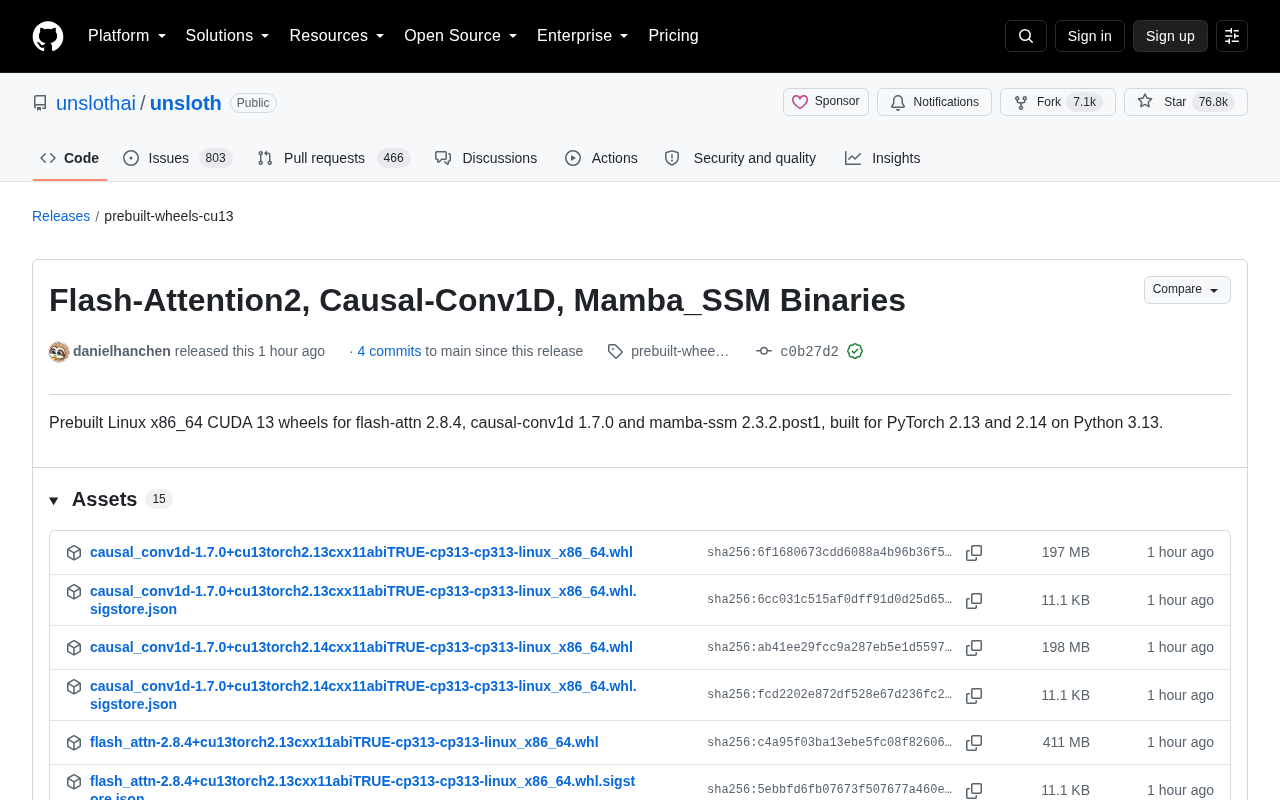
Unsloth has released prebuilt Python wheels for CUDA 13, covering flash-attn 2.8.4, causal-conv1d 1.7.0, and mamba-ssm 2.3.2.post1 — three core low-level components for large model training — built for PyTorch 2.13/2.14 and Python 3.13 on Linux x86_64. Source compilation of these libraries has long been a major environment setup headache, often taking hours and failing due to version mismatches. These prebuilt wheels shift compilation to the publisher's side, letting users install directly and dramatically reducing time and friction. The release reflects Unsloth's consistent strategy of proactively supporting cutting-edge stacks before official artifacts are available.
The open-source fine-tuning framework Unsloth has released a set of prebuilt Python wheels targeting CUDA 13, covering three key components widely used in large model training: Flash-Attention 2, Causal-Conv1D, and Mamba-SSM. For developers who have long struggled with compiling these libraries from source, this is a genuine productivity boost.
What Was Released
This release (tagged prebuilt-wheels-cu13) was personally packaged and uploaded by Unsloth core developer Daniel Han. It contains prebuilt binary wheels for the Linux x86_64 platform targeting CUDA 13, with the following specific versions:
- flash-attn 2.8.4: A high-performance attention computation kernel, now practically standard for Transformer training and inference.
- causal-conv1d 1.7.0: A causal 1D convolution operator, primarily serving state space model (SSM) architectures.
- mamba-ssm 2.3.2.post1: The core implementation of the Mamba series of state space models.
These wheels are built specifically for PyTorch 2.13 and 2.14 and are compatible with Python 3.13. The release includes 15 asset files covering different version combinations, making it easy for users to download exactly what they need.
Flash-Attention 2, proposed by Tri Dao and colleagues, is an IO-aware exact attention algorithm that tiles computation and reduces HBM (High Bandwidth Memory) read/write operations. It lowers standard attention's memory complexity from O(N²) to O(N) while preserving numerical precision, delivering 2–4× throughput improvements in practice. Causal-Conv1D is an efficient CUDA implementation of causal convolution — "causal" meaning the convolution kernel at time step t can only access inputs at t and earlier, which is essential for autoregressive sequence modeling and serves as one of Mamba's foundational operators. Mamba-SSM is grounded in State Space Model (SSM) theory and uses a Selective Scan mechanism to process long sequences with linear complexity instead of Transformer's quadratic complexity, attracting widespread attention in recent years across language modeling, audio processing, and more. Together, these three components form the core low-level infrastructure underpinning today's efficient large model training and inference.
Why Prebuilt Wheels Matter
Anyone familiar with setting up large model training environments knows that installing libraries like Flash-Attention and Mamba-SSM is often the first major hurdle. These libraries depend on low-level CUDA kernels, and pip install typically requires on-the-fly local compilation — a process that can easily take anywhere from ten minutes to several hours, and is highly prone to failure due to subtle mismatches between CUDA version, compiler version, and PyTorch version.
This is precisely where prebuilt wheels shine: they shift the compilation step to the publisher's side. Users simply download and install the matching binary for their environment, eliminating both the time cost and the risk of hitting obscure build errors. For teams that repeatedly set up training environments on cloud servers or ephemeral containers, this kind of determinism and speed is especially valuable.
Python's .whl (Wheel) format is the binary distribution standard defined by PEP 427. The filename directly encodes the Python version, ABI tag, and platform tag (e.g., cp313-cp313-linux_x86_64), allowing pip to automatically match the current environment without triggering any compilation steps. For CUDA extensions, the filename also implicitly binds to the CUDA toolchain version used during compilation — which is why CUDA version, PyTorch version, and Python version must all align simultaneously. Any mismatch leads to missing symbols or ABI incompatibility errors at runtime. Source compilation is time-consuming because CUDA C++ code must pass through the nvcc compiler to generate PTX intermediate code before being compiled into cubin binaries. Libraries like Flash-Attention, with their extensive template instantiations, often produce build artifacts exceeding several GB, with a single compilation run taking tens of minutes on a typical CPU.
A Signal on Version Support
One notable aspect of this release is that it proactively targets a relatively cutting-edge technology stack — CUDA 13, PyTorch 2.13/2.14, and Python 3.13. All three are relatively new versions, and official or upstream projects often take a while to provide corresponding prebuilt artifacts. By stepping in to fill this gap, Unsloth is effectively doing the heavy lifting for early adopters in the ecosystem.
This aligns with Unsloth's consistent positioning. As a fine-tuning framework celebrated for being "faster and more memory-efficient" (with over 76,000 stars and 7,100+ forks on GitHub), its user base is inherently highly sensitive to training efficiency and environment usability. Providing out-of-the-box dependency binaries is a natural extension of lowering the barrier to entry and improving the overall developer experience.
How to Use
The usage process is straightforward: visit the corresponding release page on the Unsloth repository, download the .whl file that matches your PyTorch and Python version, and install it locally via pip install. The key prerequisites to keep in mind are:
- The operating system must be Linux x86_64 (Windows and macOS users cannot use these wheels directly);
- The CUDA driver must support CUDA 13;
- PyTorch version must be 2.13 or 2.14, and Python must be 3.13.
Only when your local environment fully satisfies these constraints will the prebuilt wheels work correctly. Otherwise, you'll need to fall back to source compilation or choose a different version combination.
Summary
This isn't a "major release" introducing new features, but for engineers doing day-to-day model training and fine-tuning, it addresses a real and frequently encountered pain point. In an era of rapid AI toolchain iteration and growing version fragmentation, whoever can first provide stable, ready-to-use prebuilt dependencies genuinely saves the community time. Unsloth's move here is a textbook example of this kind of "infrastructure-level contribution."
Related articles

Free Unlimited Claude Code Solution: Agnes AI + CC Switch Setup Guide
No paid subscription needed — pair the free AI platform Agnes AI with the open-source tool CC Switch to provide a backend for Claude Code, enabling unlimited free calls to text, image, and video models. This guide covers the full setup, test results, and usage boundaries.

A Complete Zero-Cost Guide to Getting Started with Claude Code for Beginners in China
A beginner's guide to Claude Code for users in China: two installation methods (command line and IDE plugin), full configuration steps for replacing the official API with the free domestic LongCat model, and a hands-on demo of building a small tool with natural language, plus tips.

When the NSA Gets Involved: The AI Supply Chain Crisis Behind Open-Source CVEs and API Key Hijacking
Multiple open-source projects disclosed severe CVEs in one day, PHP flaws alarmed the FBI, and Railway and OpenCode were breached with API keys stolen. This article breaks down the vulnerability window, AI-accelerated exploitation, and the AI supply chain crisis behind the API key black market, with a developer defense checklist.