Unsloth Releases Dynamic V3.1 Quantized Version of Qwen3.8-27B
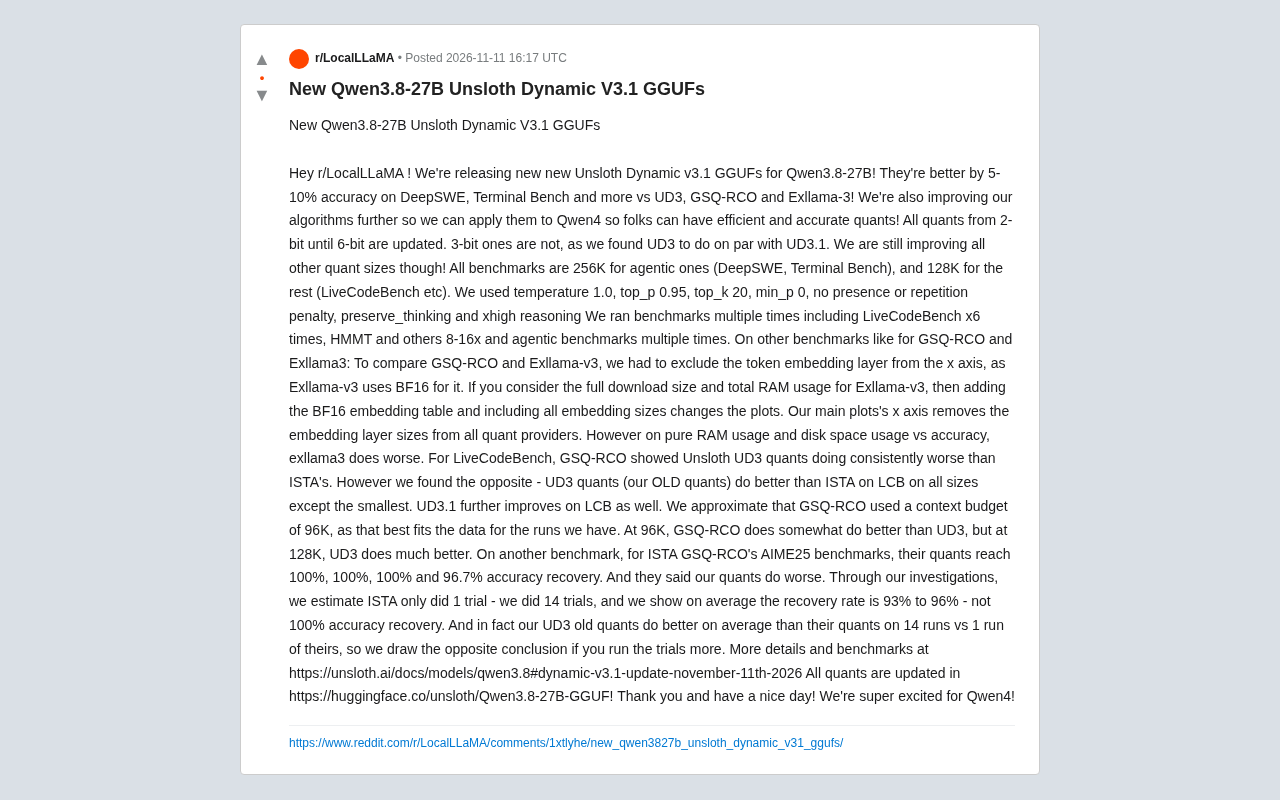
Unsloth releases Qwen3.8-27B Dynamic v3.1 GGUF, claiming 5-10% accuracy gains and rebutting competitor doubts.
The Unsloth team released Dynamic v3.1 GGUF quantization files for Qwen3.8-27B, covering 2-bit to 6-bit, with only the 3-bit version left unchanged since UD3 already matches the new version. They claim 5-10% accuracy improvements over old UD3, GSQ-RCO, and Exllama-3 on benchmarks like DeepSWE, Terminal Bench, and LiveCodeBench, and disclosed test methodology with 256K/128K context, sampling parameters, and multiple repeated runs. The article also details two disputes with ISTA: GSQ-RCO claimed UD3 was worse on LiveCodeBench, but Unsloth's retest reached the opposite conclusion; on AIME25, the other side claimed 100% recovery rate, which Unsloth rebutted with a 14-trial average of 93%-96%. Finally, it offers upgrade advice for local deployment users and notes on quantization evaluation.
The Unsloth team has released new Dynamic v3.1 GGUF quantization files for Qwen3.8-27B on r/LocalLLaMA, claiming 5-10% accuracy improvements on several key benchmarks compared to their own older UD3 version as well as competitors GSQ-RCO and Exllama-3. This update covers quantization from 2-bit to 6-bit and includes detailed benchmark methodology along with disputes with competitors.
Core Content of the Quantization Update
The focus of this update is the accuracy recovery brought by algorithmic improvements. Unsloth states that all 2-bit to 6-bit quantized files have been regenerated, with the exception of the 3-bit version—they found that UD3 already matches UD3.1 at 3-bit, so requantization was unnecessary. The remaining bit widths are still being optimized.
A detail worth noting: this update is not a simple repackaging but an iteration at the algorithm level. The team explicitly mentions they are further improving the quantization algorithm so it can be applied to Qwen4 in the future, with the goal of giving users efficient storage footprint without sacrificing model accuracy.
For local deployment users, the precision of quantized versions directly determines whether the model is usable on devices with limited VRAM. A 5-10% accuracy gap in agentic tasks often translates into a significant difference in task completion rates, so this update has practical significance for the community relying on GGUF format for local inference.
GGUF stands for GPT-Generated Unified Format, a single-file model format promoted by the llama.cpp project that packages weights, tokenizer, and metadata together for local inference on CPUs, Apple Silicon, and various consumer GPUs. So-called 2-bit to 6-bit quantization refers to compressing the original 16-bit floating-point weights to 2 to 6 bits per parameter; lower bit widths mean smaller files and less VRAM usage, but also greater information loss. Quantization is typically grouped by layer or block (e.g., the K in Q4_K_M indicates the k-quant blocking scheme), and since different layers have different sensitivity to precision, mixed bit-width strategies have become the primary means of improving small-size quantization quality. Unsloth's UD series is precisely such a dynamic scheme that retains higher precision for sensitive layers and aggressively compresses redundant layers.
Benchmark Setup and Methodology
Unsloth has published fairly detailed test conditions, which is crucial in quantization comparisons. All agentic benchmarks (DeepSWE, Terminal Bench) use 256K context, while other benchmarks (LiveCodeBench, etc.) use 128K. Sampling parameters are temperature 1.0, top_p 0.95, top_k 20, min_p 0, with no presence or repetition penalty, and preserve_thinking and xhigh reasoning enabled.
The number of test repetitions is also specified: LiveCodeBench was run 6 times, benchmarks like HMMT were run 8 to 16 times, and agentic benchmarks were also run multiple times. This practice of multiple repetitions is precisely the foreshadowing of the later dispute with ISTA—random fluctuations in a single run are enough to reverse conclusions.
Sampling parameters can significantly affect benchmark scores of large models. Temperature controls randomness, with 1.0 being a relatively high exploratory setting; top_p and top_k together perform nucleus sampling truncation, sampling only from candidate tokens with cumulative probability or top ranking; min_p sets a threshold based on relative probability, filtering out candidates with excessively low probability. Presence penalty and repetition penalty are used to suppress repetitive output, and disabling them avoids interfering with reasoning chains. preserve_thinking refers to retaining the model's previous reasoning content in multi-turn or tool-calling scenarios, while xhigh reasoning corresponds to a higher reasoning budget/longer chain of thought. With different settings, the same model on the same benchmark can differ by several percentage points, so cross-vendor comparisons must verify whether configurations are consistent.
Comparison Dispute with GSQ-RCO and Exllama-3
The handling of the x-axis in comparison charts is an easily overlooked detail. Unsloth points out that for a fair comparison with GSQ-RCO and Exllama-v3, they excluded the token embedding layer from the x-axis because Exllama-v3 uses BF16 precision for that layer. However, if calculated by full download size and total memory usage, including the BF16 embedding table, Exllama-3 performs worse on the "memory/disk footprint vs accuracy" dimension.
Regarding LiveCodeBench, there is a direct disagreement. GSQ-RCO had claimed that Unsloth's UD3 quantization was consistently worse than ISTA's version, but Unsloth's retest reached the opposite conclusion: except for the smallest size, UD3 outperforms ISTA at all sizes, and UD3.1 further improves on LCB. They speculate that GSQ-RCO used a context budget of about 96K—at which GSQ-RCO is slightly better than UD3, but at 128K UD3 is clearly better.
The token embedding layer is a lookup table that maps vocabulary IDs to dense vectors; its parameter count is often substantial (vocabulary size times hidden dimension), but during inference only one row is looked up per token, making it relatively insensitive to numerical precision. Some inference engines (like Exllama) keep this layer in BF16 without quantization for simplicity, which consumes an additional several hundred MB to over 1GB of memory and disk. When comparing different quantization schemes, if only quantized linear layers are counted while ignoring the unquantized embedding, the size overhead of certain schemes is systematically underestimated, distorting the "size vs accuracy" curve—which is why the original article emphasizes calculating by full download size and total memory usage.
The "100% Recovery Rate" Dispute on AIME25
The most intense disagreement is on the AIME25 benchmark. ISTA's GSQ-RCO reported that its quantized version achieved accuracy recovery rates of 100%, 100%, 100%, and 96.7%, and on this basis claimed Unsloth's quantization was worse. After investigation, Unsloth believes ISTA only ran 1 trial, whereas they themselves ran 14 trials, with average recovery rates between 93% and 96%, not 100%.
They further state that on the mean of 14 runs, their older UD3 actually outperforms ISTA's quantized version. This case well illustrates the pitfalls of quantization evaluation: single-run scores are easily affected by sampling randomness, and conclusions may be completely reversed when sample size is insufficient. Unsloth's questioning approach itself is worth learning from—demanding public disclosure of trial counts and full configurations rather than just looking at one impressive number.
In quantization evaluation, "recovery rate" typically refers to the percentage of accuracy retained by the quantized model relative to the unquantized full-precision model, with 100% indicating no accuracy loss after quantization. Because benchmark question counts are limited and sampling temperature is high, the variance of a single run can reach several percentage points, and accidental results of perfect scores or clearly low scores easily occur with small sample sizes. To obtain reliable conclusions, multiple independent trials with reported means and confidence intervals are needed, while fixing context length, sampling parameters, and evaluation script version. The comparison of 1 trial versus 14 trials in the original article is a typical case of the methodological problem that "single-run scores are untrustworthy" in the quantization community.
Significance for Local Deployment Users
This update conveys several practical signals. First, if you are using 2-bit, 4-bit, 5-bit, or 6-bit GGUF of Qwen3.8-27B, upgrading to UD3.1 is expected to yield better accuracy on coding and agentic tasks. Second, 3-bit users currently have no need to upgrade. Third, quantization comparisons cannot rely solely on a single number published by vendors—context length, trial counts, and embedding layer handling all change rankings.
Unsloth also announces that the improved algorithm is being migrated to Qwen4, meaning future quantized versions of new models may benefit from this round of methodological refinement from the start. For developers concerned with local large model deployment, tracking updates on their documentation page is more valuable than just reading the release post.
Full benchmarks and details are available in Unsloth's official documentation, and quantized files have been updated in the unsloth/Qwen3.8-27B-GGUF repository on Hugging Face.
Related articles

Developer Naming Woes: The Technical Names That Drive Us Crazy
Why is technical naming so maddening? From Nginx and Vite to Qt and Sudo, a YouTube creator rants about the chaos of developer naming and pronunciation, revealing the tug-of-war between creators' intentions and community habits, and the cultural roots behind spelling traps like PyPI and GNOME.

Figma Workplace Scandal: Employee Sues CEO for Forcing Confrontation with Harasser
Figma and its CEO are sued by a current employee alleging sexual harassment and discrimination, and forcing the victim to confront her harasser. This article outlines the background, potential impact, and industry reflection.

Jensen Huang and Nvidia: Elite Privilege Behind the Revolving Door of Business and Politics
An opinion piece uses Jensen Huang's reappointment as Nvidia CEO to examine business-government ties and elite impunity, questioning free-market ideals and AI industry governance.