Unsloth's New Release: A Practical Guide to Running Hundred-Billion-Parameter Models Locally
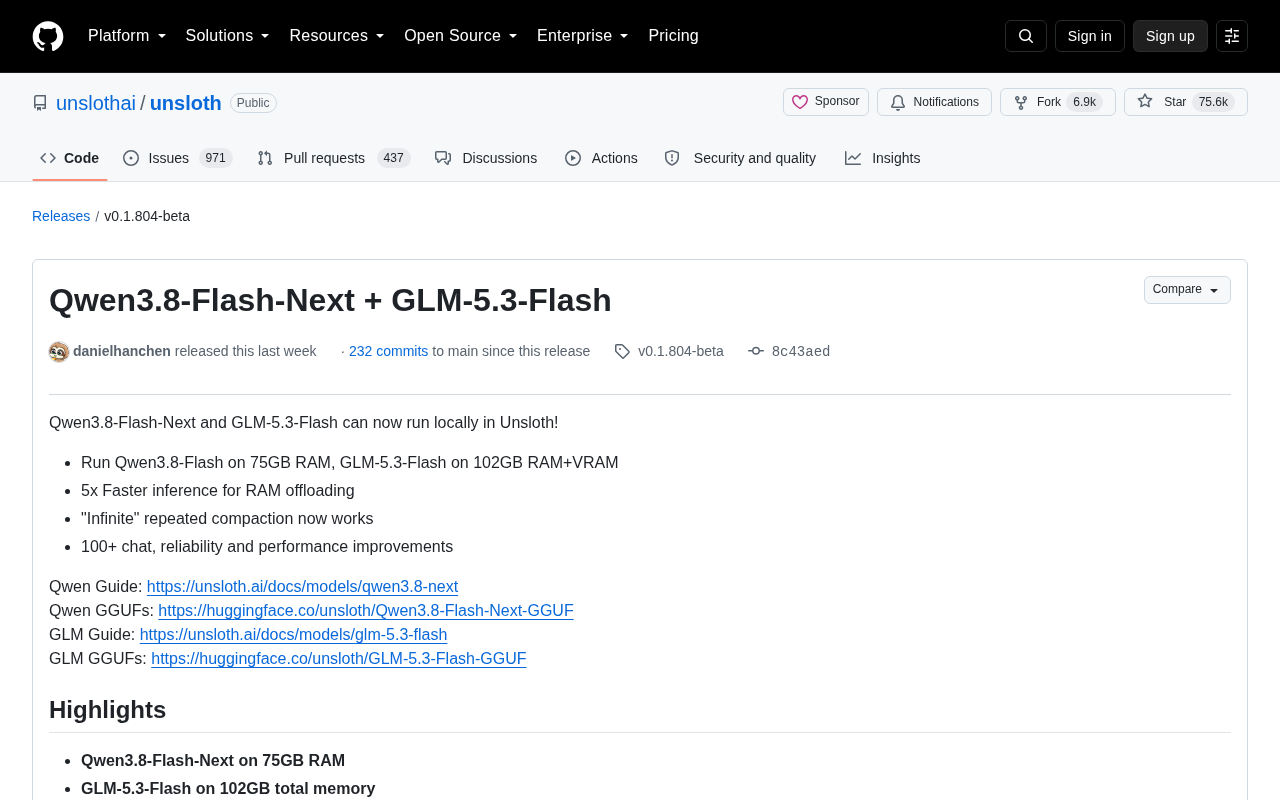
Unsloth v0.1.804-beta enables local deployment of 125B-320B models on consumer hardware via 1-bit quantization
Unsloth v0.1.804-beta brings Qwen3.8-Flash-Next (125B) and GLM-5.3-Flash (320B) to local deployment through 1-bit Dynamic GGUF quantization and intelligent GPU/RAM offloading. The update delivers 5x faster RAM offloading, automatic memory splitting, and over 100 reliability improvements for multimodal conversations and tool integration.
Recently, the open-source fine-tuning and inference tool Unsloth released version v0.1.804-beta, bringing substantial breakthroughs for local deployment of ultra-large-scale language models.
Unsloth and the Open-Source Fine-Tuning and Inference Ecosystem
Unsloth is an open-source toolkit focused on optimizing fine-tuning and inference for large language models, driven by community development. Its core value lies in enabling resource-constrained users to deploy and use large-scale language models through memory optimization, quantization techniques, and efficient inference engines. Compared to tools like Hugging Face Transformers and vLLM, Unsloth emphasizes extreme memory efficiency and local deployment friendliness. Within the open-source LLM ecosystem, these tools are filling the gap between commercial cloud services and fully autonomous deployment, allowing small and medium teams and individual developers to achieve near-production-level model capabilities without relying on expensive GPU clusters or pay-per-call APIs.
The new version officially supports two cutting-edge models: Qwen3.8-Flash-Next and GLM-5.3-Flash. Through its signature Dynamic GGUF quantization technology, hundred-billion-parameter models that originally required massive compute clusters can now be deployed on consumer-grade to workstation-level hardware.
Detailed Deployment of Two Hundred-Billion-Parameter Models Locally
The core highlight of this update is bringing two models with staggering scale to local environments. This is tremendously significant for developers and researchers who prioritize data privacy and wish to break free from cloud API dependencies.
Qwen3.8-Flash-Next: 125B Multimodal Reasoning Model
According to Unsloth's official documentation, Qwen3.8-Flash-Next is a brand-new 125B (125 billion parameters) multimodal reasoning model and also an early preview of the Qwen4 architecture. Its most striking feature is its extreme quantization compression capability.
GGUF Format and Quantization Technology Principles
GGUF (GPT-Generated Unified Format) is a model file format introduced by the llama.cpp project, designed specifically for efficient inference. It supports multiple quantization schemes, capable of compressing model weights from 32-bit floating-point numbers to 8-bit, 4-bit, or even 1-bit integer representations, drastically reducing memory footprint and bandwidth requirements. 1-bit quantization is the most aggressive compression strategy, theoretically shrinking model size to 1/16th of the original, though it typically introduces accuracy loss. Unsloth's Dynamic GGUF introduces dynamic adjustment mechanisms on top of this, dynamically selecting quantization precision based on the sensitivity of different layers and weights, achieving a better balance between compression rate and accuracy. This technology enables billion-parameter models to run within the memory constraints of consumer-grade hardware.
The 1-bit Dynamic GGUF version provided by Unsloth can run on 75GB of memory or unified memory. According to official data, this quantized version is 79% smaller than the original BF16 format while still retaining 80% of top-1 accuracy. This means achieving nearly 5x storage and memory savings with minimal performance loss, bringing hundred-billion-parameter models that were once out of reach into the operational range of high-end workstations and even some devices equipped with large-capacity unified memory.
Technical Evolution of Multimodal Models
Multimodal models are AI systems capable of simultaneously processing multiple data types such as text, images, and audio. Early multimodal architectures like CLIP adopted dual-tower structures to separately encode visual and textual information, while new-generation models like GPT-4V, Qwen-VL, and GLM deeply integrate vision encoders with language models, processing cross-modal information through a unified Transformer architecture. This design enables models to perform complex tasks such as visual question answering, image-text generation, and document understanding. As a preview of the Qwen4 architecture, Qwen3.8-Flash-Next represents Alibaba's Tongyi Qianwen team's latest exploration in multimodal reasoning. Its 125B parameter scale and 262K ultra-long context capability enable it to handle long documents containing numerous images or complex multi-turn conversations.
In terms of capabilities, Qwen3.8-Flash-Next features the following core characteristics:
- Multimodal Input: Supports mixed text and image input
- Ultra-Long Context: Context length up to 262K tokens
- Adjustable Reasoning Intensity: Offers four levels—None, Low, Medium, and Extra High—allowing users to flexibly adjust compute overhead based on task complexity
- Preserved Thinking Mechanism: Maintains logical consistency in reasoning during long conversations, avoiding logical drift during long-chain reasoning
Adjustable Reasoning Intensity and Preserved Thinking Mechanism
Reasoning depth refers to the depth of internal 'thinking' steps the model performs before generating an answer. Similar to OpenAI's o1 series, some models support Chain-of-Thought reasoning mode: the model first generates intermediate reasoning steps before providing a final answer. The four reasoning intensity levels offered by Qwen3.8-Flash-Next essentially balance reasoning depth against response speed—simple questions can use None or Low for quick responses, while complex mathematical or logical problems require Extra High mode for multi-step reasoning. The Preserved Thinking mechanism addresses logical consistency issues in long conversations: by maintaining summaries or structured representations of reasoning chains in context, it prevents the model from 'forgetting' previous reasoning logic when processing new inputs, which is particularly critical for complex tasks requiring multi-turn interactions.
GLM-5.3-Flash: 320B Sparse MoE Expert Model
The other heavyweight model is GLM-5.3-Flash from Z.ai, a multimodal model with a total parameter count of 320B (320 billion). Thanks to its MoE (Mixture of Experts) architecture, it activates only 18B parameters at any given moment, thereby dramatically reducing actual computational burden during inference while maintaining enormous knowledge capacity.
MoE Architecture and Sparse Activation Mechanism
Mixture of Experts (MoE) is an architectural strategy that achieves ultra-large scale through conditional computation. In MoE models, the network comprises multiple 'expert' sub-modules, with only a few activated during each inference. GLM-5.3-Flash has 320B total parameters but activates only 18B at a time, meaning it contains multiple 18B-scale expert modules, with a routing network dynamically selecting which experts to activate based on input features. This design allows the model to maintain enormous capacity and knowledge coverage while controlling actual computational load within acceptable limits. Google's Switch Transformer and the MoE architecture reportedly used in OpenAI's GPT-4 are both representative of this approach. For local deployment scenarios, MoE is particularly valuable: it enables users to run ultra-large-scale models with relatively small activated parameters.
With Unsloth's 1-bit GGUF quantization, GLM-5.3-Flash can run on 102GB of combined RAM and VRAM. It also supports text, image, and long document processing, with a context length reaching an impressive 1M (million-level) tokens, making it highly suitable for handling ultra-long documents, codebases, or complex multi-turn agent tasks.
Compared to its predecessor GLM-5.2, the new version shows notable enhancements in the following areas:
- Improved programming capabilities
- More robust Agent interactions
- Enhanced visual understanding
Notably, Unsloth automatically applies officially recommended sampling settings, lowering the parameter-tuning threshold for users.
Intelligent VRAM and Memory Offloading Mechanism
To run hundred-billion-parameter models on limited hardware, memory management is key. This update includes substantial engineering optimizations in this regard.
Coordinated Management of GPU VRAM and System Memory
In deep learning inference, GPU VRAM is fast but limited in capacity (consumer-grade cards typically have 8-24GB), while system memory (RAM) has large capacity but much slower access speeds. When model size exceeds GPU VRAM, the traditional solution is to run the model entirely on CPU, but this causes inference speed to drop dramatically. Modern inference engines employ offloading technology: intelligently distributing model weights and intermediate activations between GPU and RAM, keeping frequently accessed parts like KV cache for attention mechanisms on the GPU, while placing infrequently accessed weight layers in RAM for on-demand loading. Unsloth's claimed 5x speed improvement primarily comes from more granular offloading strategies and more efficient PCIe data transfers. For Apple Silicon devices with unified memory architecture, this issue is relatively straightforward since CPU and GPU share the same high-speed memory.
The new version introduces a more intelligent GPU + RAM offloading mechanism. Large GGUF files can now automatically split between GPU VRAM and system memory, allowing users to run models exceeding single-card VRAM capacity without manual configuration. Unsloth specifically mentions that for RAM offloading scenarios, inference speed has achieved a 5x improvement, directly alleviating the severe performance bottleneck previously caused by memory offloading.
Ultra-Long Context and KV Cache Optimization
A Transformer model's context length refers to the maximum number of tokens it can process at once. Traditional models like GPT-3.5's 4K and GPT-4's 8K context have been vastly exceeded by new-generation models. Qwen3.8's 262K and GLM-5.3's 1M contexts can handle documents equivalent to several hundred pages or conversation histories containing hundreds of turns. But ultra-long contexts bring enormous memory challenges: KV cache (storing Key and Value vectors for each token) grows linearly with context length. Processing 1M tokens in a 125B model, the KV cache alone might occupy tens of GB of memory. Therefore, Unsloth has specifically optimized the offload planner to prioritize keeping KV cache on the GPU, and through overflowing weights (the -ot parameter) rather than entire layers, maximizes performance under memory constraints.
Unsloth has also added the following practical features:
- Memory Usage Estimation: Provides clear Estimated Memory Usage information before loading models, allowing users to determine in advance whether their hardware can accommodate the target model, avoiding repeated trial and error
- VRAM Usage Viewing: Direct viewing of VRAM usage for downloaded models
- Offload Planner Enabled by Default: The offload planner expands the range of components that can be placed, for example, overflowing weights rather than entire layers through the
-otparameter, keeping KV cache on the GPU as much as possible to further optimize performance in long-context scenarios
Reliability Upgrades for Conversations and Tool Chains
Beyond model-level breakthroughs, this update includes over 100 improvements for chat, reliability, and performance, many of which directly impact daily usage experience.
Disconnection Recovery and Long Conversation Management
A notable improvement is disconnection recovery capability for local chats. Previously, if a connection dropped during generation, the reply being generated would often be lost; the new version can resume local generation after disconnection, preserving already-streamed content. The Deep Research function has also become more robust—when service providers require rate limiting, it can continue running rather than interrupting directly.
For long conversation management, the "Infinite repeated compaction" feature is now available and allows users to adjust or even disable GGUF's Auto Compaction in chat settings, giving users greater autonomy in context management.
Multimodal and Tool Interaction Experience
MCP Protocol and Tool Calling Ecosystem
MCP (Model Context Protocol) is a standardized protocol proposed by Anthropic for enabling AI models to securely interact with external tools, databases, APIs, and other systems. In traditional Function Calling mechanisms, models output structured function call requests that are executed by external systems which then return results. MCP adds richer context management, permission control, and multimodal data transfer capabilities on top of this. Unsloth's mention that 'images returned by MCP tools can be directly displayed' means that when AI invokes image generation or retrieval tools, the returned image data can not only be understood by the model but also seamlessly embedded in the chat interface for user display, forming a complete multimodal interaction loop. This capability is crucial for building complex AI Agent applications.
- Visual conversations now correctly handle multiple image inputs
- Images returned through MCP tools can be directly displayed in chat windows
- Chat history supports export in JSONL format, facilitating backup or migration to other tools
- Tool activity in agent conversations is collapsible by default for a cleaner interface
Desktop Stability Fixes
As a cross-platform tool, Unsloth has fixed several desktop issues that troubled users in this version:
- Linux Platform: Voice recording functionality has been fixed
- NVIDIA + Wayland Combination: Interface freezing issues have been resolved
- AMD Platform: Model loading crash issues have been fixed
- Windows Platform: llama.cpp can now properly load models from user directories containing non-English characters
While these fixes may seem minor, they significantly improve the out-of-box experience across different hardware and operating system environments.
Summary and Practical Recommendations
The release of Unsloth v0.1.804-beta once again demonstrates the open-source community's continued progress in local model deployment. Through aggressive yet effective 1-bit Dynamic GGUF quantization, intelligent GPU/RAM offloading mechanisms, and extensive engineering detail refinement, hundred-billion and even trillion-parameter models that could previously only run in data centers are gradually moving toward personal workstations.
For developers concerned with privacy, cost, and autonomous control, the maturation of such tools is tangibly expanding the boundaries of what's possible for local AI deployment. Interested readers can refer to official Qwen and GLM deployment guides and GGUF model libraries on Hugging Face for hands-on practice.
Key Takeaways
Related articles

AI-Powered SRC Vulnerability Hunting: A Hands-On Guide to Building the Hermes Agent Workbench
Based on a hands-on Bilibili video: how to build an AI-powered SRC vulnerability hunting workbench—three-step method, four report elements, Agent mode vs web chat, and tool selection.

CLI-Anything Complete Beginner's Guide: How AI Operates Software — Principles and Practice
A complete beginner's guide to CLI-Anything: how AI Agents operate professional software via the command line, covering the three-layer architecture, CLI Hub installation, DrawIO practice, generator principles, and limits.

Carbon-X: A 14.8B Open-Source Model That Handles DNA and Text Simultaneously
Carbon-X is a 14.8B open-source multimodal model on Hugging Face where DNA and text share a token stream. 6-mer tokenization, 302B token mid-training, deployable on a single 80GB GPU, 66.7% average on five DNA benchmarks, Apache 2.0 license.