Uranium from Seawater: How Fluxnium's Special Fibers Could Unlock 50,000 Years of Nuclear Fuel
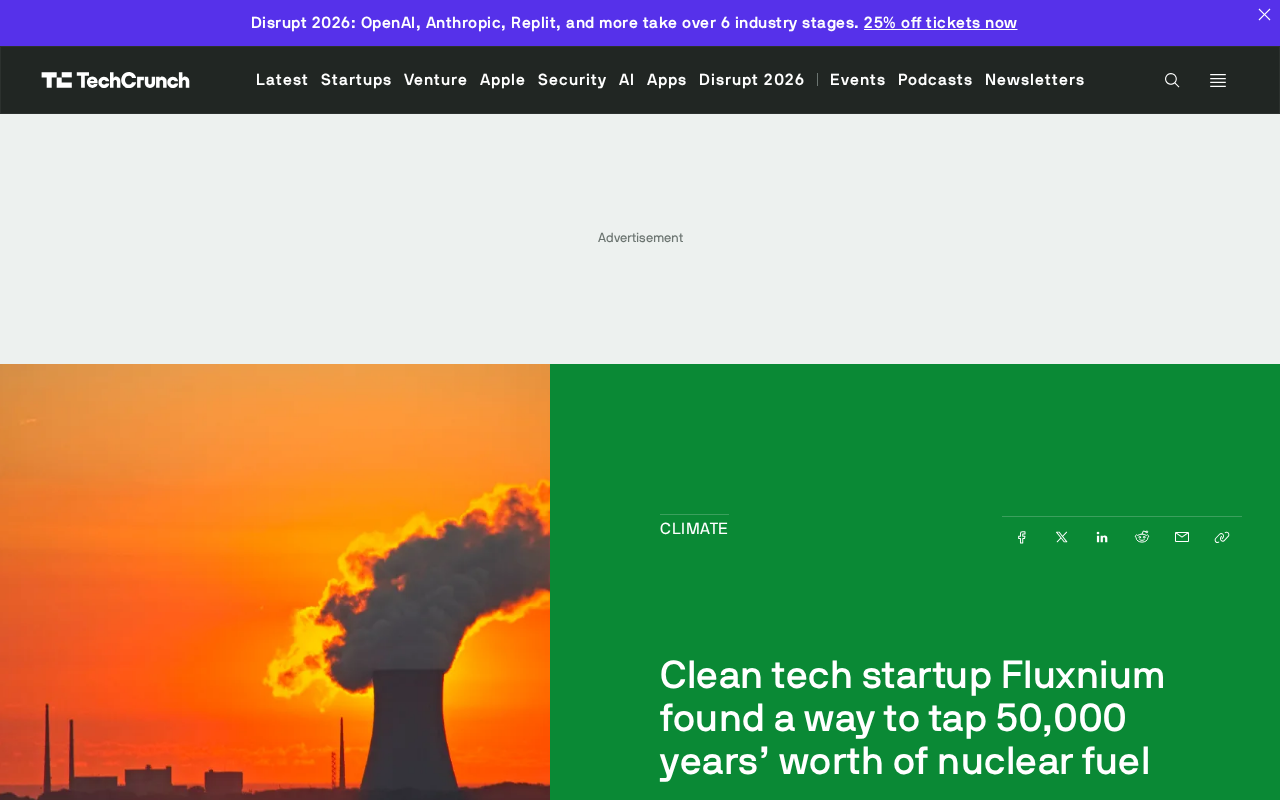
Fluxnium's fiber technology aims to extract uranium from seawater for 50,000 years of nuclear fuel, but commercialization hurdles remain.
Clean-tech startup Fluxnium proposes using specialized adsorption fibers to extract uranium directly from seawater, potentially meeting nuclear fuel needs for roughly 50,000 years. While dissolved oceanic uranium does far exceed known land reserves, concentrations are just ~3 micrograms per liter and competing ions make selective adsorption the key technical bottleneck. If commercialized, the technology could fundamentally eliminate nuclear energy's resource constraints — but current seawater extraction costs remain 3–10x higher than land mining, and Fluxnium's fiber performance, cost structure, and scalability still lack independent verification.
A Nuclear Fuel Treasure Trove Hidden in the Ocean
Clean-tech startup Fluxnium has put forward an ambitious proposition: extracting uranium directly from seawater using specially engineered fibers. According to the company, the oceans hold enough uranium to power humanity for thousands of generations — theoretically enough to meet nuclear fuel demands for roughly 50,000 years.
That figure isn't pulled from thin air. Earth's oceans do contain significant quantities of dissolved uranium — albeit at extremely low concentrations (about 3 micrograms per liter) — but the sheer volume of seawater means total dissolved uranium reserves vastly exceed known land-based uranium deposits. This is precisely why research institutions across multiple countries have been exploring seawater uranium extraction for decades.
The Core Logic Behind Fiber-Based Adsorption
Fluxnium's core technology lies in its specially developed fiber material. Based on available disclosures, these fibers can selectively "capture" uranium ions directly from seawater through adsorption. This approach is fundamentally different from conventional uranium mining — there's no need for ore excavation, crushing, or chemical leaching processes that carry significant environmental costs. Instead, functional materials submerged in seawater passively concentrate uranium over time.
The technical challenges of seawater uranium extraction have historically centered on two issues: first, uranium's extremely low concentration means enormous volumes of seawater must be processed to yield meaningful quantities; second, competing ions like vanadium, sodium, and magnesium are present in far greater concentrations than uranium, making the selectivity of adsorption materials the key determinant of economic viability. Fluxnium is betting on a breakthrough in fiber material performance to overcome the cost barrier.
The most mature adsorption materials in this field are polymer fibers functionalized with amidoxime groups, pioneered by Japan's Atomic Energy Agency (JAEA) in the 1980s and 1990s, which were advanced to open-ocean trials. After 2012, the U.S. Department of Energy (DOE) funded large-scale follow-on research, with institutions like Oak Ridge National Laboratory (ORNL) systematically optimizing amidoxime fibers — achieving uranium adsorption capacities of approximately 3–5 grams of uranium per kilogram of adsorbent under laboratory conditions. Amidoxime groups have strong complexing affinity for uranyl ions (UO₂²⁺), making this the most practically advanced technology pathway to date. Whether Fluxnium's "special fibers" are based on a similar chemical mechanism or take a novel approach with new ligands remains undisclosed — a significant unknown in assessing the credibility of their claims.
Significance and Real-World Challenges
If seawater uranium extraction can be commercialized, its strategic implications would be substantial. Nuclear energy, as a low-carbon baseload power source, has long been constrained by limited terrestrial uranium reserves and concentrated supply chains. A near-"infinite" fuel source would fundamentally reframe the resource narrative around nuclear power and open up possibilities for large-scale nuclear expansion.
However, an enormous gap remains between laboratory concept and commercial scale. Historically, seawater uranium research has consistently faced unit costs far exceeding those of land-based mining — the manufacturing cost of adsorption materials, energy consumption for seawater processing, and the cycle life of materials all significantly drive up the final cost of uranium. Fluxnium has so far disclosed limited information, and the actual adsorption efficiency, cost structure, and scalability of its fiber materials all require more detailed data for proper evaluation.
On the cost front, existing research provides a concrete reference point. DOE-funded research teams estimated seawater uranium extraction costs at approximately $200–600 per kilogram of uranium using amidoxime fibers, while spot prices for land-mined uranium have historically ranged between $50–130 per kilogram (with recent increases due to tightening supply). This three-to-tenfold cost gap means seawater uranium has limited competitiveness in today's nuclear fuel market — unless order-of-magnitude improvements are achieved in adsorbent cost, cycle count, and systems engineering. It's worth noting that nuclear fuel accounts for a relatively small share of total nuclear plant operating costs (roughly 10–15%), which raises the market's tolerance threshold for higher-priced uranium somewhat and leaves some room for seawater extraction to eventually find commercial footing.
A Direction Worth Watching
As a clean-tech startup, Fluxnium is entering a field that is simultaneously ancient and cutting-edge. Using "50,000 years of nuclear fuel" as a headline claim effectively speaks to the core anxieties around nuclear sustainability — but the real test lies in delivering a reproducible, manufacturable, and economically viable technical solution.
For readers tracking the future of nuclear energy and the clean energy transition, seawater uranium extraction is a technology space worth following over the long term. Its success or failure matters not just for one startup's fate, but could shape the global nuclear resource landscape for decades to come. Until more empirical data and independent third-party validation emerge, a balanced view of both its potential and its limitations seems the most appropriate stance.
Related articles

AI Agent Learning Path Breakdown: A Complete Framework from Principles to Practice
A complete AI Agent learning path breakdown — from Agent principles, Prompt engineering, and RAG to multi-agent collaboration, tool invocation, and hands-on projects like knowledge base assistants and intelligent customer service bots.

AI Agent Fundamentals: The Three Core Components — Brain, Memory, and Tools
A beginner's guide to AI Agents: covering the three core components (brain, memory, tools), four stages of LLM deployment, and why Agents matter for real business use cases.

Boycotting Software That Doesn't Support Linux: One Developer's Philosophy of Choice
A Linux-only developer shares his philosophy of boycotting non-Linux software — without sacrificing productivity — and explains how coding agents like Claude Code are closing the gap with commercial tools.