uRun: Multiple Decisions Per Second Make Voice and Video Agents Smarter
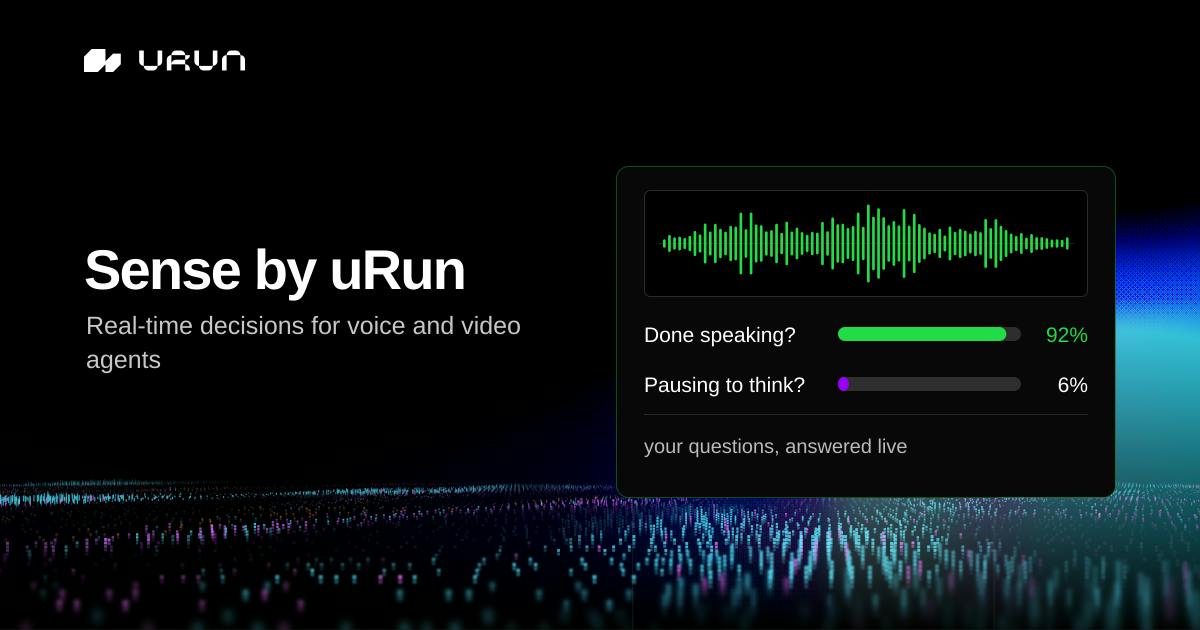
uRun (Sense) uses a real-time decision model to judge voice and video agent conversational state, filling the interaction control layer beyond VAD.
uRun (Sense) is a real-time decision model for voice and video agents that runs on streaming audio and video, answering developer-defined conversational state questions multiple times per second—such as whether the user has finished speaking, just interrupted, or whether the agent should stop talking. It aims to solve traditional VAD's misjudgments in noisy environments, multi-person conversations, and hesitant users, handing control back to developers. The product offers SDK real-time sessions and single requests, with 1,000 free credits for new accounts. Positioned as an API and developer tool, it fills the "conversational state understanding" layer beyond ASR/TTS. It received 105 votes and 18 comments on Product Hunt, ranking 13th, but accuracy, latency, and other performance metrics have not been disclosed, so actual performance still needs developer verification.
Voice and video agents are evolving from simple Q&A bots into real-time interactive systems, but a core challenge persists: how can an agent accurately judge the subtle state of a conversation? For example, whether the user has finished speaking, whether they've been interrupted, or whether the agent should stop talking. uRun (called Sense on its product page) attempts to solve this problem with a real-time decision model, and it earned 105 votes and 18 comments on Product Hunt, ranking 13th.
Real-Time Decisions: The "Nervous System" of Voice and Video Agents
Traditional voice agents typically rely on voice activity detection (VAD) to determine whether the user has finished speaking, but this approach easily misjudges in noisy environments, multi-person conversations, or when the user hesitates. uRun goes a step further: it runs on top of streaming audio and video, answering developer-defined questions multiple times per second—for example, "Has the user finished speaking?" "Did the user just interrupt?" "Should the agent stop talking?"
This "question-decision" model hands control back to developers. You simply define the state questions you care about, Sense returns decision results, and the agent acts accordingly. It's akin to installing a real-time nervous system for the agent, making interactions more natural and responses more timely.
Voice activity detection (VAD) is a technology that determines whether human speech is present in the current audio frame by analyzing signals such as audio energy, spectral features, or zero-crossing rate, typically outputting a binary "speech/no speech" state. In voice agents, VAD's main role is endpoint detection—determining when the user starts and stops speaking, thereby deciding when to trigger ASR or end a conversation turn. The limitation of traditional VAD is that it only focuses on "whether there is sound" without understanding semantics or conversational intent: background noise, coughing, or multiple people talking may be misjudged as user speech; pauses while the user is thinking may be misjudged as the end of speech, causing the agent to interject too early. uRun's attempt to replace or supplement VAD with a "decision model" is precisely aimed at upgrading from "presence of sound" to "understanding of conversational state."
SDK and Single Requests: Two Usage Paths
uRun offers two integration methods. First, use the SDK to build real-time sessions, suitable for production-grade voice or video agents that require continuous interaction. Second, send single requests for exploration, making it easy for developers to quickly validate model capabilities. New accounts receive 1,000 free credits upon registration, lowering the barrier to experimentation.
In terms of product category, uRun falls under APIs and developer tools, targeting engineering teams building real-time voice/video agents. Its value lies not in replacing ASR or TTS, but in filling the gap of "conversational state understanding."
Streaming refers to data arriving in continuous small fragments in real time and being processed immediately, rather than waiting for complete data before computing all at once. In voice and video scenarios, audio is continuously input in frames of roughly 20 milliseconds each, while video is generated at tens of frames per second. The agent must make continuous judgments as data flows, unable to wait until a sentence is finished before processing. The "multiple decisions per second" that uRun emphasizes is built precisely on a streaming architecture: the model needs to perform low-latency inference on continuously arriving audio and video frames while maintaining continuity of conversational state. This is fundamentally different from the traditional "record—upload—recognize" batch processing model, and it places higher demands on the model's inference latency and computational efficiency, since any noticeable processing lag will directly manifest as stuttering or misjudgments in the interaction.
Product Positioning Backed by Multiple Sources
According to Product Hunt launch information and the product's official website description, uRun (Sense) is positioned as a "real-time decision model," emphasizing streaming processing and high-frequency decisions. This description aligns with the developer community's general demand for real-time agents: agents need to understand conversational rhythm faster and more accurately, not just recognize textual content.
Interestingly, public information has not yet disclosed performance metrics such as model accuracy or latency, with only free credits serving as an entry point for体验. This means developers still need to evaluate its performance in specific scenarios themselves when integrating it in practice.
ASR (automatic speech recognition) and TTS (text-to-speech) are two foundational components in the voice agent pipeline: ASR is responsible for transcribing user speech into text for the language model to understand and generate replies; TTS is responsible for synthesizing the agent's text replies into speech to play back to the user. What they solve is the "content conversion" problem—turning sound into text and text into sound. However, a natural conversation also contains a great deal of non-content-level information: who is speaking, whether someone has been interrupted, whether the other party is still thinking, and when turns should switch. These belong to "conversational state" or "turn management" problems, which ASR and TTS do not handle. uRun's positioning as filling this gap means it does not compete with ASR/TTS but serves as a coordination layer above them, letting the agent know "whether to listen, speak, or stop now," thereby connecting each component into a smooth real-time interaction.
Conclusion
What uRun targets is a key link in voice and video agent interaction—real-time conversational state judgment. Through customizable questions and high-frequency decisions, it provides developers with finer-grained control than traditional VAD. Although performance details remain to be verified, its approach is worth watching, especially for real-time agent scenarios that demand a high degree of interaction naturalness.
One-line Summary
uRun (Sense) uses a real-time decision model to judge the conversational state of voice and video agents, filling the interaction control layer beyond VAD.
Paragraph Summary
uRun (Sense) is a real-time decision model for voice and video agents. It runs on streaming audio and video, answering developer-defined conversational state questions multiple times per second—such as whether the user has finished speaking, whether they just interrupted, or whether the agent should stop talking. It attempts to solve the problem of traditional VAD easily misjudging in noisy environments, multi-person conversations, and when users hesitate, handing control back to developers. The product offers two integration methods—SDK real-time sessions and single requests—with 1,000 free credits for new accounts. Positioned as an API and developer tool, it fills the "conversational state understanding" layer beyond ASR/TTS. The product received 105 votes and 18 comments on Product Hunt, ranking 13th, but performance metrics such as accuracy and latency have not been disclosed, so actual performance still needs to be verified by developers themselves.
Related articles

Beagle Brigade: From Fruit to GHB — Guarding the Border
How does the Beagle Brigade guard U.S. borders? Based on To Catch A Smuggler, this article shows detector dogs finding fruit and meat, and agencies tracking GHB and cocaine smuggling.

The Secret to High-Yield Tomatoes: How Consistent Watering Makes Container Tomatoes Outperform Ground-Planted Ones
A YouTube growing log shows container tomatoes far outyield ground-planted ones. The grower credits consistent, adequate water—not fertilizer—for the longer fruiting period and higher yield.

Reverse Role-Play: When You Become an LLM's Subagent in a Game
A reverse role-play game appears on Hacker News where players act as an LLM's subagent. This article analyzes its game mechanics, the philosophical implications amid the AI agent boom, and how indie developers use lightweight interaction to explore human-machine power relations.