User Rages at Codex for Over-Engineering: 30-Second Startup Turns into an Hour-Long Ordeal — Why AI Coding Assistants Help Less the More They Try

Reddit user rants that OpenAI Codex over-engineers, turning a 30-second startup into an hour-long monster, sparking reflection on AI coding tool practicality.
A Reddit user fiercely criticized OpenAI Codex for overcomplicating simple tasks—such as turning a 30-second startup process into a workflow running over an hour on a 180-thread, 700GB RAM machine, with generated code full of redundant checks and repeated verification. After comparing with Claude, the user found Codex clearly inferior in quality while costing more and offering less usage, and ultimately canceled two 20x accounts. The article analyzes that the issue may stem from foundation models overly pursuing safety and completeness at the expense of actual development efficiency, and notes that AI coding tools need to balance intelligence and practicality, with subscription pricing also needing to match value.
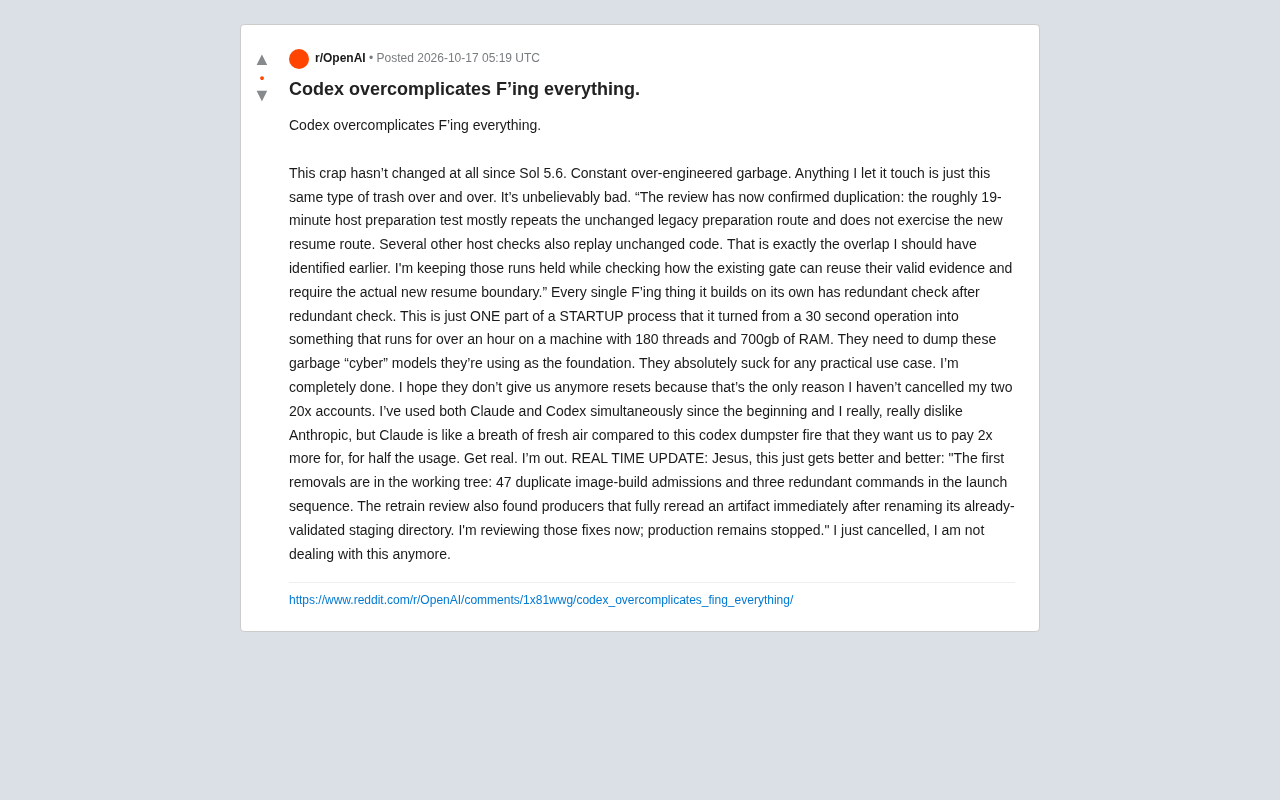
A Reddit user's fierce rant against OpenAI Codex has struck a chord with many. He bluntly stated that Codex "overcomplicates F'ing everything," turning what was originally a 30-second startup process into a monstrosity that runs for over an hour on a machine with 180 threads and 700GB of RAM. This discussion about AI coding assistants' "over-engineering" touches on the core pain points of current AI-assisted development tools.
According to the user, the code generated by Codex is riddled with redundant checks—the same tests executed repeatedly, old paths verified over and over, while new logic goes uncovered. He even posted Codex's own "self-critique": "Review has confirmed duplication: approximately 19 minutes of host preparation tests largely duplicate unchanged old preparation paths and do not exercise the new recovery path." This kind of "self-diagnostic" output doesn't solve the problem—it exposes deeper design flaws.
Specific Manifestations of Over-Engineering: Redundant Checks and Ineffective Verification
Based on the real-time updates shared by the user, Codex's "fix" process is equally disappointing: 47 duplicate mirror build admissions and three redundant startup sequence commands in the working tree. Even more ironic, the retraining review found that some producers "immediately fully re-read artifacts after renaming already-verified staging directories." These behaviors are typical anti-patterns in traditional software engineering—redundant verification, ineffective loops, wasted resources.
The user emphasized that this is not an isolated phenomenon but a systemic problem that "has never changed since Sol 5.6." He called Codex's generated content "continuously over-engineered garbage" and pointed out that "anything it touches turns into this kind of garbage." This consistent poor performance suggests the problem may lie in the model's fundamental design or training data rather than occasional generation errors.
Defensive Programming is a programming paradigm aimed at improving software robustness, emphasizing the preemptive addition of extensive checks, validations, and exception handling in code to cope with possible erroneous inputs or abnormal states. In safety-critical systems (such as aviation and medical devices), this style is necessary; but in everyday business development, overuse leads to code bloat, reduced readability, and increased maintenance costs. If AI coding assistants are overly biased toward this paradigm during training, they may generate large amounts of redundant defensive checks, complicating simple logic—which is exactly the typical manifestation of the "over-engineering" criticized in Codex here.
Comparison with Claude: Both AI Assistants, Radically Different Experiences
This user is no novice to AI coding tools—he uses both Claude and Codex and admits he "has used both since the beginning." Although he "really, really dislikes Anthropic," Claude by comparison is "like a breath of fresh air." This contrast is especially sharp because Codex reportedly requires users to pay twice the price while offering only half the usage.
This experience gap points to a key question: the value of AI coding assistants lies not in how much code they generate, but in the quality and practicality of that code. When the code generated by tools requires extensive manual review and correction, the efficiency gains are greatly diminished. The user ultimately chose to cancel two 20x accounts and hopes "they don't give us another reset," because the reset is the only reason he hasn't canceled yet—hinting at the subtle impact of "reset" mechanisms on user retention in subscription models.
Root Cause: Has the Choice of Foundation Models Gone in the Wrong Direction?
The user pointed the finger at the "network" model foundation used by Codex, arguing that "they are completely unsuitable as a foundation for any practical use case." This view is worth pondering: AI coding assistants are typically based on general-purpose large language models that have been fine-tuned for tasks like cybersecurity and code generation, but may have over-optimized certain metrics (such as security checks and completeness verification) at the expense of efficiency needs in actual development.
When models are trained to be "cautious" and "comprehensive," they may tend to add redundant validation steps and duplicate checks—which may be an advantage in safety-critical systems but becomes a burden in everyday development. This user's experience suggests that Codex may have gone too far in "defensive programming," resulting in code that is "safe" but extremely inefficient.
Reward Function is a core concept in reinforcement learning (RL), used to quantify the quality of an agent's behavior and guide the model to learn the desired policy. In the training of AI coding assistants, if the reward function overemphasizes metrics such as "safety" and "completeness," the model will tend to generate large numbers of validation steps and redundant checks to obtain high rewards, potentially sacrificing code simplicity and execution efficiency. This deviation in reward design is one of the deep mechanisms speculated in the article behind Codex "going too far in defensive programming." Adjusting the reward function to balance safety and practicality is a key direction for improving such tools.
Industry Implications: AI Coding Tools Need to Balance Intelligence and Practicality
This rant reflects a common challenge in the AI coding assistant space: how to find a balance between intelligence and practicality. Developers need assistants that understand intent and generate concise, effective code—not pedants that are overly cautious and complicate simple tasks.
For development teams building AI coding tools, real user feedback is a valuable signal for improvement. When multiple users report similar issues, it may indicate deviations in the model's training objectives or reward function design. At the same time, pricing and usage strategies under subscription models need to match the tool's actual value—users are willing to pay for efficiency but won't keep paying for tools that "help" by getting in the way.
This Reddit user's experience may be extreme, but it is by no means an isolated case. AI coding assistants still have a long way to go before truly becoming reliable partners for developers.
Anti-pattern refers to common practices in software engineering that are repeatedly used but are inefficient or prone to causing problems, such as redundant verification, ineffective loops, and wasted resources. The "repeated execution of the same test" and "repeated verification of old paths" generated by Codex in the article are typical anti-patterns. Identifying anti-patterns helps developers review the quality of AI-generated code and also provides negative sample references for model training—preventing AI from learning these seemingly reasonable but actually harmful coding habits.
One-line Summary
A Reddit user rants that OpenAI Codex over-engineers, turning a 30-second startup into an hour-long monster, sparking reflection on the practicality of AI coding tools.
Paragraph Summary
A Reddit user fiercely criticized OpenAI Codex for overcomplicating simple tasks—for example, turning a 30-second startup process into a workflow running for over an hour on a 180-thread, 700GB RAM machine, with generated code full of redundant checks and repeated verifications. After comparing with Claude, the user concluded that Codex has a clear quality gap while costing more and offering less usage, ultimately canceling two 20x accounts. The article analyzes that the problem may stem from foundation models overly pursuing safety and completeness at the expense of actual development efficiency, and points out that AI coding tools need to find a balance between intelligence and practicality, with subscription pricing also needing to match value.
Related articles

Cursor AI Programming in Practice: Build a Student Management System from Scratch in 30 Minutes
A Bilibili creator demonstrates Cursor AI programming: generating a student management system in 30 minutes with natural language. Details on Agent mode, Claude selection, prompt techniques, and thresholds.

Top 20 AI Coding Tools Ranking: From Rock-Solid to Lackluster, a Scored Matrix
Bilibili creator releases top 20 AI coding tools ranking, tiered T0–T4 from rock-solid to lackluster, with Claude Code and Codex tied at T0. This article details the scoring dimensions (capability, reliability, robustness, durability, cost, domestic availability) and tool performances to help developers choose the right AI coding assistant.

Vibe Coding Systematic Tutorial: Master AI-Assisted Programming from Zero
A three-month Vibe Coding tutorial from a Bilibili creator covering Codex, ClaudeCode, and Cursor, from core logic to commercial project practice for beginners.