Using Skill.md to Shape AI Behavior in Hacker News Comments

A Skill.md file for Hacker News reveals both the promise and pitfalls of AI joining public community discussions.
A project on Hacker News showcases a `Skill.md` file designed to guide AI in writing community-appropriate comments. These modular skill specification documents encode behavioral norms, tone, and content boundaries for AI Agents to load on demand — a more maintainable alternative to monolithic system prompts. Hacker News, with its implicit culture of rejecting marketing speak and valuing firsthand experience, is one of the hardest environments for AI to fit into naturally, making it a revealing test case. Yet the project also raises concerns: making AI better at mimicking authentic human comments could enable large-scale fake community participation, blurring the human-machine boundary in ways that undermine the genuine discourse these communities are built on.
When AI Starts Learning How to Participate in Communities
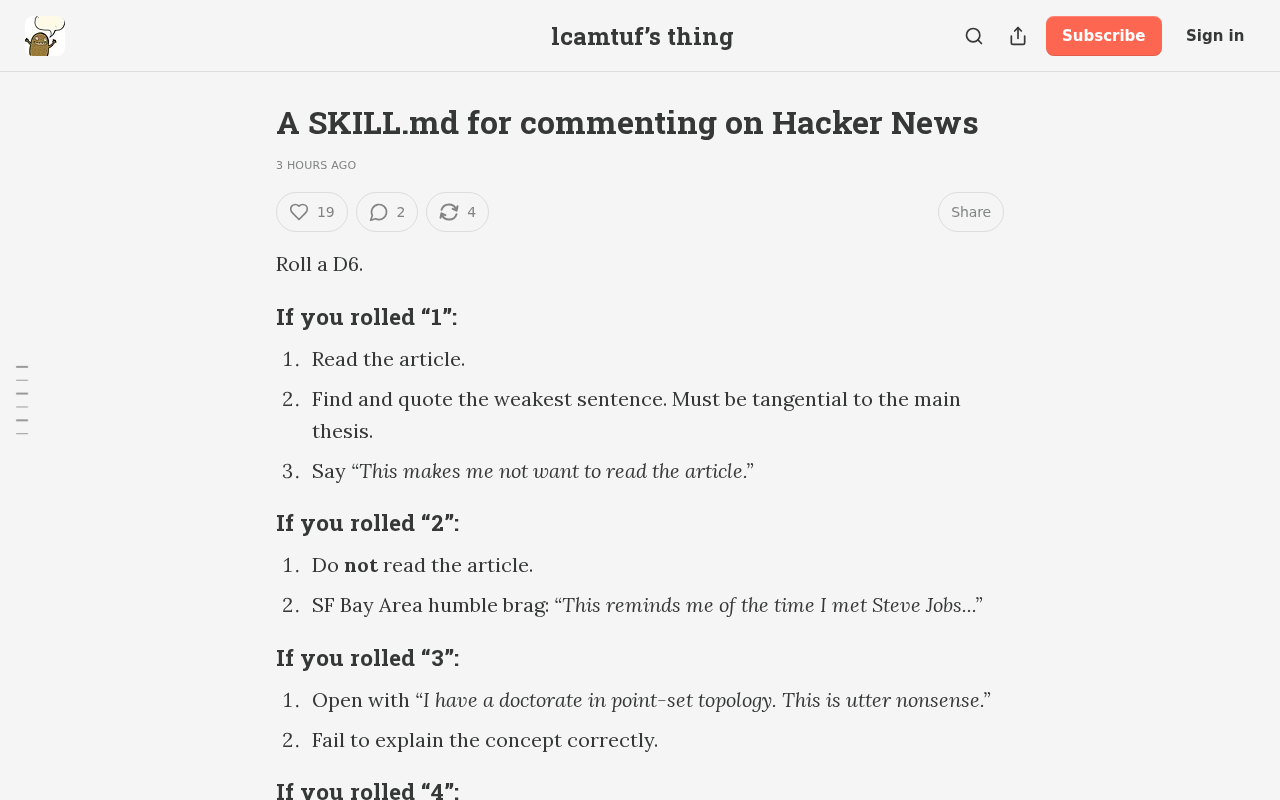
A project recently surfaced on Hacker News that sparked some interesting discussion: a Skill.md file specifically designed to guide AI in writing comments on Hacker News. These files have become increasingly common in the AI Agent and large language model ecosystem. At their core, they're "skill specification documents" — natural language instructions that tell an AI model what behavioral norms, tone, and content boundaries to follow in a given context.
The central idea behind this project is to distill Hacker News's long-established comment culture into a structured instruction document, enabling AI to generate comments that feel closer to how humans actually express themselves in the community — rather than producing generic, templated responses.
What Exactly Is Skill.md
Skill.md is a convention that gained traction alongside the rise of AI Agent toolchains. Compared to traditional system prompts, it places greater emphasis on reusability and modularity: each Skill file describes one specific capability and can be loaded on demand by different agents or workflows.
From Prompts to "Skill Modules"
Developers used to cram all their instructions into one massive system prompt — hard to maintain, harder to reuse. The Skill file approach breaks something like "how to comment on Hacker News" into a standalone document, complete with background context, behavioral guidelines, and positive and negative examples. When an AI needs to perform a related task, the corresponding Skill gets injected into the context.
The value here is that it makes soft, hard-to-quantify rules — like community etiquette — explicitly encodable and iterable.
From a technical implementation standpoint, Skill.md files are typically written in Markdown and stored in a code repository for version control. Most mainstream AI Agent frameworks — including Cursor, Claude's Projects feature, and various agents built on LangChain or LlamaIndex — support dynamically loading these context files at runtime. The core mechanism is retrieval augmentation: based on the current task type, the agent matches and appends relevant Skill file content to the system prompt, rather than loading everything at once. This on-demand injection approach both sidesteps the context window length limit and keeps different skills independently maintainable. For prompt engineers, Skill files are essentially a way to decompose the implicit assumptions buried in a giant system prompt into the smallest testable, independently updatable units.
Why Write One Specifically for Hacker News
Hacker News has a distinctly strong community culture: it pushes back against marketing speak, encourages discussion grounded in facts and firsthand experience, and is fairly intolerant of hollow praise or emotionally charged comments. Most of these norms are implicit — shaped through years of community interaction — and newcomers often need time to internalize them.
For AI, these unspoken rules are precisely the hardest things to master. By default, large language models tend to generate polite, inoffensive, but substance-free comments — the kind that Hacker News readers quickly flag as "AI-flavored" and dismiss. A dedicated Skill.md file is an attempt to make these unwritten rules explicit: avoid excessive pleasantries, back up claims with specifics, acknowledge uncertainty, and so on.
Hacker News was founded by Y Combinator in 2007, originally positioned as a technical community for founders and hackers. Its comment guidelines and moderation culture have long formed a distinctive quality-filtering mechanism. The community particularly dislikes "content farm" style empty comments — replies like "Great post!" or "Very insightful" often get collapsed or flagged as spam. Meanwhile, the Hacker News algorithm applies extra scrutiny to new accounts' comments (a practice known as "hellbanning" — where banned users' posts are only visible to themselves), making the cost of generating low-quality content at scale relatively high. This mechanism is precisely what makes "passing Hacker News's community filters" a genuinely difficult problem — and one of the real motivations behind this Skill.md project.
The Discussion Value and the Concerns It Raises
The project didn't attract enormous attention (26 points, 4 comments), but it touches on a topic worth thinking carefully about: as AI-generated content increasingly infiltrates public discourse, how should we think about "teaching AI to be more human"?
Raising Quality or Enabling Deception
On the optimistic side, a well-crafted Skill file can constrain AI to produce more valuable, context-appropriate content, reducing meaningless noise. But on the other hand, making AI better at mimicking authentic human comments could just as easily be used to mass-produce seemingly genuine community participation — blurring the human-machine boundary and posing a real threat to communities whose core value is authentic discussion.
This concern isn't hypothetical. Academic researchers and platform security teams have already documented multiple cases of large language models being used to generate "high-quality" community comments in bulk to manipulate public opinion — some researchers call this "LLM-driven astroturfing." Unlike the crude bots of earlier eras, AI-generated content fine-tuned with careful prompting is now approaching human-level readability and contextual fit, and traditional detection methods based on grammar or word frequency have become significantly less effective. Communities like Reddit and Stack Overflow have begun implementing varying degrees of AI-generated content restrictions, while Hacker News currently has no explicit prohibition. This puts the circulation of files like this Skill.md in a gray zone where policy hasn't yet caught up with technology.
Can Community Culture Be Documented
The deeper question is this: the vitality of communities like Hacker News comes precisely from the collision of real people sharing genuine experiences. Abstracting comment norms into a checklist of instructions — even if it helps AI produce superficially similar text — can't replicate the authentic professional judgment and curiosity that underlies it. Skill.md might improve surface-level quality, but the foundation of community value still rests with people.
Conclusion
This Skill.md file written for Hacker News is a telling small window into the AI Agent era: it demonstrates how developers use structured documents to shape model behavior, and it prompts us to think about the new questions that arise when AI participates deeply in public discourse. For practitioners focused on AI applications and prompt engineering, this kind of project is worth watching closely.
Related articles

Random Pruning of the DPO Computation Graph: 1.4x Training Speedup and Lower Peak Memory
DPO training too slow and memory-hungry? This paper proposes a random pruning framework for the DPO computation graph, sampling independently across position, sequence, and branch dimensions; branch pruning achieves a 1.426x step-time speedup and cuts training time by about 30%, with in-depth attribution of memory and time gains.

Why Does JEPA Underperform MLM in Longitudinal EHR Representation Learning?
New study compares JEPA and MLM for longitudinal EHR representation learning on MIMIC-IV: three JEPA variants train stably without collapse but underperform MLM; target size, not heterogeneity, drives prediction error.

Transfer Learning + Visible Light Communication: A New Approach to Energy-Efficient Indoor Positioning
A study proposes a transfer learning-based visible light communication indoor positioning method, achieving 47% accuracy improvement on the BOSCH factory dataset, 67.5% model efficiency under high noise, and introducing the ME composite metric for energy-efficient positioning in energy-constrained industrial IoT scenarios.