Valley: AI-Powered Precision Targeting of High-Intent Prospects, Boosting Reply Rates to 45%

Valley uses buying signals and AI-personalized messages to boost B2B cold outreach reply rates to 15-45%.
Valley is an AI sales tool ranked #8 on Product Hunt that tackles the ~2% reply rate of B2B cold outreach. It builds prospect pools from real-time buying signals, natural language search, and user lists, filters against the Ideal Customer Profile (ICP), does background research, and generates personalized LinkedIn and email messages. Every message requires human approval. Valley runs via MCP from Claude or ChatGPT, lowering the barrier to entry. The company claims 15-45% reply rates, and customer Bolt.new booked 25 enterprise demos in 45 days. It suits B2B teams with a clear ICP, but results depend heavily on signal quality and ICP accuracy.
Valley: AI-Powered Precision Targeting of High-Intent Prospects, Boosting Reply Rates to 45%
In B2B sales, cold outreach reply rates typically hover around 2%, but Valley claims it can raise that number to 15–45%. This AI sales tool, ranked #8 on Product Hunt, aims to rewrite the rules of outreach using real-time buying signals and personalized messaging. So how exactly does it work, and which teams is it right for?
From Buying Signals to Personalized Messages: Valley's Core Logic
Valley's positioning is clear: find the people most likely to buy from you. It builds its prospect pool in three ways: real-time buying signals, natural language search, and your own lists. The system then filters each prospect against your Ideal Customer Profile (ICP), conducts background research, and finally generates personalized messages for LinkedIn and email channels. The entire process emphasizes human review — every message must be approved by the user before it's sent, and replies are managed through a unified inbox.
This design combines AI's ability to scale with the judgment of salespeople, avoiding the brand risks that fully automated outreach can introduce. According to the Product Hunt page, teams using Valley achieve reply rates of 15–45%, compared to roughly 2% for traditional cold outreach. While this data comes from the company itself, it's enough to illustrate the tool's potential value.
Ideal Customer Profile (ICP) is a systematic description of a company's most valuable customers, typically covering dimensions such as industry, company size, revenue range, tech stack, organizational structure, and key decision-maker roles. In B2B sales, the ICP is the benchmark for lead qualification and resource allocation: sales teams use it to judge whether a given lead is worth investing time in. The more specific the ICP definition, the more precise the outreach; conversely, an overly broad profile leads to a large volume of ineffective touches. Valley uses the ICP as its core reference for filtering and background research, and the quality of its output depends heavily on whether users can break the ICP down into actionable criteria.
Integration with Claude and ChatGPT: The Role of the MCP Protocol
Valley supports running from Claude or ChatGPT via MCP (Model Context Protocol). This means salespeople can directly invoke Valley's capabilities within their familiar AI chat interface without switching tools. As an open protocol connecting AI models with external tools, MCP is gradually becoming the glue of the AI application ecosystem. Valley's integration lowers the barrier to entry and embeds AI assistants more deeply into the sales workflow.
For teams already relying on Claude or ChatGPT, this seamless connection reduces the learning curve. You can ask the AI within a conversation to find leads matching specific criteria and draft messages, and then Valley handles the filtering and send preparation. This collaborative model reflects the trend of AI tools evolving from standalone applications toward platform-level capabilities.
MCP (Model Context Protocol) is a protocol proposed and open-sourced by Anthropic to standardize how AI models connect to external data sources and tools. Before MCP, integrating each external service often required developing separate plugins or adapter layers for different models; MCP abstracts "model calling tools" into a unified client–server structure, allowing the same set of tool capabilities to be reused across multiple AI clients. For application developers, this means a single integration can cover multiple AI entry points that support MCP, reducing redundant development; for users, it means they can directly operate external tools within their preferred AI interface without switching between multiple applications.
Case Study: Bolt.new's 25 Enterprise Demos
Among Valley's customer cases, Bolt.new booked 25 enterprise demos in 45 days. This result demonstrates the tool's potential in enterprise sales scenarios. Enterprise-level sales typically involve longer cycles and higher decision thresholds, so being able to quickly secure demo bookings suggests that Valley is indeed effective at identifying high-intent prospects and personalizing outreach.
However, the case does not disclose specific reply rates or conversion funnel details, making it difficult to assess replicability. But combined with the 15–45% reply rate range, it's reasonable to infer that Valley has put significant work into signal quality and message personalization. For SDR teams that rely on outreach, this may mean less spam and higher efficiency.
Enterprise demo is a key stage in the enterprise sales funnel, typically referring to a customized product demonstration conducted for decision-makers at a target company. Unlike self-service sign-up or ordinary product trials, an enterprise demo is often initiated by a Sales Development Representative (SDR) or account manager and requires lead qualification first — confirming budget, decision-making authority, needs, and timing. A successfully booked demo means the lead has passed initial screening and entered substantive evaluation. Therefore, "booking 25 enterprise demos in 45 days" measures conversion capability in the upper-middle part of the funnel, not final closed deals; evaluation should also consider subsequent demo attendance and close rates.
Use Cases and Limitations
Valley is clearly suited for B2B teams that already have a well-defined ICP and want to scale outreach through LinkedIn and email. Teams using Claude or ChatGPT, in particular, can get up to speed faster. However, the tool's effectiveness depends heavily on the quality of signal sources and the accuracy of ICP definitions. If the input is a vague profile, the output may be less than satisfactory.
Additionally, the 15–45% reply rate range is quite wide, and actual performance may vary by industry, audience, and message content. The official data does not specify its statistical methodology, so readers should remain cautious. Valley's emphasis on human review also means it is not fully automated — salespeople still need to be involved.
Conclusion
Through buying signals, ICP matching, and AI-personalized messaging, Valley attempts to solve the pain point of low cold outreach reply rates. Its MCP integration with Claude/ChatGPT lowers the barrier to entry, and the Bolt.new case provides preliminary validation. For B2B teams looking to improve outreach efficiency, Valley is worth watching — but actual results should be evaluated in light of your own ICP and data quality.
Related articles
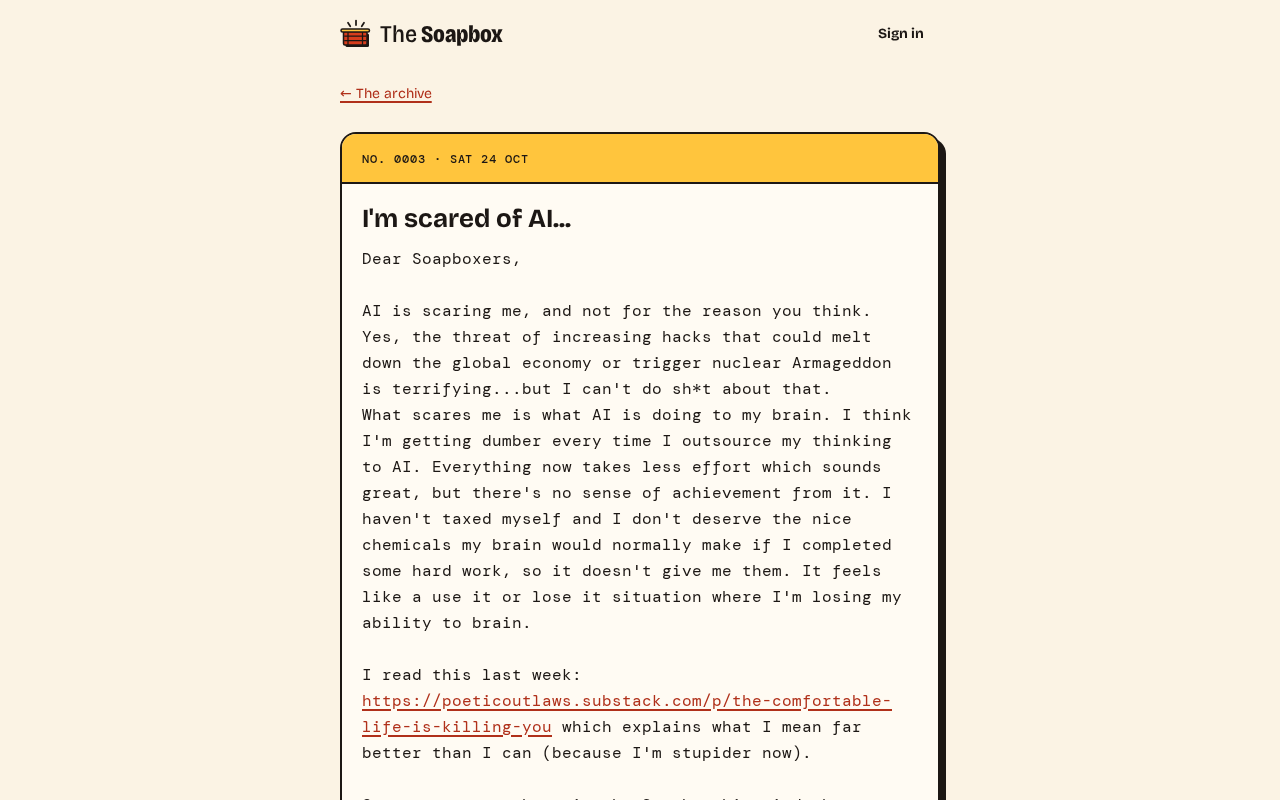
Fear of AI Is Spreading: A Technologist's Confession
A Hacker News post 'I'm Scared of AI' sparks debate with 212 points and 247 comments, showing AI anxiety spreading from the public into the tech community itself.

Unkernel: Compiling the Linux Kernel to WebAssembly
The Unkernel project compiles a real Linux kernel to WebAssembly, making it possible to run a complete kernel in the browser. This article covers its technical principles, challenges, and prospects.

New Claude Sonnet Model Tested: Performance Approaches Opus with Less Thinking
Anthropic quietly tests a new Sonnet model in Claude Code—performance approaches Opus 5.5 with far fewer thinking tokens, plus Codex transfer optimization, xAI's low-level rewrite, Google Antigravity updates, and the AI science understanding gap.