Vercel Achieves ISO 42001 Certification, Putting AI Governance on the Fast Track

Vercel achieves ISO/IEC 42001 certification, embedding AI governance into its agent deployment platform.
Vercel announced completion of ISO/IEC 42001:2023 certification, becoming one of the platforms meeting the international AI management system standard. The certification covers AI Gateway, Vercel Agent, v0, and underlying infrastructure, with a two-stage audit by an independent body, a three-year certificate, and annual surveillance. The article notes that ISO 42001's distinctive feature is AI system impact assessment, focusing on AI's impact on people rather than only information protection. Vercel implements continuous governance through a three-layer framework of impact assessment, pre-release assessment, and clear data commitments, providing customers with confidence in agent infrastructure, accelerated third-party onboarding, and clear responsibility boundaries. This marks a shift in AI governance from remediation after the fact to continuous embedding, with governance capabilities becoming a source of platform competitiveness.
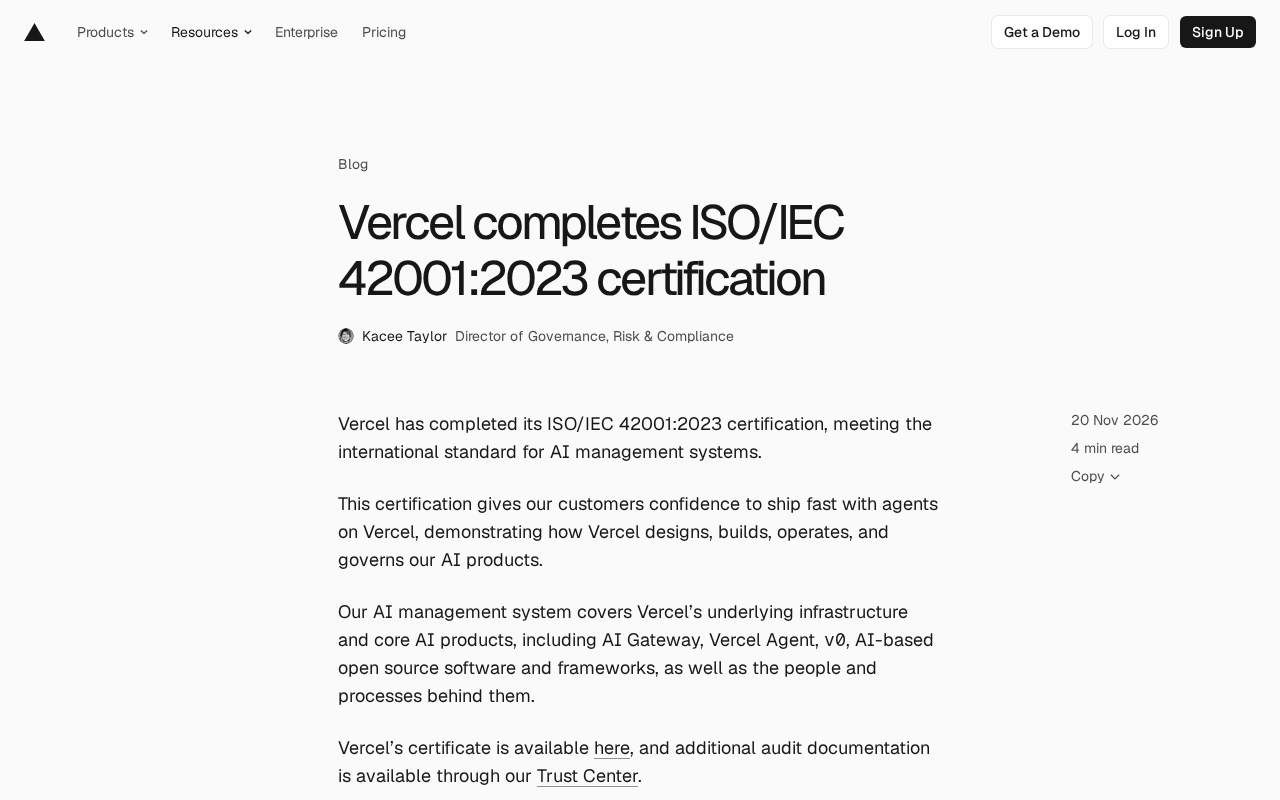
Vercel recently announced that it has completed ISO/IEC 42001:2023 certification, becoming one of the platforms that meets the international AI management system standard. This certification not only endorses Vercel's own AI governance capabilities but also sends a clear signal to enterprise customers: deploying AI agents quickly on Vercel does not have to come at the expense of governance.
Why Is ISO 42001 Worth Watching?
ISO/IEC 42001:2023 is the first international standard for AI management systems and applies to any organization that develops, provides, or uses AI. It requires organizations to establish a complete set of policies, roles, processes, and controls to continuously govern AI activities. Unlike traditional security standards, ISO 42001 is distinctive for its AI system impact assessment—it focuses not only on information protection but also on how AI systems affect people and on the benefits and harms that may arise when systems undergo significant changes.
Vercel's certification covers its underlying infrastructure and core AI products, including AI Gateway, Vercel Agent, v0, AI-based open source software and frameworks, as well as the people and processes behind them. The certification was conducted through a two-stage audit by an independently accredited certification body. The certificate is valid for three years, with annual surveillance audits during that period.
ISO/IEC 42001:2023 was jointly published by the International Organization for Standardization (ISO) and the International Electrotechnical Commission (IEC) and is the first certifiable AI management system standard. It uses a high-level structure (HLS) similar to ISO 9001 and ISO 27001, making it easier for organizations to integrate AI governance with existing quality and information security systems. The standard's core requirements include: establishing an AI policy, defining roles and responsibilities, conducting AI risk assessments and impact assessments, establishing operational controls and performance evaluation mechanisms, and continuously improving. Certification must be audited by an accredited third-party body. Certificates are typically valid for three years and require surveillance audits during that period. For enterprises, this certification can serve as objective evidence to demonstrate AI governance maturity to customers, regulators, and partners.
Vercel's Three Pillars of AI Governance
Talha Tariq, Vercel's Chief Technology Officer of Security, said: "The AI governance system we built runs as continuously as our release cadence, and ISO 42001 is an independent checkpoint to verify its effectiveness." According to its official blog, Vercel's AI governance is mainly organized around three layers:
Impact Assessment
Vercel conducts impact assessments of AI systems, covering foreseeable benefits, harms, failures, and misuse scenarios. When systems undergo significant changes, these risks and benefits are reassessed.
Pre-release Assessment
For the performance, security, and safeguards of AI systems, Vercel maintains an evaluation mechanism and conducts manual review of major changes.
Clear Data Commitments
Where the pricing plan does not provide it by default, customers can set their own data processing preferences, from zero data retention (ZDR) to opting out of training. Vercel's AI policy can be viewed at v0.app/policy.
AI System Impact Assessment is a key mechanism that distinguishes ISO/IEC 42001 from traditional information security standards. It requires organizations to systematically identify throughout the AI system lifecycle: the intended benefits of the system, potential harms (such as bias, misuse, and security risks), failure modes, and misuse scenarios, and to assess the severity and likelihood of these impacts on individuals, groups, and society. When the system undergoes major changes (such as model updates or expanded use cases), reassessment is required. This assessment emphasizes impacts on "people" rather than focusing only on data confidentiality, so it is often used in combination with risk assessment and ethical review to form an auditable governance record.
Zero Data Retention (ZDR) means that after processing a customer request, the service provider does not store any prompts, inputs, or outputs; inference is completed only in memory and the data is immediately discarded. For AI products, ZDR can significantly reduce the risk of data leakage and training data contamination, but it may also affect abuse monitoring, debugging, and personalization features. In contrast, customers can also choose to "opt out" of training, meaning data may be retained for a short period for service operation but is not used for model training. Vercel makes data processing preferences customer-configurable precisely to provide a flexible balance among compliance, functionality, and privacy.
What Does This Mean for Customers?
AI is entering the critical path of software building much faster than governance systems are keeping up. Teams release agents, assistants, and model-driven features on Vercel every day, and the questions that follow are no longer hypothetical: Who is responsible when a model behaves unexpectedly? What data entered the model? How is the system monitored after launch? Who decides the system is ready?
ISO 42001 certification provides several practical benefits for customers:
- Confidence in agent infrastructure: Vercel's AI systems have been audited, so when customers use its AI products, they start from a reviewed foundation rather than an untested framework.
- Governance at the same speed as product: Agents now drive application development and deployment, and quarterly governance cannot manage software that changes every hour, so Vercel has built an AI review system synchronized with its release cadence.
- Simplified and accelerated assurance: Customers and partners can rely on this certification, together with other compliance evidence, to meet AI governance due diligence requirements and accelerate third-party vendor onboarding.
- Clear boundaries of responsibility: ISO 42001 requires responsibility to be allocated across the AI supply chain. Vercel's documentation clarifies what Vercel is responsible for and what remains with the customer, consistent with the shared responsibility model in security.
- Long-term discipline: Annual surveillance audits mean this is not a one-time statement. As AI products change, the governance system continues to undergo independent review.
The shared responsibility model originates in cloud computing security and refers to platform providers and customers each bearing responsibility at different layers. In AI scenarios, Vercel as the platform provider is typically responsible for infrastructure security, governance of the model access gateway, and platform-level AI policies and review; customers are responsible for prompt design at the application layer, compliance of input data, review of output content, and final business decisions. ISO 42001 requires clear allocation of responsibility across the AI supply chain, so certification documentation defines the boundaries between the two parties. During due diligence, customers can use this to confirm which controls are covered by Vercel and which they must implement themselves, thereby avoiding governance gaps.
Industry Impact and Outlook
Vercel's certification is a microcosm of AI governance shifting from "remediation after the fact" to "continuous embedding." As enterprises put agents into production environments, how to maintain auditable and accountable AI management while iterating quickly has become key to platform competitiveness. By productizing governance capabilities through ISO 42001, Vercel not only lowers the compliance barrier for customers but also adds leverage for its expansion in the enterprise market. In the future, as the boundaries of AI products expand, Vercel says it will continue to broaden the scope of certification so that governance grows alongside its products.
Related articles

ChatGPT Plus Subscription Pitfall Guide: Go/Plus/Pro Tier Comparison and Quick Activation
A complete ChatGPT Plus subscription guide based on a Bilibili tutorial: from registering an account, comparing Go/Plus/Pro tiers, to the practical steps for quickly completing your subscription.

GPT-6.2 Sol/Astra Released! A Step-by-Step ChatGPT Plus Subscription Guide and Tier Comparison
GPT-6.2 Sol/Astra is out—here's a ChatGPT Plus subscription guide: register an account, compare Go/Plus/Pro tiers, and subscribe in a minute.

Comparing Three Channels for Subscribing to GPT Plus in China: Is Website Top-Up the Easiest?
How to subscribe to GPT Plus in China? This article compares website top-up, credit card, and mobile top-up channels—process, cost, and risk—with steps and tips to help you choose wisely.