Vercel AI SDK @ai-sdk/zai 3.0.6 Update: A Deep Dive into Zhipu Model Integration
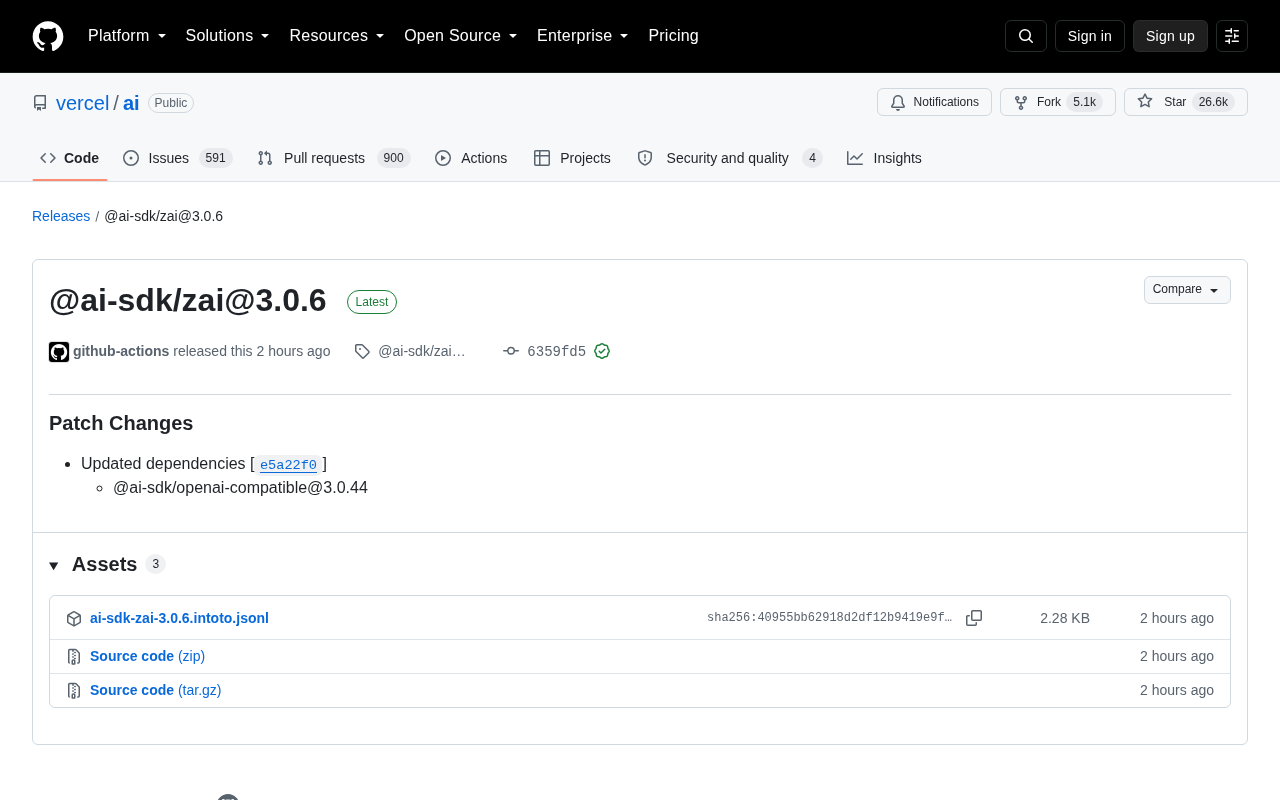
@ai-sdk/zai 3.0.6 syncs its openai-compatible dependency, keeping Zhipu GLM integration aligned with the Vercel AI SDK ecosystem.
The @ai-sdk/zai 3.0.6 patch release updates its core dependency @ai-sdk/openai-compatible to version 3.0.44, automatically published via GitHub Actions with GPG signature verification. While no new features are introduced, the update reflects Vercel AI SDK's modular provider architecture and automated Monorepo release pipeline — ensuring the Zhipu GLM integration stays in sync with the broader ecosystem.
The Continued Evolution of the AI SDK Ecosystem
Vercel's AI SDK has become one of the most widely adopted toolchains for JavaScript/TypeScript developers building AI applications. To date, its GitHub repository has accumulated over 26.6k stars and 5.1k forks. Recently, @ai-sdk/zai — a sub-package within the AI SDK ecosystem — received a 3.0.6 update, automatically published on September 4th via GitHub Actions and verified with a GPG signature.
While this is a minor patch-level release, it reflects the modular, multi-provider architectural philosophy at the heart of the Vercel AI SDK.
What Is @ai-sdk/zai
The Role of a Provider Package
@ai-sdk/zai is a provider adapter package for the Vercel AI SDK, enabling integration with Zhipu AI (Z.ai / GLM series models). In the AI SDK's architecture, the core library handles unified abstract interfaces — such as generateText, streamText, and generateObject — while each specific model service provider is connected through its own dedicated provider package.
These core APIs correspond to the most common interaction patterns in large language model applications. generateText retrieves a complete text response in a single call, making it suitable for offline processing scenarios. streamText returns results token by token via streaming (Server-Sent Events or WebSocket), significantly reducing perceived latency — the standard choice for chat applications. generateObject leverages structured output capabilities to have the model return objects that conform to a predefined JSON Schema directly, sparing developers the tedious step of manually parsing natural language output. The design philosophy behind this API draws inspiration from the ORM (Object-Relational Mapping) concept in the database world: upper-level business code programs against abstract interfaces, while the underlying driver can be swapped freely.
The biggest advantage of this design is that developers can use a single unified API to seamlessly switch between models from OpenAI, Anthropic, Google, Zhipu, and other vendors without rewriting business logic. @ai-sdk/zai is the key bridge that lets Chinese developers conveniently call Zhipu's GLM series large language models.
Zhipu AI and the GLM Model Series
Zhipu AI is an artificial intelligence company incubated by the Knowledge Engineering Lab at Tsinghua University. Its core product is the GLM (General Language Model) series of large language models. GLM uses a unique autoregressive blank-infilling pre-training method and excels at bilingual understanding and generation in both Chinese and English. Its flagship model, GLM-4, has reached GPT-4-comparable performance on multiple benchmarks, with a particular edge in Chinese-language contexts. The API service provided by Zhipu AI is largely compatible with OpenAI's Chat Completions format — including the same request/response structure, function calling support, and streaming protocol — which makes adapting via an OpenAI-compatible layer entirely feasible. For Chinese developers, Zhipu's API also offers practical advantages such as domestic data compliance, low-latency access, and RMB billing.
Understanding the Version Number
The version number 3.0.6 follows Semantic Versioning (SemVer). The major version 3 indicates it evolves in sync with the AI SDK 5.x mainline, while the patch position in 0.6 signals a backward-compatible bugfix update that won't break existing code.
Semantic Versioning (SemVer) is the most widely adopted version naming convention in modern software engineering, formatted as MAJOR.MINOR.PATCH. A MAJOR increment means backward-incompatible API changes have been introduced, requiring developers to update their code on upgrade. A MINOR increment means new backward-compatible features have been added. A PATCH increment contains only backward-compatible bug fixes. In the Node.js/npm ecosystem, dependency declarations in package.json use the ^ (compatible with major version) and ~ (compatible with minor version) prefixes to control automatic upgrade ranges. For example, ^3.0.0 allows automatic upgrades to any 3.x.x version but will not cross over to 4.0.0. This convention lets package managers automatically fetch the latest fixes while preserving compatibility — it's the cornerstone of large-scale dependency management.
Core Changes in This Update
Dependency Upgrade
According to the official release notes, the core change in @ai-sdk/zai@3.0.6 is a Patch Change, specifically an upstream dependency update:
Updated dependencies [e5a22f0]
- @ai-sdk/openai-compatible@3.0.44
This update doesn't introduce new features directly; instead, it syncs the @ai-sdk/openai-compatible dependency to version 3.0.44.
Why Depend on openai-compatible
@ai-sdk/openai-compatible is a general-purpose adapter layer provided by the AI SDK, designed specifically to interface with third-party model services that implement the OpenAI API format.
OpenAI's Chat Completions API has become the de facto standard interface for large language model services. This API defines a JSON format that takes a messages array (containing roles like system, user, and assistant) as input and returns a choices array as output, and specifies extension protocols for function calling, tool use, and streaming responses (SSE format). Thanks to OpenAI's first-mover advantage and its massive developer ecosystem, numerous model providers worldwide — including Zhipu AI, Mistral, Groq, Together AI, Fireworks AI, and Ollama — have chosen to be compatible with this format. This "API convergence" phenomenon has dramatically lowered migration costs and the learning curve for developers, and it's what gives a general adapter layer like openai-compatible its value: implement the compatibility logic once and cover dozens of providers.
Since Zhipu AI's interface is largely compatible with OpenAI's calling conventions, @ai-sdk/zai opts to wrap openai-compatible rather than implement everything from scratch. The benefits include:
- Less duplicated code: Common logic for request construction, streaming parsing, and error handling is reused from a single implementation
- Automatic improvements: When
openai-compatiblefixes bugs or adds features, downstream packages likezaibenefit automatically through dependency upgrades - Lower maintenance burden: The Vercel team can focus on maintaining the core compatibility layer
Engineering Practices Reflected in the Release Process
Automated Release Pipeline
This version was automatically published by the github-actions account and signed using GitHub's verified signature (GPG Key ID: B5690EEEBB952194). This reflects mature open-source project practices around supply chain security — the signing mechanism ensures that published artifacts haven't been tampered with, giving developers confidence to include them in production dependencies.
Software supply chain attacks have become one of the most serious threats in cybersecurity in recent years. The 2021 SolarWinds incident and the 2022 npm ua-parser-js malicious code injection fully exposed the fragility of the open-source ecosystem. GPG (GNU Privacy Guard) signature verification is one of the key countermeasures: publishers sign artifacts with a private key, and consumers verify the signature's integrity and authenticity with a public key. Since 2022, GitHub has heavily promoted commit and release signature verification; a green "Verified" badge on a release indicates it genuinely came from the claimed publisher's account. Building on top of this, the SLSA (Supply-chain Levels for Software Artifacts) framework and projects like Sigstore are constructing a more comprehensive software supply chain trust system. Vercel AI SDK's use of automated GitHub Actions releases combined with GPG signing represents a high standard of security practice for open-source projects today.
Monorepo and Changesets Management
Vercel AI SDK uses a Monorepo (single repository) to manage dozens of provider packages. The "Updated dependencies" phrasing in the release notes indicates the project uses a tool like Changesets to automatically track dependency relationships between packages. When the underlying openai-compatible publishes a new version, all dependent upstream packages — including zai — are automatically triggered to increment their versions and publish.
Monorepo is the strategy of managing multiple logically independent packages or projects within a single Git repository, widely adopted by companies like Google, Meta, and Vercel. Its core advantages include: atomic commits for cross-package code sharing and refactoring, unified CI/CD pipelines, and globally consistent dependency version management. But Monorepo also introduces complexity around version publishing — when a lower-level package changes, how do you precisely determine which upper-level packages need to cascade-publish? Changesets was built to solve exactly this problem. Developers attach a changeset file to their PR declaring which packages were affected and the type of change (major/minor/patch). The CI pipeline, after merging, automatically aggregates all changesets, calculates the new version number for each package, generates the CHANGELOG, and batch-publishes to npm. The Vercel AI SDK Monorepo manages dozens of provider packages (OpenAI, Anthropic, Google, Zhipu, etc.), and Changesets ensures that when openai-compatible upgrades, all dependent packages automatically and consistently complete their version increments and releases.
Practical Impact for Developers
Should You Upgrade Right Away
For developers currently using Zhipu models, this is a low-risk patch update. Since its essence is syncing upstream dependency fixes, upgrading at your convenience is recommended to get the improvements and fixes included in openai-compatible@3.0.44. The command is:
npm install @ai-sdk/zai@3.0.6
# or
pnpm add @ai-sdk/zai@3.0.6
Tracking Upstream Changes
Since the core changes in this release come from @ai-sdk/openai-compatible, developers who want to understand exactly what was fixed should consult that dependency's changelog for version 3.0.44. The patch commit hash e5a22f0 is the key clue for tracing the specific changes.
Summary
@ai-sdk/zai@3.0.6 may be a patch update, but it illustrates the architectural philosophy behind the Vercel AI SDK: unified abstraction + modular providers + automated dependency management. This design allows the AI SDK to rapidly support new model services emerging around the world, and gives developers the freedom to switch between models in a multi-model era. For developers in China, the continued maintenance of @ai-sdk/zai means the Zhipu GLM series can always keep pace with the evolution of the AI SDK's mainline ecosystem.
Related articles

Cursor AI Programming in Practice: Build a Student Management System from Scratch in 30 Minutes
A Bilibili creator demonstrates Cursor AI programming: generating a student management system in 30 minutes with natural language. Details on Agent mode, Claude selection, prompt techniques, and thresholds.

Top 20 AI Coding Tools Ranking: From Rock-Solid to Lackluster, a Scored Matrix
Bilibili creator releases top 20 AI coding tools ranking, tiered T0–T4 from rock-solid to lackluster, with Claude Code and Codex tied at T0. This article details the scoring dimensions (capability, reliability, robustness, durability, cost, domestic availability) and tool performances to help developers choose the right AI coding assistant.

Vibe Coding Systematic Tutorial: Master AI-Assisted Programming from Zero
A three-month Vibe Coding tutorial from a Bilibili creator covering Codex, ClaudeCode, and Cursor, from core logic to commercial project practice for beginners.