Vercel AI SDK Releases @ai-sdk/rsc@2.0.292 Patch Update

Vercel AI SDK's RSC module receives a patch update syncing the core dependency to ai@6.0.292 with no breaking changes.
`@ai-sdk/rsc@2.0.292` is a routine patch update for the Vercel AI SDK, with the primary change being a sync of the `ai` core dependency to `6.0.292` — no breaking changes or new features included. `@ai-sdk/rsc` is a module built for React Server Components that enables server-side streaming of AI-generated UI, a key piece of Vercel's Generative UI vision. The project uses a monorepo unified versioning strategy with fully automated publishing via GitHub Actions. For developers, this type of patch update carries minimal upgrade cost; it's recommended to also update the `ai` core package to the matching version to maintain compatibility.
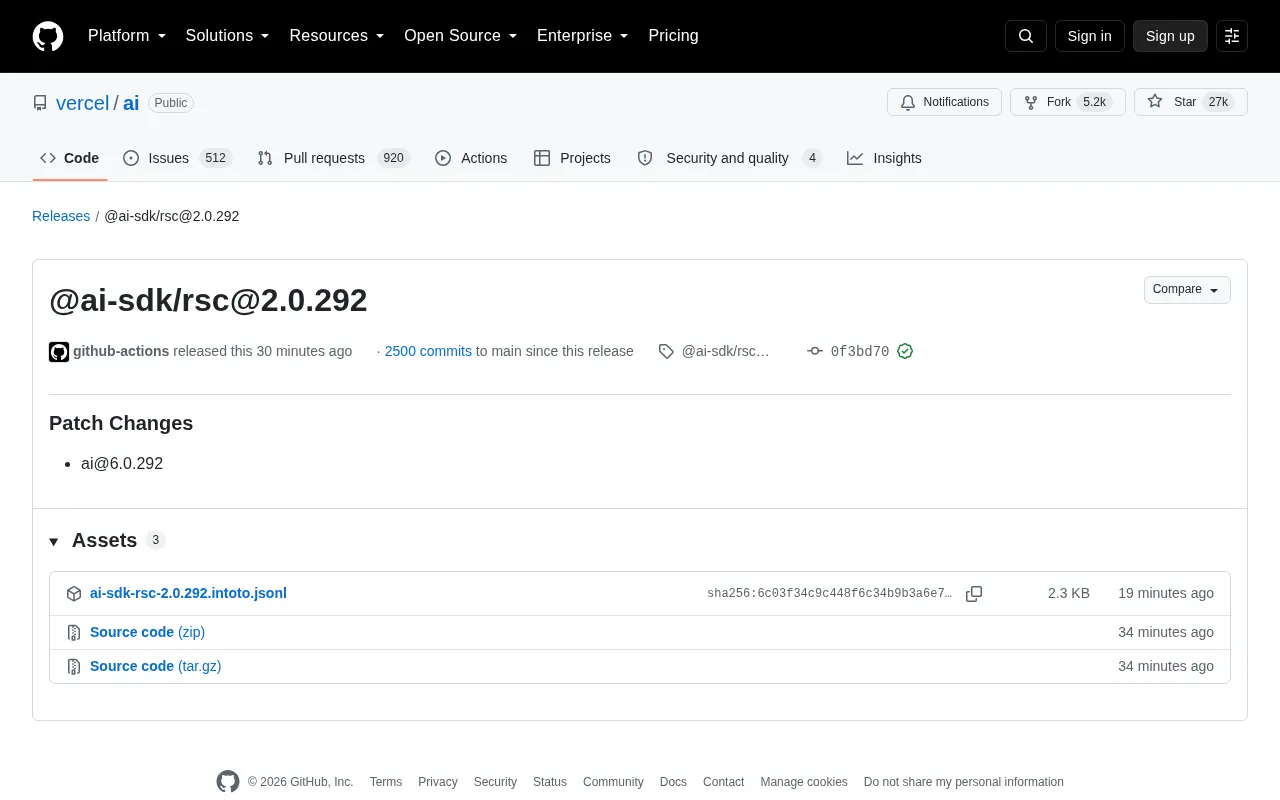
Vercel's AI SDK ecosystem continues its rapid iteration pace. The @ai-sdk/rsc package has recently released version 2.0.292, automatically published by GitHub Actions on September 25th, containing a single patch-level dependency update.
What's in This Update
According to the release notes, @ai-sdk/rsc@2.0.292 is a patch release whose primary change is syncing the core dependency ai@6.0.292. This means the release introduces no breaking changes and no major new features — it's a routine alignment update that follows the main ai package's version progression.
The version numbers reveal that @ai-sdk/rsc and the ai core package follow a unified versioning strategy, incrementing in sync. This approach is common in monorepo projects, ensuring cross-package compatibility and reducing the risk of conflicts from mixing mismatched versions.
Worth noting: this release is backed by a GitHub Verified Signature with GPG Key ID B5690EEEBB952194, guaranteeing the authenticity of the release source.
What Is @ai-sdk/rsc
@ai-sdk/rsc is the module within the Vercel AI SDK family specifically designed for React Server Components (RSC). It enables developers to stream AI-generated UI from server components, bridging large language model outputs with React's server-side rendering capabilities.
With this module, developers can build experiences like "AI-generated dynamic interfaces" and "streaming chat components" without manually managing the complex data flow from server to client. It is one of the key components through which Vercel is bringing the Generative UI concept to life.
React Server Components (RSC) is an architectural feature introduced in React 18 that allows components to render on the server and stream results to the client without executing JavaScript on the client side. Unlike traditional server-side rendering (SSR), RSC enables fine-grained, component-level streaming — a natural fit for AI scenarios where content is generated incrementally.
@ai-sdk/rscleverages this capability by mapping the token stream from large language models to incremental updates in the React component tree, allowing AI responses to be rendered and interacted with like ordinary React UI rather than plain text strings. This is the core technical foundation that distinguishes "Generative UI" from the traditional chat bubble model — the model no longer just outputs text, but directly drives structured UI components.
The Engineering Logic Behind High-Frequency Releases
This release offers a glimpse into the overall activity level of the Vercel AI SDK project: as of this version, the main branch has accumulated over 2,498 commits, with 27k GitHub stars and more than 5.2k forks. This density of patch releases reflects the team's adoption of an automated, small-step continuous release strategy.
For developers using the AI SDK, patch updates like this are generally safe to apply — they typically involve dependency alignment or minor fixes with minimal upgrade overhead. That said, in production environments it's still advisable to review the changelog and confirm whether the underlying ai core package version introduces any behavioral changes worth noting.
The Vercel AI SDK uses a typical monorepo architecture, managing dozens of sub-packages — including
ai,@ai-sdk/rsc, and@ai-sdk/openai— via pnpm workspaces. Under this architecture, synchronized versioning is a common strategy: regardless of whether a sub-package has substantive changes, all related packages are bumped to a new version whenever the main package releases. The benefit is that developers can directly infer compatibility between packages from version numbers alone, eliminating the mental overhead of "can package A v3 work with package B v2?" Changesets is a widely used tool in the JavaScript ecosystem for implementing this kind of release workflow, and combined with GitHub Actions, it fully automates the entire process of version bumping, changelog generation, and npm publishing.
Recommendations for Developers
If you're currently using @ai-sdk/rsc in your project, you can upgrade it to 2.0.292 via your package manager and simultaneously update ai to 6.0.292 to keep versions in sync. Since this is a patch update, no changes to your existing code should be necessary.
For teams focused on the Generative UI space, staying up to date with the AI SDK's version evolution helps you adopt new features and fixes as soon as they land. Consider incorporating it into your regular dependency review process.
(Note: This article is based on publicly available information from the official GitHub releases page. Refer to the official changelog for specific change details.)
Related articles

Free Unlimited Claude Code Solution: Agnes AI + CC Switch Setup Guide
No paid subscription needed — pair the free AI platform Agnes AI with the open-source tool CC Switch to provide a backend for Claude Code, enabling unlimited free calls to text, image, and video models. This guide covers the full setup, test results, and usage boundaries.

A Complete Zero-Cost Guide to Getting Started with Claude Code for Beginners in China
A beginner's guide to Claude Code for users in China: two installation methods (command line and IDE plugin), full configuration steps for replacing the official API with the free domestic LongCat model, and a hands-on demo of building a small tool with natural language, plus tips.

When the NSA Gets Involved: The AI Supply Chain Crisis Behind Open-Source CVEs and API Key Hijacking
Multiple open-source projects disclosed severe CVEs in one day, PHP flaws alarmed the FBI, and Railway and OpenCode were breached with API keys stolen. This article breaks down the vulnerability window, AI-accelerated exploitation, and the AI supply chain crisis behind the API key black market, with a developer defense checklist.