Vercel AI SDK Releases @ai-sdk/rsc@3.0.109 Patch Update
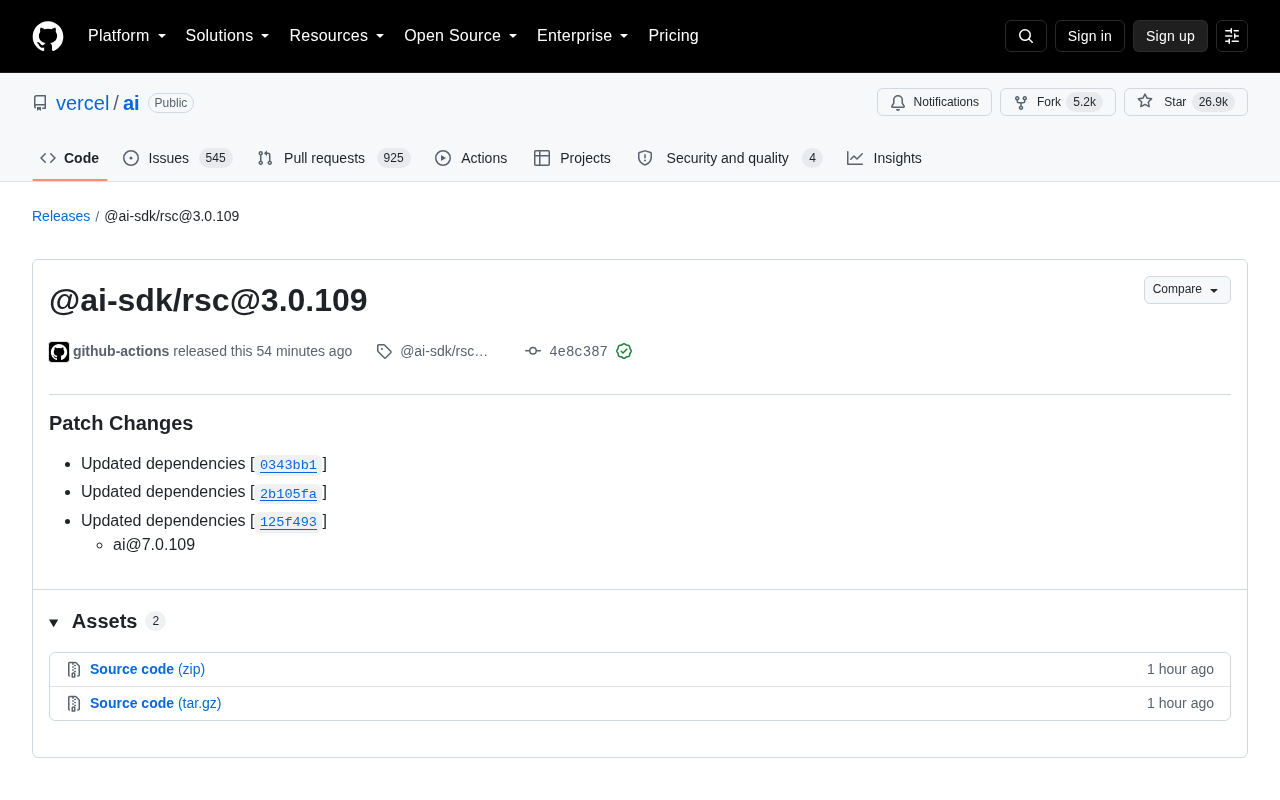
Vercel releases @ai-sdk/rsc@3.0.109 patch update, syncing with ai@7.0.109 — no new features or breaking changes.
Vercel AI SDK has released `@ai-sdk/rsc@3.0.109`, a routine patch update focused on dependency synchronization with no independent new features or breaking changes. Designed for React Server Components, `@ai-sdk/rsc` enables LLM streaming and generative UI in server-side rendering environments. This release follows the core `ai@7.0.109` package in Vercel's lockstep monorepo release strategy. The update is backward-compatible and low-risk, though developers are advised to review the `ai@7.0.109` changelog and run basic regression tests before deploying to production.
Version Overview
Vercel's AI SDK project has received another update with the release of @ai-sdk/rsc@3.0.109. This version was automatically built by GitHub Actions and signed with GitHub's verified signature, making it a patch-level iteration.
As a key component of the Vercel AI ecosystem, @ai-sdk/rsc is designed specifically for React Server Components (RSC) scenarios, helping developers more easily integrate LLM streaming responses and generative UI capabilities within server-side rendering environments. Vercel's ai repository has accumulated approximately 26,900 stars and 5.2k forks on GitHub, reflecting a highly active community.

React Server Components (RSC) is a new component paradigm introduced in React 18 that allows components to execute on the server and stream rendering results to the client, reducing client-side JavaScript bundle size and improving initial page load speed. @ai-sdk/rsc is purpose-built for this scenario: it encapsulates the streaming data processing logic required to call LLMs within an RSC environment, enabling developers to use APIs like streamUI to return AI-generated React component trees directly from server components — without manually managing SSE (Server-Sent Events) or WebSocket connections. The core advantage of this "generative UI" pattern is that AI output is no longer limited to plain text; it can be rendered directly as interactive UI fragments — such as stock cards or weather widgets — significantly enhancing the user experience of AI-powered applications.
What's in This Update
According to the release notes, 3.0.109 is a Patch Change, with its core content being a dependency sync update:
- Updated dependencies [
0343bb1] - Updated dependencies [
2b105fa] - Updated dependencies [
125f493] - Depends on
ai@7.0.109
The version numbers reveal that @ai-sdk/rsc maintains a synchronized x.x.109 release cadence with the core ai package. This means the update introduces no independent features of its own — it's a cascading upgrade driven by the underlying ai@7.0.109 iteration, ensuring version consistency and compatibility across all SDK modules.
What a Patch Update Means
Under the Semantic Versioning (SemVer) specification, a patch version typically represents backward-compatible bug fixes or dependency syncs, and introduces no breaking changes. For developers currently using the Vercel AI SDK, these types of updates are generally safe to adopt with minimal risk.
Also worth noting is Vercel AI SDK's high-frequency release cadence. The rapid, sequential version number increments reflect an engineering practice built on continuous integration and automated releases — every change to a core dependency triggers a cascading update across related packages. While this approach results in frequent version bumps, it ensures that all sub-packages within the ecosystem remain aligned at all times, reducing runtime issues caused by version mismatches.
Semantic Versioning (SemVer) is a widely adopted versioning specification formatted as MAJOR.MINOR.PATCH. A MAJOR version change indicates incompatible API changes; a MINOR version change indicates new backward-compatible features; and a PATCH version change includes only backward-compatible bug fixes or dependency syncs. The Vercel AI SDK is currently on MAJOR version 7.x, meaning there were breaking changes when upgrading from 6.x to 7.x, while patch iterations within 7.x are relatively safe. It's also worth noting that Vercel's monorepo strategy keeps @ai-sdk/rsc in full version lockstep with the core ai package (both at x.x.109). This "lockstep release" model is common in large SDK ecosystems and helps prevent implicit dependency conflicts caused by version drift between sub-packages.
Recommendations for Developers
If your project depends on @ai-sdk/rsc, it's recommended to review the changelog for the associated ai@7.0.109 package before upgrading, to confirm whether the underlying dependency changes are relevant to your use case. For production environments, it's still advisable to follow standard version-pinning and staged rollout practices — even patch updates should go through basic regression testing.
Since the release notes themselves contain limited information — listing only the commit hashes of dependency updates — understanding exactly what was fixed requires tracing the change history in the main ai package. Developers can compare differences between tags on the GitHub Releases page to get a more complete picture of what changed.
Related articles

Free Unlimited Claude Code Solution: Agnes AI + CC Switch Setup Guide
No paid subscription needed — pair the free AI platform Agnes AI with the open-source tool CC Switch to provide a backend for Claude Code, enabling unlimited free calls to text, image, and video models. This guide covers the full setup, test results, and usage boundaries.

A Complete Zero-Cost Guide to Getting Started with Claude Code for Beginners in China
A beginner's guide to Claude Code for users in China: two installation methods (command line and IDE plugin), full configuration steps for replacing the official API with the free domestic LongCat model, and a hands-on demo of building a small tool with natural language, plus tips.

When the NSA Gets Involved: The AI Supply Chain Crisis Behind Open-Source CVEs and API Key Hijacking
Multiple open-source projects disclosed severe CVEs in one day, PHP flaws alarmed the FBI, and Railway and OpenCode were breached with API keys stolen. This article breaks down the vulnerability window, AI-accelerated exploitation, and the AI supply chain crisis behind the API key black market, with a developer defense checklist.