Vercel AI SDK Releases @ai-sdk/rsc@3.0.127 Patch Update
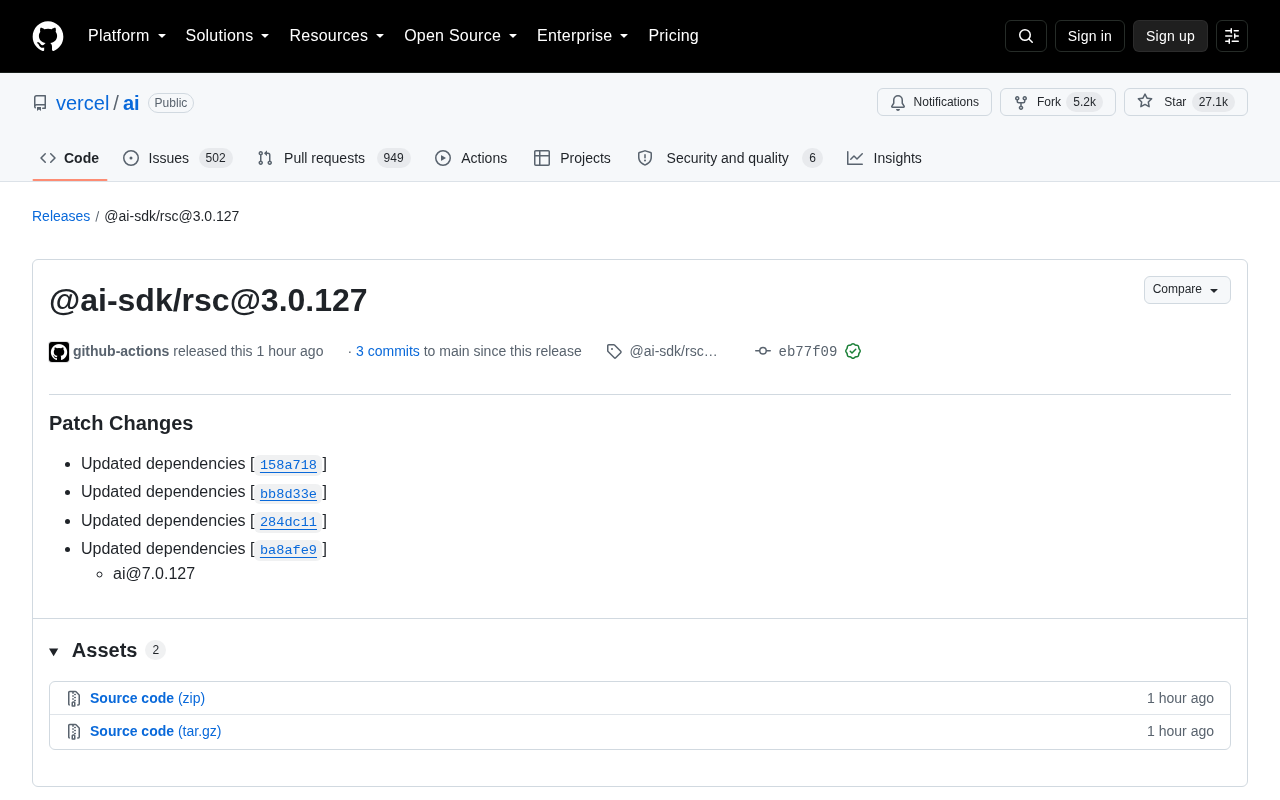
Vercel AI SDK releases @ai-sdk/rsc@3.0.127 patch with dependency sync and no breaking changes.
Vercel AI SDK has released `@ai-sdk/rsc@3.0.127` as a patch update, alongside the core package `ai@7.0.127`. The update involves dependency synchronization with no breaking changes, making it safe for developers to upgrade. `@ai-sdk/rsc` is a sub-package designed for React Server Components, enabling Generative UI by streaming LLM output directly into interactive React components. The synchronized versioning reflects Vercel's monorepo release strategy, ensuring toolchain consistency and compatibility.
Vercel's AI SDK has released a new version: @ai-sdk/rsc@3.0.127. This is a patch-level release focused primarily on dependency synchronization, accompanied by a corresponding update to the core package ai@7.0.127.
What's in This Update
According to the GitHub Release page, this version was published on October 1st and falls under the Patch Changes category. The release notes are concise — the core change is a series of dependency updates, referencing commit hashes 158a718, bb8d33e, 284dc11, and ba8afe9.
Patch releases typically contain no breaking changes. They focus on bug fixes, dependency syncing, and internal optimizations. For developers using this SDK, these updates are generally safe to apply without modifying any existing code.
What Is @ai-sdk/rsc
@ai-sdk/rsc is a sub-package within the Vercel AI SDK ecosystem. The "RSC" stands for React Server Components. This module helps developers build AI-powered interactive interfaces within a server component architecture — for example, streaming large language model output directly into rendered UI components, enabling what's known as "Generative UI."
In React's server-side rendering paradigm, this package lets developers bind structured model responses to React components, creating a more fluid and native-feeling frontend experience for AI applications. It works in tandem with the core ai package, which provides foundational capabilities such as unified model invocation, streaming, and tool calling.
React Server Components (RSC) is a new component model introduced in React 18 that allows components to execute and render on the server. The rendered output is transmitted to the client in a serialized format, reducing client-side JavaScript bundle size and enabling direct access to server-side resources like databases and file systems. Unlike traditional server-side rendering (SSR), RSC doesn't send HTML strings to the client — instead, it sends a special React component tree description that allows the client to perform partial updates without a full page refresh. In AI contexts, RSC is especially powerful: large language model outputs can be mapped directly to React components on the server, with no additional parsing logic needed on the client. This tight integration between model output and UI rendering is also the technical foundation of the "Generative UI" concept — where AI returns not just text, but interactive interface elements.
The Significance of Synchronized Dependency Upgrades
The fact that @ai-sdk/rsc@3.0.127 and ai@7.0.127 share aligned version numbers reflects Vercel AI SDK's monorepo unified release strategy. When the core package receives internal updates, dependent sub-packages are simultaneously published with corresponding patches, ensuring version consistency and compatibility across the entire toolchain.
This release cadence is particularly important for a rapidly evolving AI toolkit. As underlying model capabilities and APIs change frequently, the SDK must keep pace — and small, frequent patch releases allow the team to steadily advance features and fixes without disrupting developers.
A monorepo (single repository) is a development strategy that centralizes multiple related packages or projects in one codebase. It's widely adopted by Google, Meta, and many open-source projects. Vercel AI SDK uses this architecture so that sub-packages like
ai,@ai-sdk/rsc, and@ai-sdk/reactshare the same build, test, and release pipelines. Under Semantic Versioning (SemVer), a version number consists of Major, Minor, and Patch segments — a patch increment signals only backward-compatible bug fixes. Uniformly incrementing patch versions across a monorepo is common practice, ensuring peer dependency relationships between packages stay aligned and preventing runtime conflicts caused by version mismatches.
Recommendations for Developers
If you're using Vercel AI SDK to build Generative UI or AI chat interfaces, it's worth keeping an eye on patch updates like this one and upgrading promptly to benefit from the latest bug fixes and dependency security improvements. Since this is a patch release, the upgrade risk is low.
Keep in mind that the release notes themselves are fairly sparse. For a full picture of what changed, you'll want to dig into the referenced commit history or the complete changelog for ai@7.0.127 to understand exactly what each update addresses. Overall, this is a routine part of Vercel AI SDK's ongoing maintenance cycle.
Related articles

Free Unlimited Claude Code Solution: Agnes AI + CC Switch Setup Guide
No paid subscription needed — pair the free AI platform Agnes AI with the open-source tool CC Switch to provide a backend for Claude Code, enabling unlimited free calls to text, image, and video models. This guide covers the full setup, test results, and usage boundaries.

A Complete Zero-Cost Guide to Getting Started with Claude Code for Beginners in China
A beginner's guide to Claude Code for users in China: two installation methods (command line and IDE plugin), full configuration steps for replacing the official API with the free domestic LongCat model, and a hands-on demo of building a small tool with natural language, plus tips.

When the NSA Gets Involved: The AI Supply Chain Crisis Behind Open-Source CVEs and API Key Hijacking
Multiple open-source projects disclosed severe CVEs in one day, PHP flaws alarmed the FBI, and Railway and OpenCode were breached with API keys stolen. This article breaks down the vulnerability window, AI-accelerated exploitation, and the AI supply chain crisis behind the API key black market, with a developer defense checklist.