Vercel AI SDK Releases @ai-sdk/valibot 3.0.49 Patch Update

Vercel AI SDK ships @ai-sdk/valibot 3.0.49, syncing provider-utils to 5.0.49 with no breaking changes.
`@ai-sdk/valibot@3.0.49` is a routine maintenance patch in the Vercel AI SDK ecosystem, auto-published via GitHub Actions with an official GPG signature. The update introduces no new features — its core change is bumping the internal dependency `@ai-sdk/provider-utils` to `5.0.49` to maintain version consistency across the monorepo. The package itself bridges the lightweight Valibot schema validation library into AI SDK tool calling and structured output workflows, making it ideal for edge runtime environments. Projects using multiple `@ai-sdk/*` packages should upgrade together during their next maintenance window.
Vercel's AI SDK ecosystem has shipped a patch release of @ai-sdk/valibot@3.0.49, automatically published via GitHub Actions and verified with an official GitHub signature. This is a maintenance update focused on dependency synchronization, with no new features introduced.
What's Changed
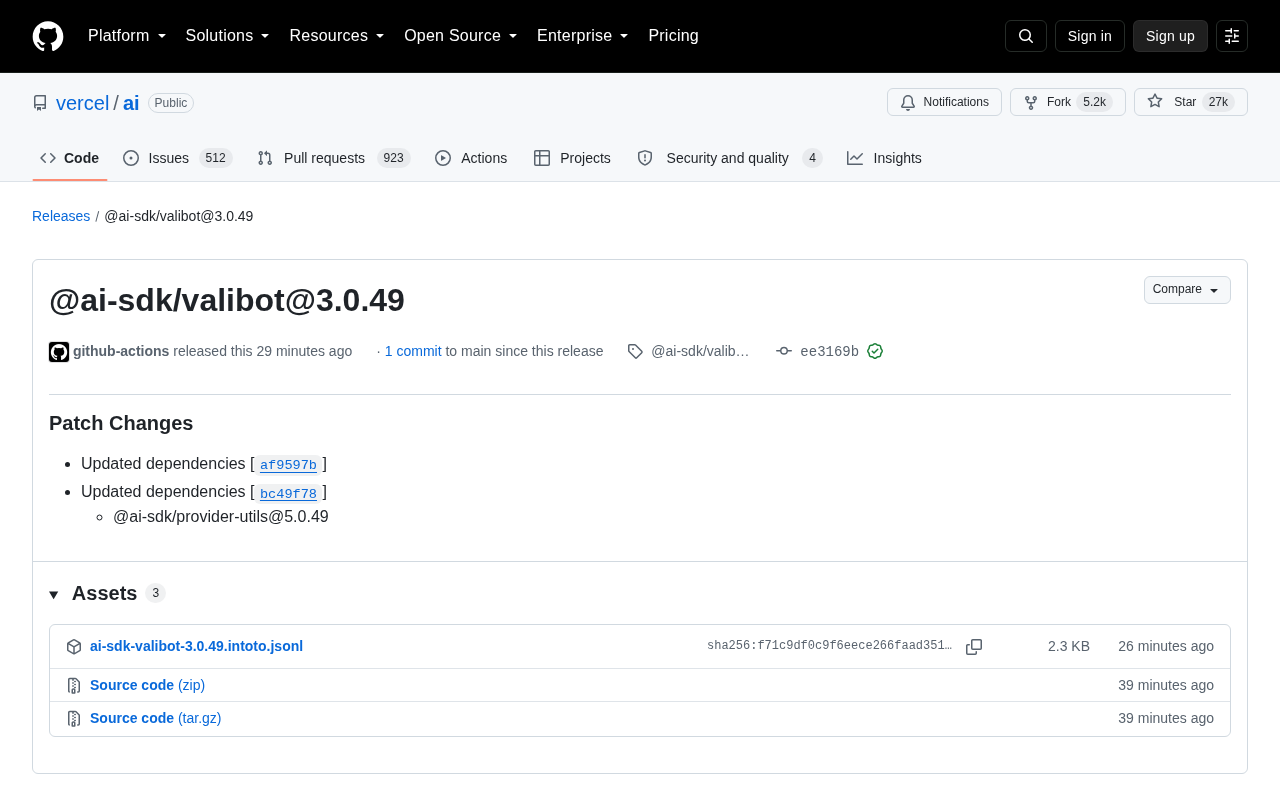
According to the GitHub Releases page, version 3.0.49 is a Patch-level release. The core changes are:
- Updated internal dependencies (commits
af9597bandbc49f78) - Bumped
@ai-sdk/provider-utilsto5.0.49
The release was published on September 25th, pointing to a single commit on the main branch, and includes a GPG signature (Key ID: B5690EEEBB952194) to ensure trustworthy provenance. For the vast majority of users, this type of patch update introduces no breaking changes and is safe to upgrade.
What Is @ai-sdk/valibot
@ai-sdk/valibot is an adapter package within the Vercel AI SDK family. Its purpose is to integrate Valibot — a lightweight schema validation library — into the AI SDK's tool calling and structured output workflows.
When building AI applications, developers often need large language models to return data conforming to a specific structure (such as JSON schema-constrained objects), or to define tools that the model can invoke (tool calling). The traditional approach relies heavily on Zod, whereas Valibot is known for its significantly smaller bundle size and modular design — making it particularly well-suited for bundle-size-sensitive environments like Edge Runtimes and frontend applications. @ai-sdk/valibot serves as the bridge layer for exactly these use cases.
Both Valibot and Zod are TypeScript runtime validation libraries, but they differ in design philosophy. Zod uses a chained API to build schema objects, with all validation logic concentrated in a single class instance — meaning even minimal usage pulls in the full codebase. Valibot, by contrast, adopts a functional, tree-composable design where each validation rule is an independent function, enabling full tree-shaking support. In extreme cases, this can reduce bundle size by over 98%. For AI applications deployed on cold-start-sensitive environments like Cloudflare Workers or Vercel Edge Functions, this difference has a direct impact on request latency. @ai-sdk/valibot provides a unified schema adapter interface, allowing developers to switch to Valibot simply by replacing the schema definition layer — without changing any of their AI SDK tool calling code.
What This Patch Actually Means
The version number tells a clear story: @ai-sdk/valibot and @ai-sdk/provider-utils are tightly coupled. Vercel AI SDK uses a monorepo structure, where multiple sub-packages are versioned in sync with core utility library updates. This commonly results in "core library changes, peripheral packages follow with a patch" release patterns.
The primary value of 3.0.49 lies in maintaining dependency chain consistency. If your project uses multiple @ai-sdk/* sub-packages simultaneously, keeping versions aligned helps avoid potential type mismatches or runtime behavior discrepancies. For teams managing dependencies with a lockfile, this can be bundled into a regular maintenance window.
Monorepo (single repository) is a common code organization strategy for large JavaScript/TypeScript projects, co-locating multiple logically independent but interdependent packages in one repository. Vercel AI SDK implements this architecture using pnpm workspaces with Turborepo, where all sub-packages (such as @ai-sdk/openai, @ai-sdk/anthropic, @ai-sdk/valibot, etc.) share the same build pipeline and release scripts. When the core utility package @ai-sdk/provider-utils changes, all dependent peripheral packages automatically trigger a "pass-through release" — even if their own code hasn't changed, their version numbers still increment. This mechanism ensures that version relationships between packages on the npm registry remain clear at all times, preventing users from running into version matrix mismatches.
Recommendations for Developers
For projects currently using Vercel AI SDK, here are a few things to keep in mind:
- Patch updates are safe to apply: Patch versions follow semantic versioning and should contain no breaking changes
- Upgrade related packages together: Since
provider-utilshas been bumped to5.0.49, it's advisable to update all related@ai-sdk/*packages at the same time - Trust the signature: This release carries a GitHub Verified signature, ensuring trustworthy provenance — no additional supply chain security concerns needed
As an active open-source project with 27k stars and 5.2k forks, Vercel AI SDK's high-frequency minor releases reflect its rapid development pace. These seemingly unremarkable patch updates are precisely what keeps the entire SDK ecosystem running stably.
Related articles

RAG Getting Started in Practice: From Principles to Building an Enterprise Knowledge Base
Bilibili RAG course highlights: from retrieval-augmented generation principles, document chunking and vectorization, to five accuracy factors and enterprise knowledge base boundaries, with fine-tuning vs RAG selection advice.

AI Model Selection Guide: DeepSeek vs. Qwen3 in Practice
How should AI developers choose models? Based on a Bilibili tutorial, this article breaks down the Function Calling differences between DeepSeek V3 and R1, Qwen3's programmatic thinking mode switching and agent capabilities, and outlines a multi-model learning path and practical selection logic.

Anchoring, Loss Aversion, and Nudges: 5 Psychological Tactics Retailers Use to Make You Spend
Behavioral economics reveals how retailers use anchoring, framing, loss aversion, and nudge theory to manipulate your spending decisions. This article breaks down 5 common psychological tactics and offers counterstrategies like slowing down decisions and setting your own anchors to see through the pricing design behind discounts.