Vercel AI SDK Releases @ai-sdk/vue 4.0.127 Patch Update
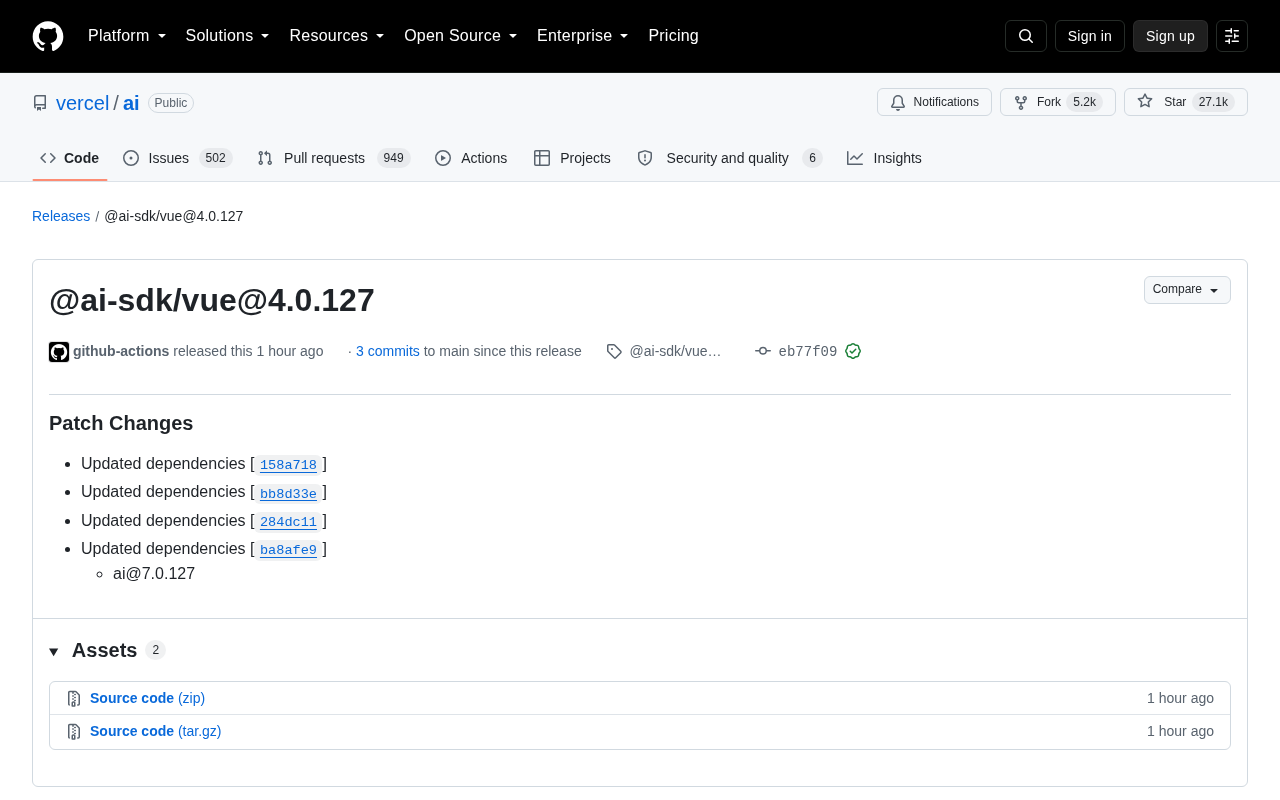
Vercel AI SDK releases @ai-sdk/vue 4.0.127, a maintenance patch syncing to ai@7.0.127.
`@ai-sdk/vue@4.0.127` is a routine maintenance release from Vercel AI SDK, classified as a patch update with no new APIs or behavioral changes. Its primary change is aligning with the `ai@7.0.127` core package. This follows the typical monorepo SDK pattern where framework adapters (Vue, React, Svelte, etc.) stay in version sync with the core library. Being a SemVer patch release, it is backward-compatible and generally safe to upgrade, though developers should ensure all `@ai-sdk/*` sub-packages are kept on consistent versions to avoid mismatches.
Vercel's AI SDK has released @ai-sdk/vue@4.0.127. This is a patch-level update focused primarily on dependency synchronization. For developers building AI applications with the Vue framework, minor releases like this may not introduce new features, but they play an important role in maintaining the stability of the engineering pipeline.
Update Overview
According to the GitHub Releases page, @ai-sdk/vue@4.0.127 falls under Patch Changes. The core change involves updating several internal dependencies — associated commits include 158a718, bb8d33e, 284dc11, and ba8afe9 — along with a synchronized upgrade to the ai@7.0.127 core package.
This means the release does not introduce any new developer-facing APIs or behavioral changes. Instead, it aligns the package version with the underlying ai core library's iteration. This pattern is very common in monorepo-structured SDK projects — framework adapter packages (such as the React, Vue, and Svelte variants) are published in sync with the core library to ensure consistent version numbers and clear dependency relationships.
About Vercel AI SDK
Vercel AI SDK is one of the most widely adopted AI application development libraries in the frontend ecosystem. It has accumulated over 27,000 stars and 5,200 forks on GitHub, with a highly active community. The SDK provides developers with a unified interface for integrating with leading LLM providers such as OpenAI and Anthropic, and wraps common capabilities including streaming responses, tool calling, and state management.
@ai-sdk/vue is the adapter package specifically designed for the Vue framework, enabling Vue developers to leverage AI capabilities in a framework-idiomatic way — such as using the Composition API — for use cases like building chat interfaces and handling streaming text output. As Vercel continues to maintain Vue, Svelte, and other adapter packages alongside the React version, it is steadily strengthening the AI SDK's cross-framework coverage.
Vercel AI SDK uses a monorepo architecture to manage its codebase. The repository contains the core ai package alongside multiple framework adapter packages (@ai-sdk/react, @ai-sdk/vue, @ai-sdk/svelte, etc.). The core package handles communication protocols with LLM providers, streaming data parsing, and tool-calling logic, while the framework adapters wrap these capabilities into hooks or composable functions that align with each framework's conventions. For example, composables like useChat and useCompletion provided by @ai-sdk/vue all rely on the core ai package under the hood. This layered design means the core logic only needs to be maintained once, while developers across different frameworks can access AI capabilities with a "native" experience. During version iterations, each adapter package simply follows the core package in a unified release.
What Developers Should Do
For projects currently using this SDK, patch updates like this are generally safe to apply. Under Semantic Versioning (SemVer), an increment in the patch version number indicates backward-compatible bug fixes and dependency maintenance — it should not break existing code.
Developers are advised to verify that the ai core package is also updated to 7.0.127 when upgrading, to avoid version mismatches between the Vue adapter and the core library. If your project uses multiple @ai-sdk/* sub-packages, keeping them all on the same version is standard practice for minimizing potential compatibility risks.
Semantic Versioning (SemVer) defines a three-part version structure: MAJOR.MINOR.PATCH. A MAJOR version change indicates breaking API changes that require active code adaptation; a MINOR version change means new backward-compatible features have been added; a PATCH version change contains only backward-compatible bug fixes or internal maintenance. This convention has become the de facto standard for package version management in the npm ecosystem. In package.json, the ^ prefix allows automatic updates to the latest version within the same MAJOR (including MINOR and PATCH), so projects locked with ^4.0.x will automatically pick up patch updates like this when running npm update, without any manual version changes.
Summary
@ai-sdk/vue@4.0.127 is a typical maintenance release with no new feature highlights, but it reflects Vercel AI SDK's high-frequency iteration cadence and commitment to healthy dependency management. For teams focused on the Vue + AI stack, staying current with these updates helps ensure access to the latest underlying fixes and stability improvements. Since the specific fix details of this update require further review of each associated dependency's changelog, production projects that are sensitive to changes are advised to validate in a test environment before deploying to production.
Related articles

Free Unlimited Claude Code Solution: Agnes AI + CC Switch Setup Guide
No paid subscription needed — pair the free AI platform Agnes AI with the open-source tool CC Switch to provide a backend for Claude Code, enabling unlimited free calls to text, image, and video models. This guide covers the full setup, test results, and usage boundaries.

A Complete Zero-Cost Guide to Getting Started with Claude Code for Beginners in China
A beginner's guide to Claude Code for users in China: two installation methods (command line and IDE plugin), full configuration steps for replacing the official API with the free domestic LongCat model, and a hands-on demo of building a small tool with natural language, plus tips.

When the NSA Gets Involved: The AI Supply Chain Crisis Behind Open-Source CVEs and API Key Hijacking
Multiple open-source projects disclosed severe CVEs in one day, PHP flaws alarmed the FBI, and Railway and OpenCode were breached with API keys stolen. This article breaks down the vulnerability window, AI-accelerated exploitation, and the AI supply chain crisis behind the API key black market, with a developer defense checklist.