Vercel AI SDK Releases @ai-sdk/workflow 2.0.45 Patch Update

Vercel AI SDK releases @ai-sdk/workflow 2.0.45, syncing the core ai package to 7.0.114.
`@ai-sdk/workflow@2.0.45` is a routine maintenance patch in the Vercel AI SDK ecosystem, primarily syncing the core `ai` dependency to `7.0.114` with no breaking changes or major new features. Published automatically via GitHub Actions with GPG signature verification, this release is a typical byproduct of the monorepo's coordinated release mechanism. With ~26.9k stars, Vercel AI SDK maintains a high-frequency, small-increment release cadence. For developers using this toolchain, the patch is generally safe to apply after testing, and syncing to `ai@7.0.114` is recommended for full dependency alignment.
Vercel's open-source ai project recently published @ai-sdk/workflow@2.0.45 via its GitHub Actions automation pipeline. This is a patch-level release focused primarily on dependency updates. While the changes are minor, it's worth understanding the maintenance cadence and ecosystem evolution behind it — especially for developers building AI applications on this toolchain.
What's in This Release
According to the release notes, @ai-sdk/workflow@2.0.45 is classified as a Patch Change, consisting mainly of upstream dependency synchronization. It includes two commits (b5679a7 and ca31b89) and bumps the core ai dependency to 7.0.114.
Patch-level updates typically mean no breaking changes and no significant new features — just bug fixes, dependency syncs, or minor optimizations. For production projects, these updates are generally safe to apply with relatively low risk.
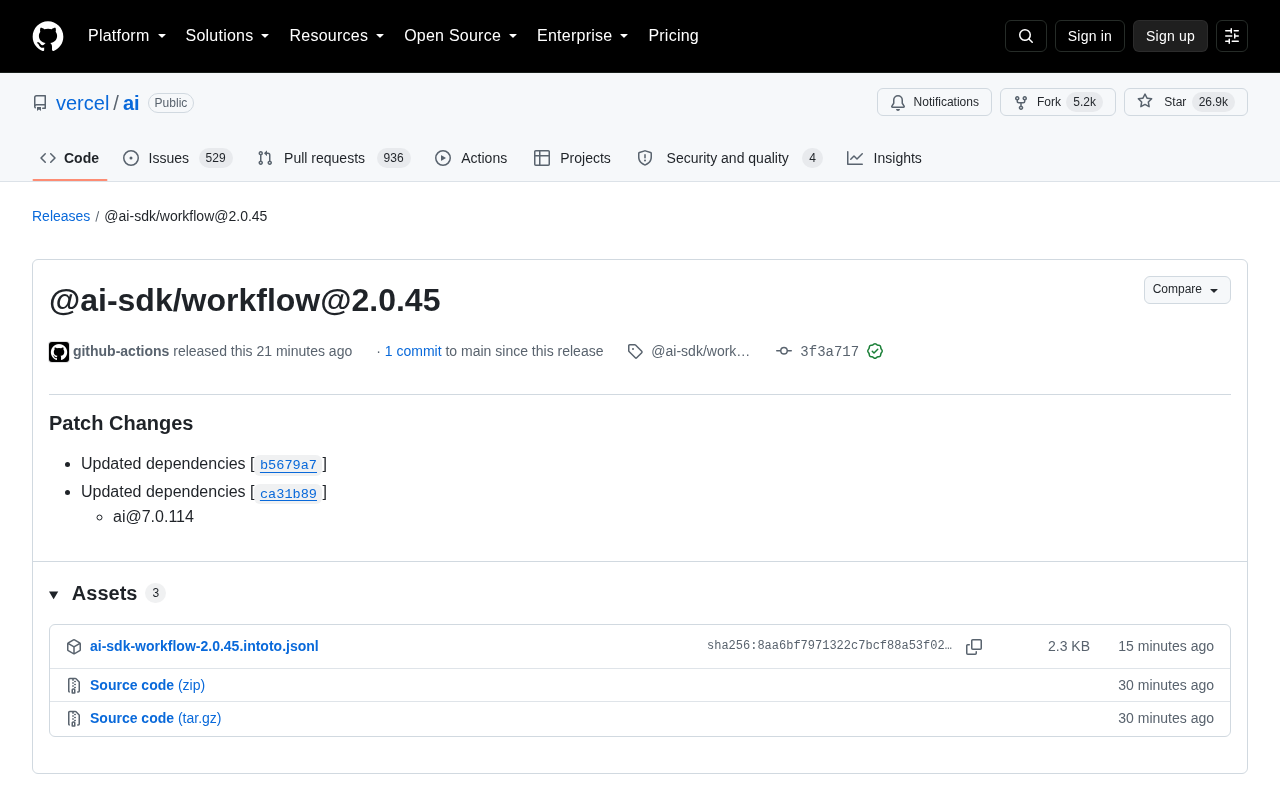
This release was automatically published by the github-actions bot on September 24 at 18:52 UTC. The commit was verified with GitHub's official GPG signature (GPG key ID: B5690EEEBB952194) under vigilant mode, ensuring the trustworthiness of the release source.
Semantic Versioning (SemVer) is the de facto versioning convention in the npm ecosystem, following the MAJOR.MINOR.PATCH format. A PATCH bump (like this one, from 2.0.44 to 2.0.45) is reserved for backward-compatible bug fixes or dependency syncs that shouldn't break any existing consumer code. MINOR bumps introduce new backward-compatible features, while MAJOR bumps signal breaking changes. This is why many teams use the ^ prefix in package.json (e.g., ^2.0.0) to automatically accept MINOR and PATCH updates within the same MAJOR version, while treating MAJOR upgrades as requiring manual migration assessment. Understanding SemVer helps developers quickly gauge the risk level of any given patch release.
About the Vercel AI SDK Ecosystem
Vercel's ai repository is one of the most widely followed open-source projects in the frontend and full-stack AI development space, with approximately 26.9k stars and 5.2k forks — a testament to its active community and broad influence.
The SDK is designed to give developers a unified toolkit for building AI-powered applications, covering capabilities like streaming output, multi-model support, and tool calling. @ai-sdk/workflow is a sub-package focused on workflow orchestration, helping developers organize multi-step AI task logic in a structured way.
Why Dependency Upgrades Matter
This update syncs the underlying ai package to 7.0.114. In the modern JavaScript/TypeScript ecosystem, packages are tightly interdependent — keeping core dependencies aligned helps avoid compatibility issues caused by version mismatches.
For large projects managed as a monorepo (which is exactly how Vercel AI SDK is structured), it's common practice for sub-packages to release patch versions in lockstep with the core package. This high-frequency, small-increment iteration style ensures modules stay in sync while giving downstream users timely access to fixes and optimizations.
Vercel AI SDK is built around the principle of model-agnosticism — providing a unified abstraction layer that supports major LLM providers including OpenAI, Anthropic, Google Gemini, and Mistral, among others. Developers don't need to write separate adapter code for each provider's API; switching models is as simple as changing the provider configuration. One of the SDK's core capabilities is streaming output built on the Web Streams API, enabling AI responses to render token-by-token in real time on the frontend rather than waiting for a complete response — a critical UX feature for chat-based applications. The SDK also includes standardized support for Tool Calling (Function Calling), allowing AI models to invoke developer-defined functions in a structured way, which is foundational for building AI agents.
Vercel AI SDK uses a monorepo architecture managed with pnpm workspaces, housing dozens of sub-packages — including @ai-sdk/openai, @ai-sdk/anthropic, and @ai-sdk/workflow — in a single repository. The key advantage of this approach is that interface changes in the core ai package can be immediately tested and published across all sub-packages, significantly reducing cross-package version drift. The tradeoff, however, is that even when a sub-package has no meaningful changes of its own, it still needs to publish a patch version whenever the core package releases a new version — to update the version range declarations in peerDependencies or dependencies. This is exactly the context for @ai-sdk/workflow@2.0.45: it's a product of the monorepo's coordinated release mechanism, not the result of any independent change in the sub-package itself.
What Should Developers Do?
For projects currently using @ai-sdk/workflow, you can decide whether to upgrade based on your situation:
- Projects with locked dependencies: Validate in a test environment first, then upgrade after confirming compatibility with your existing
aiversion. - Projects that want the latest features: It's recommended to also upgrade to the matching
ai@7.0.114to ensure full dependency alignment. - Stability-first production environments: Patch updates are generally safe, but it's still worth monitoring the changelog and observing runtime behavior after the upgrade.
Since the release notes don't detail which specific bugs were fixed or what behavioral changes were made, developers who need more context should review the actual contents of commits b5679a7 and ca31b89, as well as the full changelog for ai@7.0.114.
Summary
@ai-sdk/workflow@2.0.45 is a typical maintenance patch release, with its core purpose being to sync the upstream dependency to ai@7.0.114. It doesn't introduce significant feature changes, but it does reflect the Vercel AI SDK team's high-frequency iteration and dependency maintenance cadence — which is a positive signal for developers relying on this ecosystem. Keeping an eye on these updates helps you stay ahead of the toolchain's evolution.
Related articles

Qwen 4 First Test Leaks: Performance Rivals Opus 5.5, DeepSeek V4 Series Surfaces
Early Qwen 4 test outputs leak, with front-end generation said to rival Opus 5.5; DeepSeek V4 Mini, Flash, and Pro names appear in a code repo; Ant Group's Ling-3.1-flash surfaces too. Here's the latest on model tiering and on-device lightweight models.

OpenCode Makes DeepSeek V4.1 Flash Free, AI Daily Roundup
AI daily roundup: OpenCode makes DeepSeek V4.1 Flash free, StepFun Step5 Preview and Ling 3.1 Flash open-sourced, Grok Voice 3.0 tops speech leaderboard, Matrix Game 4.0 open-sourced, and the EU opens its first AI Act enforcement probe into OpenAI and Anthropic.

DeepSeek V4.1 Flash 1017 Released: Reasoning and Coding Upgrades, Search and Fetch API Now Available
DeepSeek releases V4.1 Flash 1017 with major gains in reasoning, coding, and agentic tasks, plus web search and fetch APIs at 5 yuan per 1,000 requests. Tencent Hunyuan open-sources High Memory 2.0, Perplexity open-sources multimodal decision models, and MOFCOM seeks comments on AI export catalog.