Vercel AI SDK Releases @ai-sdk/xai 5.0.11: Upgraded Image Model Capability Advertising

xAI SDK 5.0.11 patch refines image model capability advertising to reduce multi-model integration risks.
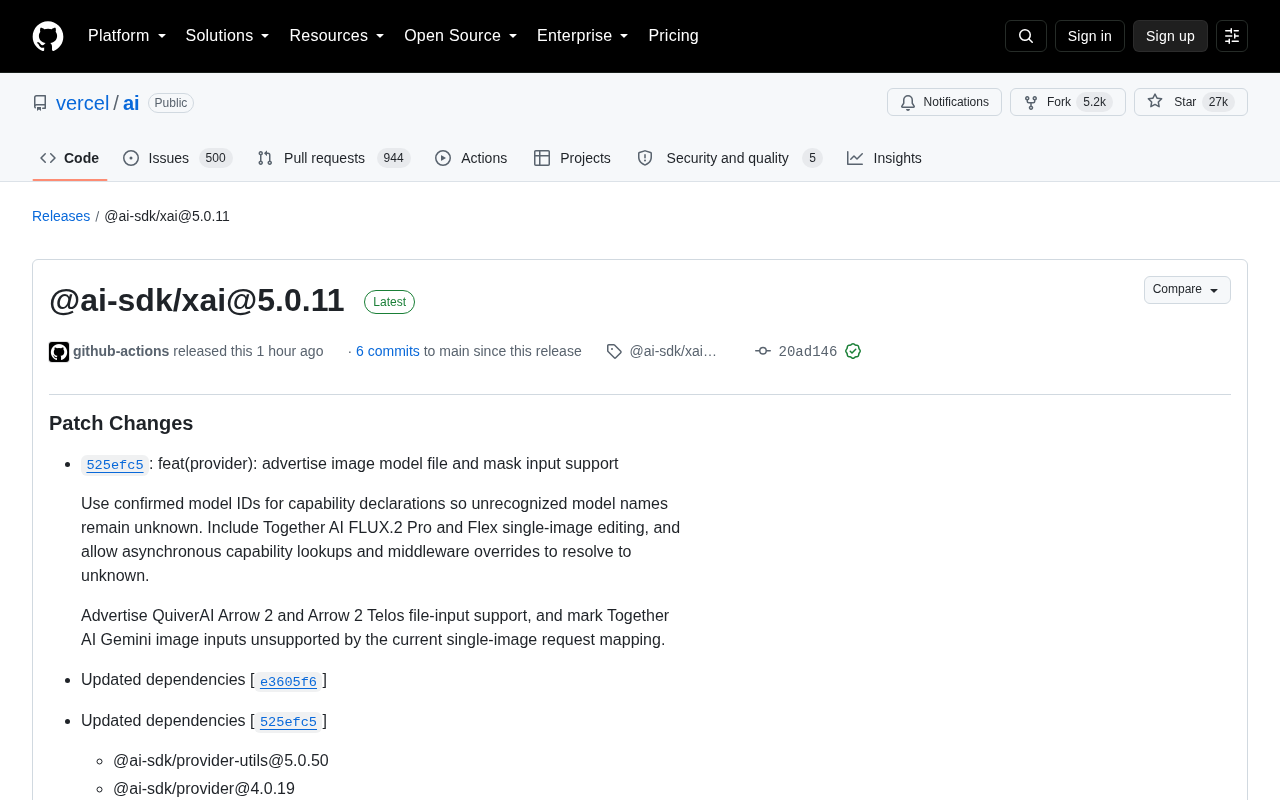
`@ai-sdk/xai@5.0.11` is a patch update focused on image model capability advertising. The core change: the SDK now only declares specific capabilities for confirmed model IDs, keeping unrecognized models in an `unknown` state to avoid incorrect assumptions. Together AI FLUX.2 Pro/Flex gain single-image editing declarations, QuiverAI Arrow 2 series gain file-input declarations, and Together AI Gemini image input is marked unsupported for single-image request mapping. Async lookups and middleware overrides now resolve to `unknown` when results are indeterminate. Companion packages `@ai-sdk/provider-utils@5.0.50` and `@ai-sdk/provider@4.0.19` also updated.
The xAI provider in the Vercel AI SDK ecosystem has received a patch-level update. @ai-sdk/xai@5.0.11 was recently published automatically via GitHub Actions. While the version bump may seem minor, the changes focus on the capability advertising mechanism for image models — and they have real implications for developers working with multi-model image generation and editing.
What's New
This is a Patch release. The core change centers on the capability advertising (advertise) mechanism for file input and mask input support in image models. In short, the SDK now more accurately declares which input types each image model supports, preventing developers from making incorrect assumptions when calling a model with unknown capabilities.
The key change is concentrated in a single commit (525efc5), titled feat(provider): advertise image model file and mask input support — indicating this isn't just a bug fix, but also introduces new capability declaration features.
Why Capability Advertising Matters
In a multi-model abstraction layer, different image models vary significantly in the inputs they support: some handle single-image editing, some accept mask inputs, and others don't support file input at all. If the SDK misrepresents these capabilities, developers may encounter runtime errors or hold incorrect expectations about unsupported features.
This update adopts a strategy of "advertising capabilities only for confirmed model IDs," meaning only explicitly recognized models will have specific capabilities declared, while unrecognized model names will remain in an unknown state. This conservative design avoids making potentially incorrect capability assumptions about unfamiliar models — a more robust engineering trade-off.
Asynchronous Capability Lookups and Middleware Overrides
The update also allows asynchronous capability lookups and middleware overrides to resolve to unknown. This provides clearer semantic boundaries for advanced use cases involving dynamically registered models or capability extension through middleware — when the system cannot determine a model's capabilities, it now explicitly returns "unknown" rather than an incorrect default value.
"Capability advertising" is a design pattern in multi-model abstraction layers: before actually calling a model, the SDK exposes metadata to the caller about which input/output types that model supports. This is similar to an interface contract — callers can query "does this model support mask input?" before runtime, and decide whether to take a specific code path, rather than blindly making a request and handling errors afterward.
In image processing scenarios, mask input is typically used for inpainting — modifying only the masked region of an image. File input refers to passing an existing image into the model as a reference or editing target. Not all image models support both capabilities. If the SDK incorrectly advertises unsupported capabilities, feature branches built by developers will silently fail or throw hard-to-trace runtime errors in production.
In Vercel AI SDK's architecture, middleware overrides allow developers to inject custom middleware to intercept or extend the SDK's model-calling behavior, including modifying capability declaration results. For example, if an enterprise has deployed a private image model that isn't registered in the SDK's known model list, but the developer knows it supports mask input, they can override its capability declaration to "supported" via middleware. This update explicitly specifies that when a middleware override or asynchronous lookup cannot determine the result, it should resolve to unknown rather than falling back to some default value. The value of this change: unknown is an explicit semantic state that callers can use to trigger graceful degradation, whereas an incorrect default (such as defaulting to "supported") would mask the real situation and lead to hard-to-reproduce errors.
Specific Models Affected
This update refines capability declarations for several third-party image models:
- Together AI FLUX.2 Pro and Flex: Added single-image editing support declaration.
- QuiverAI Arrow 2 and Arrow 2 Telos: Added file-input support declaration.
- Together AI Gemini image input: Marked as unsupported for the current single-image request mapping.
These declaration adjustments reflect the AI SDK's ongoing effort to track the capability boundaries of various image model providers, helping developers make correct calling decisions in multi-provider environments.
Dependency Updates
Related dependency packages were also updated alongside this release:
@ai-sdk/provider-utils@5.0.50@ai-sdk/provider@4.0.19
For teams building multimodal applications with the Vercel AI SDK, it's worth monitoring version consistency across these underlying packages to avoid behavioral discrepancies caused by mismatched capability declaration logic.
What This Means for Developers
Vercel AI SDK currently has over 27k stars and 5.2k forks on GitHub, making it a critical piece of infrastructure for building AI applications in the JavaScript/TypeScript ecosystem. Patch updates like this — seemingly small — actually reflect the SDK's maturity at the multi-provider abstraction layer: through precise capability advertising, they reduce the cognitive overhead of cross-model development.
If you're integrating image generation or editing features in your project — especially when connecting to multiple services like Together AI and QuiverAI simultaneously — upgrading to 5.0.11 will give you more accurate capability feedback and fewer runtime surprises. For users working only with text generation, the impact of this update is minimal, but keeping dependencies up to date remains good practice.
Related articles

Cursor AI Programming in Practice: Build a Student Management System from Scratch in 30 Minutes
A Bilibili creator demonstrates Cursor AI programming: generating a student management system in 30 minutes with natural language. Details on Agent mode, Claude selection, prompt techniques, and thresholds.

Top 20 AI Coding Tools Ranking: From Rock-Solid to Lackluster, a Scored Matrix
Bilibili creator releases top 20 AI coding tools ranking, tiered T0–T4 from rock-solid to lackluster, with Claude Code and Codex tied at T0. This article details the scoring dimensions (capability, reliability, robustness, durability, cost, domestic availability) and tool performances to help developers choose the right AI coding assistant.

Vibe Coding Systematic Tutorial: Master AI-Assisted Programming from Zero
A three-month Vibe Coding tutorial from a Bilibili creator covering Codex, ClaudeCode, and Cursor, from core logic to commercial project practice for beginners.