Vercel AI SDK Update: xAI Integration Adds Grok 4.7 Model Support

Vercel AI SDK's xAI package v2.0.95 adds Grok 4.7 model ID support with no breaking changes.
Vercel AI SDK's `@ai-sdk/xai` integration package released patch version `2.0.95`, with the core change being support for xAI's Grok 4.7 model ID. As a patch-level update following SemVer conventions, it introduces no breaking changes and is safe to upgrade. The SDK's unified abstraction means developers only need to update the model ID string to switch models — no changes to streaming, tool calling, or business logic required. The repo has ~26.9k stars and releases are verified via GitHub Actions, reflecting mature engineering practices. Note that SDK support is just the entry point; actual model availability depends on your xAI account permissions.
Overview
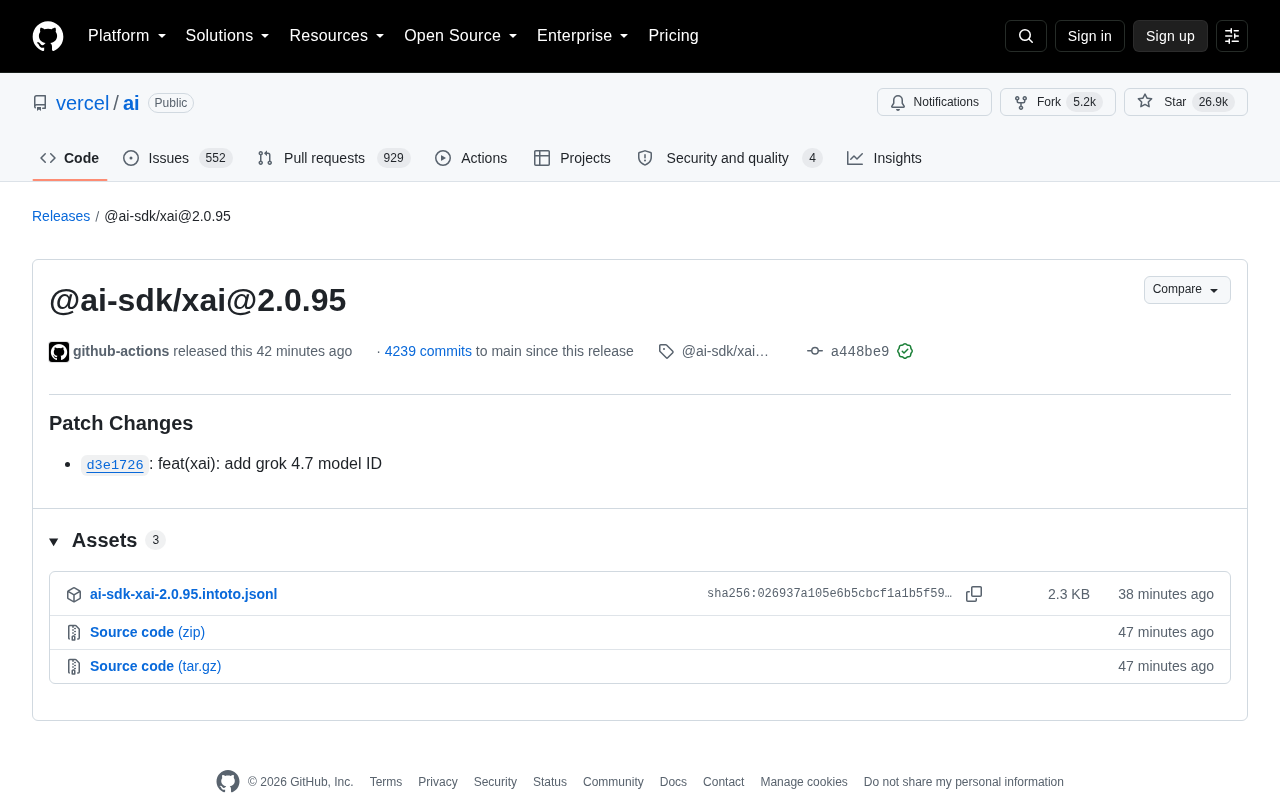
Vercel's officially maintained AI SDK recently released version @ai-sdk/xai@2.0.95. According to the GitHub Release page, this is a patch-level update with one core change: adding support for the Grok 4.7 model ID in the xAI integration package.
For developers building applications with the Vercel AI SDK, this means you can call xAI's latest Grok 4.7 model directly — without switching to a third-party library.
What's in This Update
The changelog for this release is tightly scoped. The corresponding commit (d3e1726) is clearly labeled:
feat(xai): add grok 4.7 model ID
This is a classic model adapter update — when a model provider (in this case, xAI) releases a new model version, the SDK needs to register the corresponding model identifier in its type definitions and call logic before developers can use it through the unified interface.
As a patch version like 2.0.95, it follows Semantic Versioning (SemVer) conventions: no breaking changes, only backward-compatible additions. This means the risk of upgrading existing projects to this version is extremely low.
A note on SemVer: Semantic Versioning defines version numbers in the
MAJOR.MINOR.PATCHformat. A Patch increment specifically refers to backward-compatible bug fixes or minor capability additions — no breaking API changes allowed. Minor versions introduce backward-compatible new features, while Major versions signal incompatible breaking changes. The increment in the last digit of2.0.95indicates this is the lowest-risk update category. If your project's dependency tree contains a version constraint like^2.0.x, npm/yarn will automatically pull this update duringinstall— no manual intervention needed.
Why This Kind of Update Matters
Keeping the Toolchain in Sync with Model Releases
AI models iterate at a rapid pace, and keeping up at the application layer depends heavily on timely SDK-level support. Vercel AI SDK maintains separate integration packages for each model provider (e.g., @ai-sdk/xai, @ai-sdk/openai, etc.), allowing developers to import only what they need and get first-day support when new models launch.
The addition of the Grok 4.7 model ID is a direct result of this mechanism. Developers can try out the new model in their applications without manually constructing API requests or handling low-level differences.
The Value of a Unified Abstraction
The design philosophy behind Vercel AI SDK is to provide a unified calling abstraction across different large model providers. Under this architecture, the cost of switching or adding models is dramatically reduced — in most cases, you only need to change the model ID string. This update makes Grok 4.7 one of the options you can simply drop in.
In terms of project popularity, Vercel's ai repository has accumulated approximately 26.9k stars and 5.2k forks. The release was published and verified via GitHub Actions automation, reflecting its active maintenance and engineering maturity.
How the unified abstraction works in practice: Vercel AI SDK's unified abstraction is implemented through core functions like
generateTextandstreamText— whether the underlying call goes to OpenAI, Anthropic, or xAI, developers face the same API signature. For model switching specifically, you simply replacexai('grok-3')withxai('grok-4.7'); all streaming output handling, Tool Calling, structured output, and other logic remain untouched. This "provider-agnostic" design also reduces vendor lock-in risk: if you ever need to switch providers, the migration cost is confined to the model ID and API key configuration layer — no business logic rewrite required.
How Developers Can Use It
For projects already using the xAI integration, upgrading follows the standard npm package process. Once you update @ai-sdk/xai to 2.0.95, you can reference the Grok 4.7 model ID when creating model instances.
Note that SDK-level model ID support is just the first step in the call chain. Whether Grok 4.7 is actually usable still depends on your account permissions and model availability on the xAI side.
Summary
This is a typical toolchain adapter update in response to model iteration. The change itself is small, but it reflects Vercel AI SDK's maintenance strategy of keeping pace with model providers. For teams relying on the Grok model family, upgrading promptly will let you take advantage of the new model's capabilities right away.
Since the original release notes are limited in detail, refer to xAI's official documentation for specifics on Grok 4.7's capabilities, performance characteristics, and pricing.
Related articles

Bilibili's Hit Dify Tutorial: A Practical Guide to Building 20+ AI Apps from Scratch
A distilled guide to Bilibili's top-rated Dify tutorial: Windows + Docker deployment, MySQL connection, five app types, model integration strategy, and publishing.

Agent Skills Beginner's Guide: From Concepts to Multi-Agent Collaboration in Practice
A comprehensive guide to Agent Skills: core concepts, components, the importance of Description, standardization, beginner learning paths, and multi-agent collaboration.

One Neuron Detects Both Cats and Cars? We Reproduced It and Found a New Explanation
The cat-car neuron reinterpreted: researcher Cammarata argues it distinguishes pointy from round, not cats from cars. We reproduced the experiment and found the new explanation holds on most inputs—but cars are the exception. The interpretability debate continues on language models.