Vercel AI SDK Vue 3.0.277 Release Update Analysis
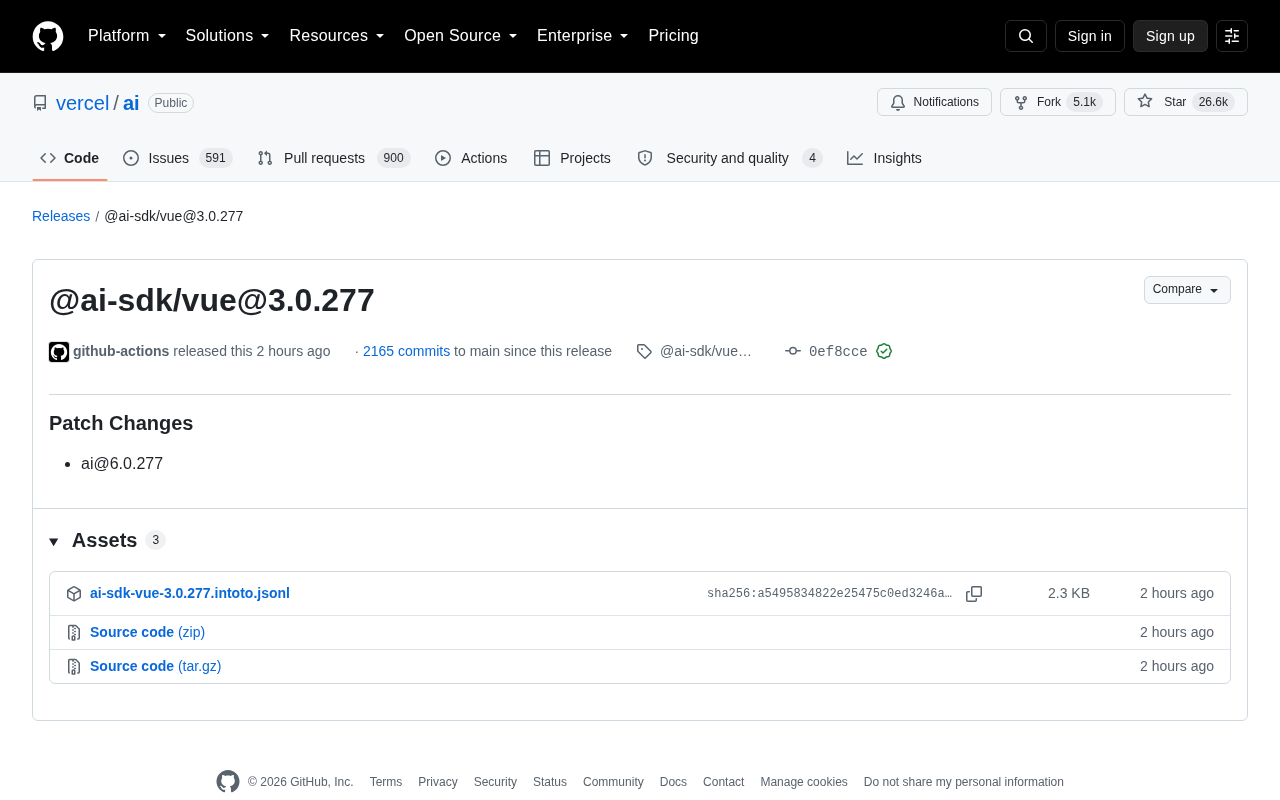
Analysis of @ai-sdk/vue 3.0.277 patch update covering architecture, versioning, and dependency management.
Vercel released @ai-sdk/vue@3.0.277, a patch update syncing with core package ai@6.0.277. This article examines the SDK's modular architecture separating core logic from framework adapters, explains streaming responses and Tool Calling mechanisms for Vue developers, and provides practical guidance on semantic versioning, supply chain security via GPG signatures, and dependency management strategies for high-frequency AI toolchain iterations.
Introduction: The Continuous Evolution of AI SDK
Vercel's AI SDK is one of the most popular toolchains for frontend and full-stack developers building AI applications today. Recently, the official team released @ai-sdk/vue@3.0.277, a patch version update that synchronizes changes from the core package ai@6.0.277. While this is just a minor iteration, understanding the significance behind every update is crucial for teams relying on this SDK to build production-grade AI applications.
GitHub data shows that the Vercel AI project has garnered over 26.6k Stars and 5.1k Forks, with more than 2,165 commits — a testament to its activity and influence in the open-source community. This article examines this release, outlines the positioning of the AI SDK, explores the value of the Vue integration, and discusses how developers should approach such high-frequency iterations.
Core Architecture of @ai-sdk/vue
Modular Design Philosophy
The Vercel AI SDK follows a modular design where core logic is encapsulated in the ai main package, with dedicated adapter layers for different frontend frameworks. @ai-sdk/vue is the official binding package for the Vue.js ecosystem, alongside integration solutions for React (@ai-sdk/react), Svelte, and other frameworks.
This architectural approach centralizes core capabilities — model invocation, streaming response handling, Tool Calling, and more — within the ai package, while the framework adapter layers are only responsible for exposing these capabilities in ways that align with each framework's idiomatic patterns (such as Vue's Composition API and reactivity system). That's why the Patch Changes for @ai-sdk/vue@3.0.277 explicitly notes the linked update to ai@6.0.277.
Background: AI SDK and Frontend Framework Integration
Traditionally, integrating AI capabilities into frontend applications required developers to handle WebSocket connections, streaming data parsing, error retries, and other low-level logic themselves — a costly and error-prone process. The Vercel AI SDK changed this landscape by wrapping API calls to mainstream large language models from OpenAI, Anthropic (Claude), Google (Gemini), and others into a unified interface, while providing composables or hooks tailored to each framework's ecosystem conventions for React, Vue, Svelte, and more. This "unified core logic + separated framework adapters" design ensures a consistent cross-framework experience while fully respecting each framework's development paradigm, making it the go-to toolchain for full-stack developers rapidly building AI applications.
Value for Vue Developers
For Vue developers, @ai-sdk/vue provides composable functions like useChat and useCompletion, enabling developers to integrate chatbot, text completion, streaming output, and other AI features into Vue applications with minimal effort. The SDK abstracts away the complexity of interacting with multiple model providers such as OpenAI and Anthropic, delivering a unified interface.
Streaming Responses and Server-Sent Events
One of the AI SDK's core capabilities is support for streaming responses — where model-generated text is returned incrementally rather than waiting for the entire output to complete. This is critical for user experience, as users can see the AI's "thinking process" in real time, significantly reducing wait anxiety. Technically, streaming responses are typically implemented via Server-Sent Events (SSE) or HTTP Chunked Transfer Encoding. The AI SDK encapsulates these underlying protocols so developers only need to call functions like useChat, and the SDK automatically handles data stream reception, parsing, and state updates, reflecting changes to the UI in real time through Vue's reactivity system.
Tool Calling Mechanism
Tool Calling (or Function Calling) is an important extension capability of large language models, allowing models to proactively invoke external APIs or functions during conversations to retrieve real-time data (such as weather queries or database lookups). Developers need to declare available tool schemas (parameter types, descriptions, etc.) in the request. When the model determines a tool call is needed, it returns a structured tool invocation instruction, and the frontend or backend executes the tool and feeds the result back to the model for continued generation. The AI SDK simplifies this workflow by providing unified tool registration and invocation interfaces, abstracting away differences in tool calling protocols between model providers (such as OpenAI's functions vs. Anthropic's tools), enabling developers to implement complex AI Agent interactions in a consistent manner.
Detailed Version Update Analysis
Semantic Versioning Explained
According to Semantic Versioning (SemVer), 3.0.277 is a Patch-level update, typically representing backward-compatible bug fixes or dependency synchronization without introducing Breaking Changes. The release notes for this version are fairly concise, only noting the dependency update to ai@6.0.277, indicating that the changes primarily propagate downstream from the core package.
This version was automatically published via GitHub Actions and verified with GitHub's verified signature (GPG Key ID: B5690EEEBB952194). This reflects Vercel's commitment to software supply chain security — using automated pipelines and signature verification to ensure the trustworthiness of published artifacts and guard against supply chain attacks.
Semantic Versioning and Patch Updates
Semantic Versioning (SemVer) is a foundational convention in modern software engineering, with version numbers formatted as MAJOR.MINOR.PATCH. MAJOR changes represent incompatible API modifications (Breaking Changes), MINOR represents backward-compatible feature additions, and PATCH represents backward-compatible bug fixes. This 3.0.277 release falls under PATCH level, which theoretically should only contain bug fixes or dependency synchronization without breaking existing code. However, in rapidly iterating AI toolchains, even Patch versions may introduce subtle behavioral changes (such as model response handling optimizations or timeout strategy adjustments), so thorough testing before upgrading in production environments is still recommended.
Software Supply Chain Security and Signature Verification
In recent years, the npm ecosystem has experienced multiple supply chain attack incidents (such as malicious package poisoning and account hijacking), and the security of open-source software has received increasing attention. GPG (GNU Privacy Guard) signature verification is an important mechanism for ensuring the integrity of published artifacts — publishers sign packages with their private key, and users or CI systems can verify the signature with the corresponding public key to ensure the package hasn't been tampered with and genuinely comes from the claimed publisher. The Vercel AI SDK publishes automatically through GitHub Actions with GPG signatures (Key ID: B5690EEEBB952194), meaning every version goes through a verifiable build process that reduces supply chain attack risk. Developers can verify the signature status of their dependencies using tools like npm audit signatures.
The Engineering Philosophy of High-Frequency Iteration
From the version number 3.0.277, it's clear that the AI SDK follows an extremely high-frequency release cadence. This "small steps, fast pace" approach is particularly common in the rapidly evolving AI space — new models and new capabilities (such as structured output, multimodal support) emerge constantly, and the SDK needs to keep up quickly to stay competitive.
For developers, this is both an advantage and a challenge. The advantage is having access to the latest features immediately; the challenge lies in establishing solid dependency management strategies to avoid blindly upgrading and introducing insufficiently validated changes into production. Teams are advised to use version locking (lockfiles) combined with periodic upgrade reviews to balance the tension between "early adoption" and "stability."
Practical Recommendations for Developers
Dependency Management Strategy
Given such high-frequency releases, developers should consider the following strategies:
- Lock exact versions: Use exact version numbers in
package.jsonor rely on lockfiles to ensure consistency across team members and CI/CD environments - Focus on core package changes: Since framework adapter layers typically update in tandem with the core
aipackage, attention should be focused on theaimain package's Changelog to understand the actual functional and behavioral changes - Regression testing: Even for Patch versions, running comprehensive regression tests after upgrading is recommended, especially for critical paths involving streaming responses and tool calling
Lockfiles and Dependency Consistency
In modern frontend engineering, lockfiles (such as package-lock.json, pnpm-lock.yaml) record the exact versions and hashes of the dependency tree, ensuring that team members, CI/CD environments, and production deployments use identical dependency versions. Even if package.json uses range version specifiers like ^ (compatible updates) or ~ (patch updates), the lockfile pins specific versions, preventing the classic "works on my machine" problem caused by automatic dependency updates. For high-frequency iteration libraries like the AI SDK, version locking is especially important — developers should proactively and periodically review and upgrade dependencies rather than letting package managers automatically select the latest version, striking a balance between stability and new features.
Technology Selection Considerations
For teams in the process of technology selection, the Vercel AI SDK's activity level, multi-framework support, and standardized release process are all significant advantages. Its equal treatment of Vue, React, and other mainstream frameworks is particularly notable, allowing teams across different tech stacks to benefit from the same unified AI capability abstraction. This holds considerable appeal in today's diverse frontend ecosystem.
Conclusion
While @ai-sdk/vue@3.0.277 is just a routine patch update, it reflects the engineering maturity of the Vercel AI SDK as a well-established open-source project: modular architecture, automated publishing, signature verification, and high-frequency iteration. For AI application developers, continuously tracking the evolution of such toolchains and establishing dependency management and upgrade strategies suited to your team is essential for navigating the rapidly changing AI technology landscape with confidence.
Key Takeaways
Related articles

Qwen3.8 Flash Deep Dive: How Hybrid Architecture Is Reshaping LLM Efficiency
Qwen releases Qwen3.8 Flash Next with hybrid architecture: 125B params, only 6B activated per token, at 1/9 training cost. Deep dive into Gated DeltaNet, million-token context, and agent workflows.
GPT-6 Astra: AI Competition Shifts from Best Answers to Workflow Ownership
AI competition is shifting from single-answer quality to workflow ownership. Explore how GPT-6 Astra signals AI's evolution from passive responder to autonomous workflow agent.
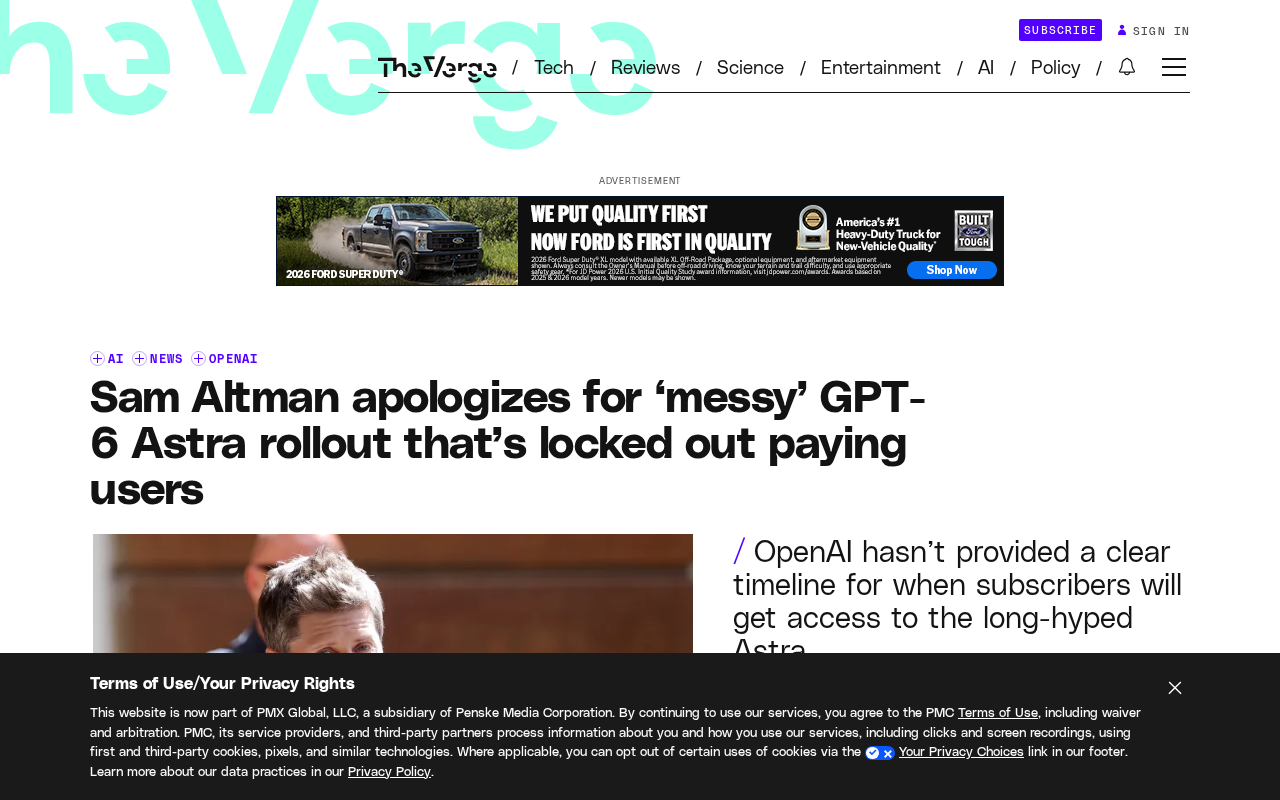
GPT-6 Astra Launch Goes Wrong: Paying Users Locked Out, Altman Issues Emergency Apology
OpenAI's GPT-6 Astra launch backfired as paying subscribers were locked out of the flagship model. CEO Sam Altman apologized within hours, calling it a messy rollout. A deep dive into what went wrong.