Vercel AI SDK Workflow 2.0.60 Released: Fixes Tool Approval Resumption Bug

Vercel AI SDK 2.0.60 patches a critical bug where denied tool results were lost during workflow resumption.
Vercel AI SDK's `@ai-sdk/workflow` package ships version 2.0.60, fixing a bug where persisted tool call denial results weren't correctly reused when a workflow resumed after a human approval pause — potentially causing denied operations to be re-triggered. This directly impacts Human-in-the-loop designs and poses notable risks in security-sensitive domains like finance and DevOps. The update includes no breaking changes; projects using tool approval are encouraged to upgrade promptly.
Vercel's AI SDK recently shipped @ai-sdk/[email protected], a patch release focused on stability. The core change targets a bug in the workflow module's tool approval mechanism. While the version bump is minor, this fix is critically important for AI Agent workflows that rely on human approval steps.
What's in This Update
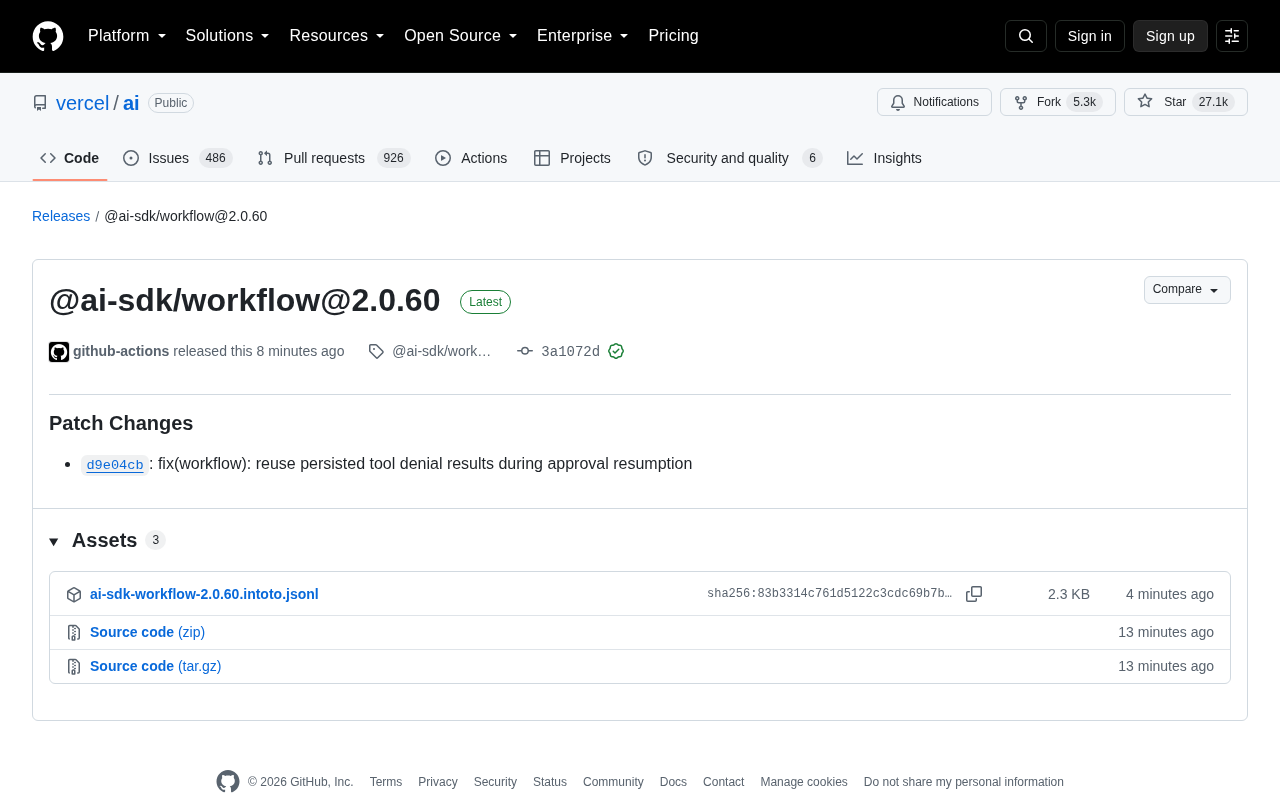
According to the GitHub Releases notes, 2.0.60 is a Patch Change containing a single fix:
fix(workflow): reuse persisted tool denial results during approval resumption(commit hashd9e04cb)
In plain terms: when an AI workflow pauses for human approval and is later resumed, the system should correctly reuse previously persisted "tool call denied" results — rather than losing them or re-triggering the approval request.
This release was automatically published via GitHub Actions and carries a verified GPG signature (Key ID: B5690EEEBB952194), ensuring the authenticity of the release artifact.
Why Tool Approval Resumption Matters
When building production-grade AI Agent applications, Human-in-the-loop (HITL) is a common and necessary design pattern. When an AI attempts to invoke high-risk tools — such as deleting data, initiating payments, or calling external APIs — the system typically pauses execution and waits for a human to approve or deny the action.
This means workflows must support pause and resume capabilities. Workflow state must be persisted so execution can continue from the breakpoint after the user makes a decision. This fix addresses exactly that scenario: when resuming execution, previously "denied" tool call results must be correctly read and reused.
Without this fix, a workflow resuming from a paused state might incorrectly re-execute a denied operation, or lose the denial state entirely, leading to unintended tool invocations. In security-sensitive domains like finance and DevOps, the impact of such a bug is far from trivial.
Workflow state persistence typically relies on a database or key-value store (such as Redis or PostgreSQL) to snapshot execution context — including the current step, completed tool call results, and intermediate states. In distributed systems, "pausing" a workflow often means the process exits and memory is freed; resumption requires fully reconstructing the execution context from the persistence layer. This is precisely where the "denial result reuse" issue becomes subtle: if the deserialization logic fails to recognize "denied" as a terminal state, the system may treat it as "pending," re-triggering an approval request or directly executing the tool call. Such bugs are notoriously hard to reproduce in integration tests and typically only surface in real asynchronous production flows.
About Vercel AI SDK
Vercel's ai repository is a widely adopted open-source AI development toolkit, with over 27.1k stars and 5.3k forks on GitHub. The SDK provides a unified interface for integrating various large language models, and abstracts common capabilities like streaming output, tool calling, and agent orchestration — helping developers ship AI-powered applications faster.
The @ai-sdk/workflow sub-package focuses on workflow orchestration, enabling developers to organize multi-step AI tasks into controlled, resumable pipelines. Tool approval, state persistence, and checkpoint-based resumption are among its core features — and what differentiates it from simple single-turn LLM calls.
The orchestration model in @ai-sdk/workflow closely mirrors the design philosophy of dedicated workflow engines like Temporal and Inngest. The core idea is to model an AI Agent's execution as a deterministically replayable sequence of steps. Each step's inputs and outputs are recorded; when a workflow resumes from a breakpoint, completed step results are read directly from the log rather than re-executed, ensuring idempotency. The tool approval mechanism is built on this model: the step waiting for human input is modeled as a step requiring an external event to complete. Once an approval or denial is written to the persistence layer, it becomes an immutable historical record. This fix ensures that the "denied" result — a special terminal outcome — is correctly recognized and handled by the replay logic.
Upgrade Recommendation
As a patch release, 2.0.60 contains no breaking changes and carries minimal upgrade risk. If your project uses @ai-sdk/workflow with tool approval flows, upgrading promptly is recommended to avoid potential state reuse issues:
npm install @ai-sdk/[email protected]
For users not yet leveraging the human approval feature, the impact of this update is limited and you can upgrade at your normal cadence. Overall, this is a low-risk, high-value stability fix that reflects Vercel AI SDK's continued investment in production-grade reliability.
Related articles

Apple HomeView Hands-On Review: Is the $300 Smart Home Hub Worth It?
Apple HomeView hands-on: a $300 smart home hub with facial recognition for quick account switching, but no App Store or voice recognition. Is the wall-mounted version worth it? Should you buy the first generation?

Meta Muse Wonder Launch: What It Means for Meta's Return to the Frontier AI Race
Meta releases Muse Wonder and WonderFull, benchmarks reach the frontier, community feedback is polarized. An in-depth look at Meta's return to the frontier AI race, its personal agent strategy, and Zuckerberg's different path.

Apple Home Smart Home Lineup Leaked: LG and Schneider Team Up, UWB Door Lock on Board
Apple Home ecosystem gains new LG and Schneider devices: UWB smart lock with proximity unlock, 2.5K dual-camera doorbell, privacy indoor camera, and AirPods-like seamless pairing.