Vercel Connect Opens MCP Events Beta: Let Agents Subscribe to Webhook Events

Vercel Connect opens the MCP Events beta, enabling Agents to subscribe to webhook events and complete the MCP ecosystem's passive awareness capability.
Vercel Connect enters the MCP Events public beta, letting applications and Agents subscribe to webhook events from MCP-compatible servers, moving from passively waiting for user triggers to actively responding to remote state changes. Connect acts as an event subscription manager, handling subscription creation, automatic renewal, webhook source verification, and authenticated event forwarding. The subscription API introduces ttlMs lifetimes and idempotencyKey values for safe retries, while delivery-side experimental_verifyMcpEvent prevents forged events. Connect can also package event discovery and subscription interfaces as Agent tools, lowering token usage and compute costs in event-driven workflows. All APIs currently carry the experimental_ prefix, and ecosystem growth depends on MCP providers implementing event push.
From Passive Invocation to Active Subscription: Vercel Connect Fills a Key Gap in the MCP Ecosystem
Vercel Connect has officially entered the public beta phase of MCP Events, allowing developers to have their applications and Agents subscribe to webhook events from MCP-compatible servers. This means Agents no longer have to passively wait for user triggers — they can now respond to state changes in remote services.
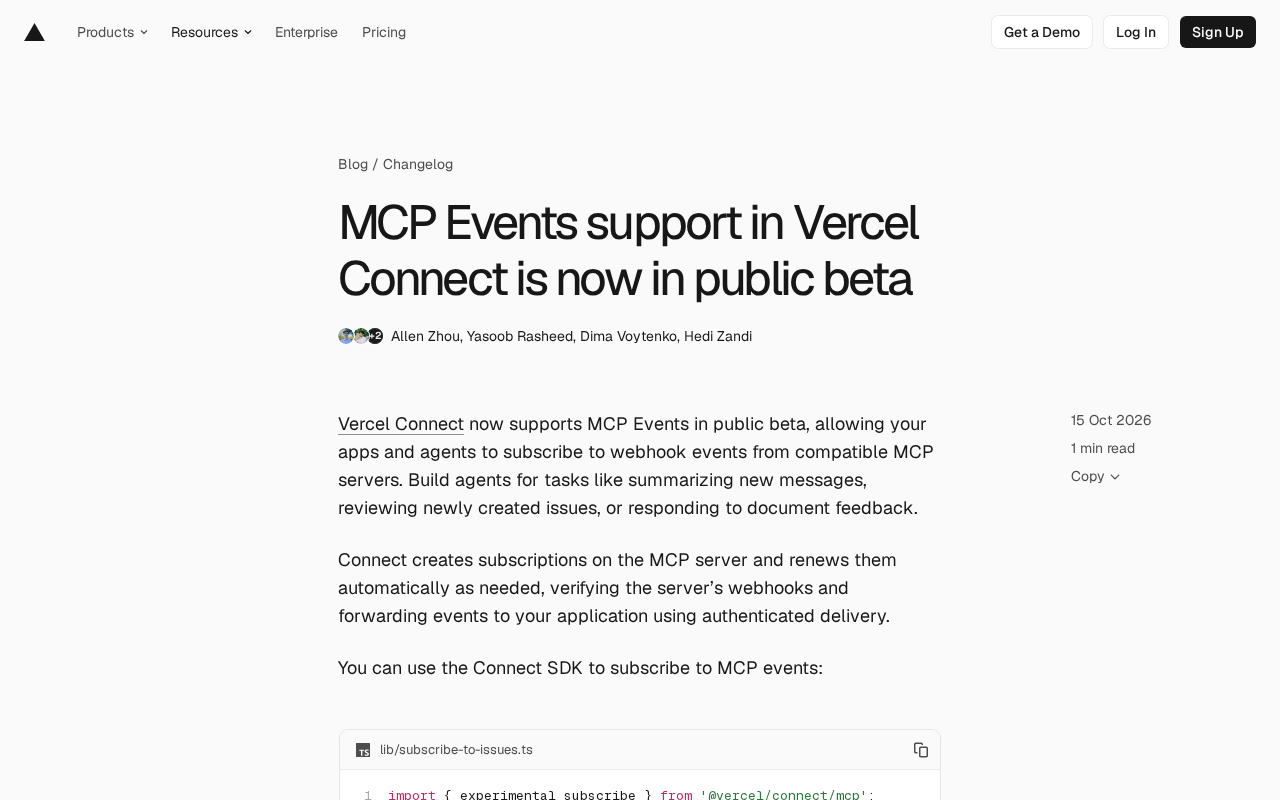
From a product positioning standpoint, Connect plays the role of an "event subscription manager": it handles creating subscriptions on MCP servers, automatically renewing them as needed, verifying webhooks sent by servers, and forwarding events to your application via authenticated delivery. This mechanism solves a long-standing pain point for Agent developers — how to reliably perceive changes in the outside world.
MCP (Model Context Protocol) is a protocol proposed and open-sourced by Anthropic in late 2024 to standardize how large language model applications connect with external tools and data sources. It uses a client-server architecture: AI applications (clients) connect to one or more MCP servers, which expose their capabilities and data in a unified format. Before MCP emerged, every AI tool integration needed to be adapted separately for a specific model or framework, resulting in a highly fragmented ecosystem; MCP attempts to play the role of "USB-C for the AI world," letting tool providers implement once and reuse across many contexts. The protocol originally defined three core primitives: tools (functions the model can call), resources (contextual data that can be read), and prompts (preset prompt templates). As Agent use cases deepened, the community gradually realized that "request-response" style invocation alone is not enough to support long-running agents that need to react to environmental changes. Event push capabilities (i.e., the Events discussed in this article) were therefore put on the agenda, becoming a new piece of the MCP capability puzzle.
Webhook is a kind of "reverse API" mechanism: in the traditional model, the client actively initiates a request to the server and waits for a response, but webhooks flip the direction — when a specific event occurs on the server side (such as a new issue being created or a document receiving a comment), the server actively sends an HTTP POST request to a pre-registered URL, pushing event data to the subscriber. For an Agent, this means it does not need to continuously poll remote services (repeatedly asking "is there anything new?"), but instead waits quietly to be awakened by an event, greatly reducing unnecessary requests, latency, and computational overhead. But webhooks also introduce new engineering problems: delivery may fail and need retries, endpoints must verify the source to prevent forgery, and subscriptions need lifecycle management and renewal before expiration. The value of Vercel Connect lies precisely in encapsulating these trivial but critical steps as infrastructure, allowing developers to focus on business logic rather than delivery pipelines.
Subscription Model Analysis: Idempotency Keys, TTL, and Secure Delivery
The Connect subscription interface design has several noteworthy details. The following example shows how to subscribe to issue creation events:
import { experimental_subscribe } from '@vercel/connect/mcp';

// Use a new key for each subscription.
// Reuse it when retrying the same request.
export async function subscribeToIssues(idempotencyKey: string) {
  return experimental_subscribe('oauth/issues', {
    tokenParams: { subject: { type: 'app' } },
    name: 'issue.created',
    arguments: { project_id: 'ABC' },
    destination: { path: '/hooks' },
    ttlMs: 24 * 60 * 60 * 1000,
    idempotencyKey,
  });
}
Several design points are worth unpacking. ttlMs gives the subscription an explicit lifetime, in this example 24 hours, and Connect will automatically renew it before expiration, so developers do not need to implement polling or renewal logic themselves. idempotencyKey is used to ensure retry safety — submitting the same key repeatedly will not create duplicate subscriptions, which is especially important in production environments with unstable networks. tokenParams.subject is specified as the app type, indicating that the subscription is established under the application's identity rather than a user's identity, making it suitable for background Agent scenarios.
Security Verification on the Delivery Side
After an event reaches your server, you must first verify the legitimacy of its source before processing it. Connect provides experimental_verifyMcpEvent:
import { experimental_verifyMcpEvent } from '@vercel/connect/mcp';

export async function POST(request: Request) {
  await experimental_verifyMcpEvent(request, { path: '/hooks' });
  return new Response(null, { status: 204 });
}
This step cannot be omitted. If the webhook endpoint exposed by an MCP server is not verified, any third party could forge events and push them to your application, thereby triggering subsequent Agent actions. Connect performs source verification here, moving the security guarantee forward into the SDK layer.
Webhook signature verification is a common practice for preventing forged events. Because webhook endpoints must be publicly accessible, anyone could send a crafted HTTP request to them. To distinguish real events from malicious forgeries, the service provider usually attaches a signature calculated from a shared secret in the request headers or body (the common algorithm is HMAC-SHA256), with the signature covering the timestamp and request body content. The receiver recalculates the signature locally using the same secret and compares it, trusting the request only if they match; the timestamp is used to resist replay attacks. What experimental_verifyMcpEvent does in the original text is the same: extract the signature from the request, recalculate it using the credentials negotiated when the subscription was registered, and only allow it through after verification passes. The reason this step "cannot be omitted" is that downstream it often triggers Agent actions — once a forged event is accepted, an attacker can induce the Agent to perform unexpected operations. Moving verification down into the SDK layer both reduces the risk of developers overlooking it and unifies the signature differences across different MCP servers.
Agent Tooling: Letting the Model Manage Subscriptions Itself
Connect provides more than just a set of APIs; it can also wrap the AI SDK's event discovery and subscription interfaces into Agent tools. After enabling the event features of an MCP connection in eve, the Agent gains several capabilities: discovering which events a server supports, creating subscriptions, checking current subscription status, and stopping subscriptions that are no longer needed.
The significance of this design is that the subscription lifecycle can be decided autonomously by the Agent, rather than being hardcoded by the developer. For example, an Agent responsible for code review can, upon detecting that a new repository has been connected, subscribe itself to issue.created and pull_request.opened, and then actively unsubscribe when the task is complete, avoiding long-term occupation of server resources.
Typical use cases include: summarizing new messages, reviewing newly created issues, and responding to documentation feedback. The common characteristic of these tasks is that they are "event-driven" — the Agent does not need to run continuously, only to be awakened when relevant events occur, significantly reducing token consumption and computational cost.
Ecosystem Significance and Current Limitations
The MCP protocol initially focused on tool invocation (tools) and resource reading (resources), while event subscription capability has been relatively absent. By making MCP Events usable infrastructure, Vercel Connect is in effect completing the other half of the puzzle for how Agents interact with the real world: the model actively initiating calls is one side, and passively receiving external changes is the other.
It is worth noting that these APIs currently all carry the experimental_ prefix, meaning the interface signatures may still change and are not suitable for direct use in production systems with extremely high stability requirements. In addition, the event capability depends on support on the MCP server side — if a server does not expose webhooks, Connect has nothing to subscribe to. Whether the ecosystem can expand depends on how many MCP service providers are willing to implement event push.
Vercel officially provides Connect quickstart documentation covering SDK installation and authentication configuration, which is a good starting point for developers who want to get hands-on.
The experimental_ prefix is an explicit stability contract in this kind of SDK: APIs bearing this prefix may undergo breaking changes at any time — function renames, parameter structure reorganization, or even complete removal — and usually do not follow semantic versioning's backward compatibility promises. The signal it conveys is "the design is not yet finalized; do not rely on it in critical production paths." For adopters, practical approaches include: isolating experimental calls into an adapter layer for easier replacement later; pinning dependency versions rather than using floating ranges; and covering these calls in integration tests so incompatibilities are discovered immediately during upgrades. By contrast, once an API drops the prefix and reaches a stable release, changes follow a formal deprecation cycle. Given that event subscriptions themselves still depend on MCP servers implementing webhooks, the entire ecosystem is in an early stage of co-building, and the experimental label is both a risk warning and a reflection of the reality that the protocol and toolchain are still iterating rapidly.
One-line Summary
Vercel Connect opens the MCP Events beta, letting Agents actively subscribe to webhook events and completing the MCP ecosystem's passive perception capability.
Paragraph Summary
Vercel Connect has officially entered the MCP Events public beta, allowing applications and Agents to subscribe to webhook events from MCP-compatible servers, shifting from "passively waiting for user triggers" to "actively responding to remote state changes." Connect acts as an event subscription manager, responsible for creating subscriptions, automatically renewing them as needed, verifying the source of server webhooks, and forwarding events to applications via authenticated delivery. The subscription API introduces ttlMs lifetime and idempotencyKey idempotency keys — the former eliminates the need for custom renewal logic, while the latter ensures retry safety; on the delivery side, experimental_verifyMcpEvent must be used to verify the source and prevent forged events. Connect can also wrap event discovery and subscription interfaces into Agent tools, allowing the subscription lifecycle to be decided autonomously by the model and actively canceled after task completion, significantly reducing token consumption and computational cost in event-driven mode. Currently, all APIs carry the experimental_ prefix, interfaces may change, and ecosystem expansion depends on MCP service providers implementing event push.
Related articles

Bilibili's Hit Dify Tutorial: A Practical Guide to Building 20+ AI Apps from Scratch
A distilled guide to Bilibili's top-rated Dify tutorial: Windows + Docker deployment, MySQL connection, five app types, model integration strategy, and publishing.

Agent Skills Beginner's Guide: From Concepts to Multi-Agent Collaboration in Practice
A comprehensive guide to Agent Skills: core concepts, components, the importance of Description, standardization, beginner learning paths, and multi-agent collaboration.

One Neuron Detects Both Cats and Cars? We Reproduced It and Found a New Explanation
The cat-car neuron reinterpreted: researcher Cammarata argues it distinguishes pointy from round, not cats from cars. We reproduced the experiment and found the new explanation holds on most inputs—but cars are the exception. The interpretability debate continues on language models.