Vercel Launches Board: A Secure Message Board for Humans and Agents
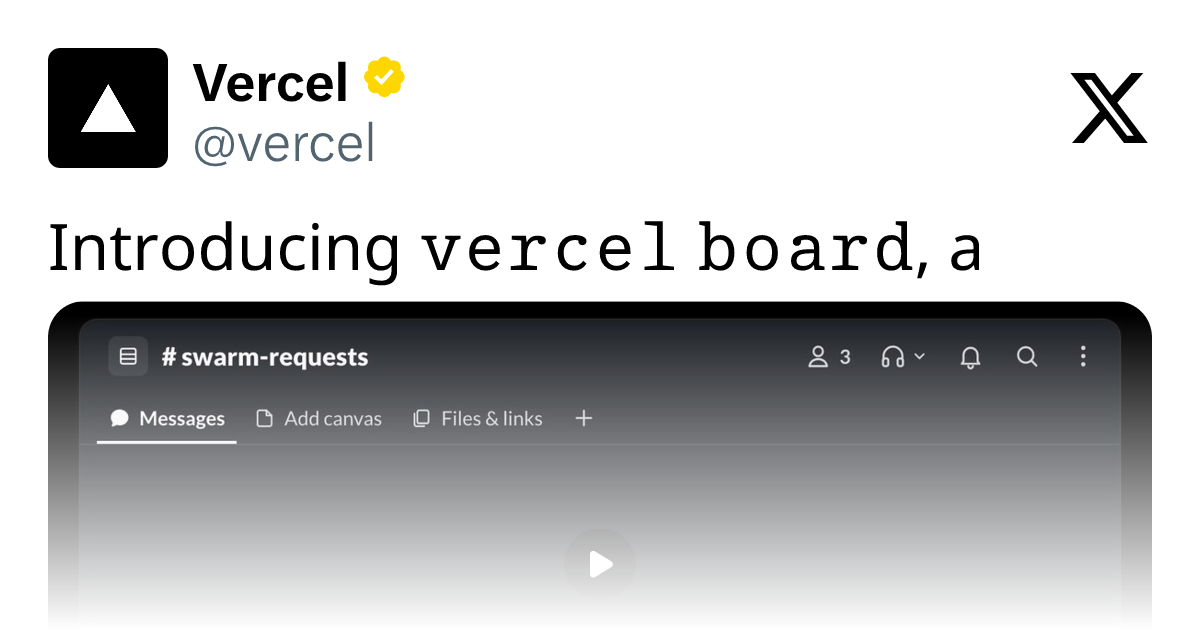
Vercel launches Board, an experimental shared and controllable task space for humans and Agents.
Vercel released vercel board, an experimental secure message board for humans and Agents. It offers a shared task board, supports multi-Agent swarm collaboration, and provides separate fine-grained permissions. The article notes that when multiple Agents share a task space, the message board becomes an information hub, making permission governance critical. Board is seen as Vercel's move from deployment platform to Agent collaboration layer, but the product is not finalized and key challenges remain unverified.
Vercel announced a new product called vercel board on social media, positioned as a "secure message board for humans and Agents." The brief tweet revealed several key directions: giving Agents a shared task space, building "swarms" and software factories, and setting separate permissions for humans and Agents. The product is currently labeled as experimental, and the team is collecting feedback.
From Deployment Platform to Agent Collaboration Layer
Vercel has long been known for developer deployment and frontend infrastructure. The Board it launched this time is not another deployment tool but a shift of focus toward multi-Agent collaboration scenarios. The three bullet points in the tweet outline the product's contours:
- Shared task space: Give Agents, and Agents and humans, a common task board rather than having each work in isolated sessions.
- Build swarms and software factories: Support multiple Agents forming a "swarm" to collaboratively complete development tasks, creating a pipeline akin to a software factory.
- Fine-grained permissions: Set permissions separately for humans and Agents, clarifying who can read, write, and execute which operations.
This direction aligns with the current evolution of AI coding tools: the capability of a single Agent is already strong enough, and the bottleneck has shifted to collaboration, orchestration, and permission governance. Board attempts to fill exactly this layer.
Why "Security" and "Permissions" Are Front and Center
It is no coincidence that the team calls Board a "secure message board" and lists permission settings as a separate bullet point. When multiple Agents share the same task space, the message board naturally becomes an information hub: task descriptions, context, and execution results all flow through it. Without clear permission boundaries, a single Agent's misoperation or unauthorized access could affect the entire collaboration chain.
Setting permissions separately for humans and Agents means Board may adopt a role-based access control model, distinguishing "who can publish tasks," "who can claim tasks," and "who can modify results." For teams looking to bring Agents into production workflows, this kind of governance capability is often more critical than the model itself.
Swarms and Software Factories: An Experimental Ground for Multi-Agent Orchestration
The phrase "build swarms and software factories" in the tweet is worth noting. It suggests that Board is not just a message board but a vehicle for multi-Agent orchestration. The software factory metaphor points to a production process with clear division of labor: requirement decomposition, coding, testing, and review are each handled by different Agents, with the message board serving as the handoff documents and status records between them.
Such patterns have been explored considerably in the community, but most remain at the level of individual experiments. Vercel's entry as a platform player may signal an intention to incorporate Agent collaboration into its developer toolchain. However, the team explicitly labels Board as an experimental product, indicating that its form and interfaces may still change.
Multi-Agent Orchestration refers to organizing multiple AI Agents with different capabilities or roles to collaboratively accomplish complex goals through task allocation, message passing, and result aggregation. Common patterns include hierarchical (a scheduling Agent splits tasks among execution Agents), pipeline-based (sequential handoffs by stage), and decentralized (peer-to-peer negotiation among Agents). The orchestration layer needs to solve problems such as task routing, context sharing, failure retries, and conflict resolution, and often affects overall output quality more than the reasoning capability of a single Agent. Current mainstream frameworks such as LangGraph, AutoGen, and CrewAI all compete at this layer, while Vercel Board attempts to use a message board as the physical carrier of orchestration, making task states and handoff records auditable.
Role-Based Access Control (RBAC) is a permission model mediated by "roles": the system first defines roles (such as administrator, publisher, executor, observer), then binds permissions to roles, and finally assigns roles to users or Agents. Compared with granting permissions directly to each subject one by one, RBAC is easier to manage and audit, especially suitable for scenarios with many subjects and frequently changing permissions. In systems mixing humans and Agents, RBAC also needs to additionally consider the verifiability of Agent identities, the timeliness of permissions (such as temporary tokens), and automatic blocking of unauthorized behavior. Vercel Board's proposal to set permissions separately for humans and Agents will most likely adopt a similar role division approach.
What an Experimental Release Means
"Board is experimental. Tell us what you think." This sentence conveys two signals: first, the product is not yet finalized, and neither feature scope nor stability is guaranteed; second, the team hopes to use early user feedback to refine its direction. For developers, the value of participating now lies in influencing the product's direction rather than treating it as a production dependency.
Given Vercel's past product cadence, experimental releases are often how it validates new tracks. Whether Board can grow from an experiment into a standard component of Agent collaboration depends on whether it can solve several hard problems: the permission model, message reliability, and multi-Agent conflict coordination. At least judging from the release information, Vercel has already put these three issues on the table.
Summary
The core proposition of Vercel Board can be summed up in one sentence: give humans and Agents a shared, controllable task space. It brings permission governance in multi-Agent collaboration to the forefront and uses "swarms" and "software factories" to depict usage scenarios. The product is still in the experimental stage, and its actual capabilities remain to be verified, but the direction it points to—that Agent collaboration needs an infrastructure layer—is worth watching.
One-line Summary
Vercel launches the experimental product Board, providing a shared, controllable task collaboration space for humans and Agents.
Paragraph Summary
Vercel released the experimental product vercel board, positioned as a secure message board for humans and Agents. Its core capabilities include providing a shared task board among Agents and between Agents and humans, supporting multiple Agents forming a "swarm" for collaborative development, and setting fine-grained permissions separately for humans and Agents. The article notes that when multiple Agents share a task space, the message board becomes an information hub, which is why permission governance is placed first. Board is seen as Vercel's attempt to extend from a deployment platform to an Agent collaboration layer and as an experimental ground for multi-Agent orchestration. The team explicitly states that the product is not yet finalized and is collecting feedback, and whether it can solve hard problems such as the permission model, message reliability, and conflict coordination remains to be verified.
Related articles

500,000 Robots to 'Refreeze' the Arctic? Real Ice's Wild Plan
A startup called Real Ice plans to use 500,000 underwater drones to thicken Arctic ice, with test-area ice already 50 cm thicker. This article breaks down the technology, the 4-million-fold scale gap, the controversial $10 billion annual cost, and the window before an ice-free summer in the 2030s.
T3 Code: One Tool Aggregates All AI Coding Assistants and Models
T3 Code aggregates multiple AI models and coding assistants like Claude and DeepSeek into one interface, enabling mid-conversation switching with automatic context handoff. This article covers its core selling points, hands-on switching flow, and use cases.
Why Did The New York Times Ban Photographers From Using the Latest Version of Photoshop?
The New York Times told photographers not to use the latest Photoshop, a ban that reflects photojournalism's caution toward AI-generated content and authenticity. This article analyzes the logic behind the ban, its impact on photographers' workflows, and the long-term struggle between tools and ethics in the news industry.