Vercel Launches UI SDK: Giving AI Agents the Building Blocks for Interface Creation

Vercel releases open-source UI SDK, giving AI agents reusable accessible interface behavior modules across five major frameworks.
Vercel launched the open-source UI SDK on Product Hunt, led by founder Guillermo Rauch. Rather than a finished component library, it offers reusable "interface behavior" modules for AI agents, with a core library serving React, Vue, Svelte, Solid, and Web Components. It splits UI into behavior and rendering layers—agents compose appearance while the SDK ensures consistent accessibility like keyboard navigation, focus management, and ARIA attributes.
Vercel has released a new tool called UI SDK on Product Hunt, designed to provide AI agents with reusable interface behavior modules so they can build custom, accessible UI components. The product is led by Vercel founder Guillermo Rauch, received 81 upvotes after launch, and ranked 17th on the day's Product Hunt leaderboard, categorized under productivity, open source, and artificial intelligence.
A Unified Core Library Across Frameworks
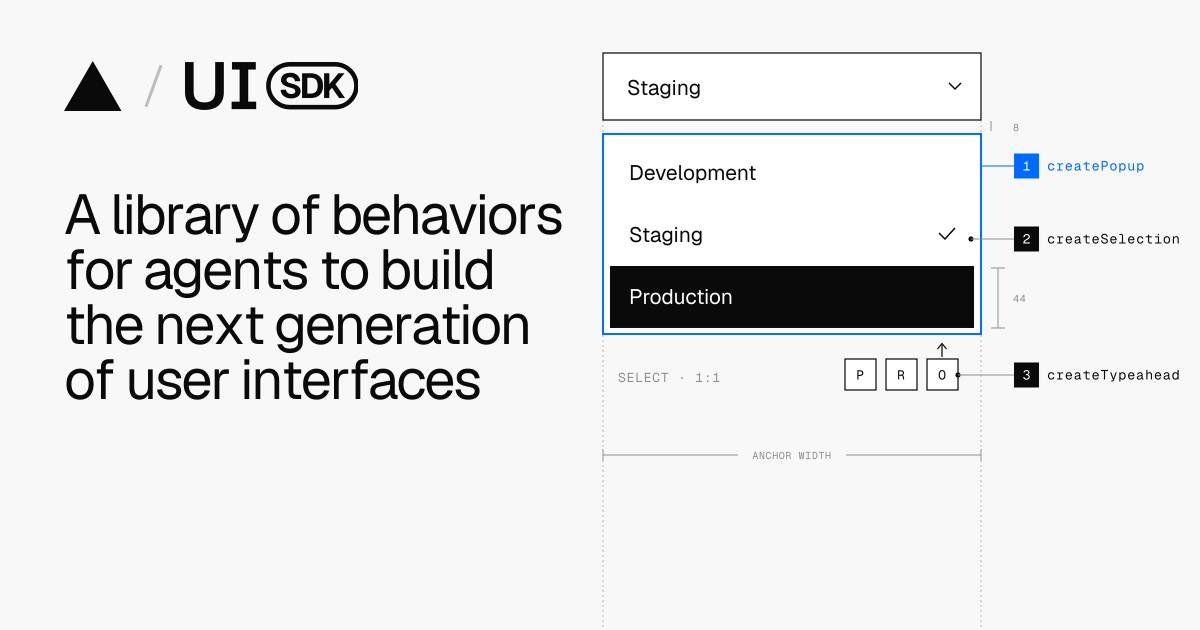
The core selling point of UI SDK is "write once, run on multiple frameworks." It provides a core library that simultaneously serves five major frontend tech stacks: React, Vue, Svelte, Solid, and Web Components. For AI agents that need to generate interfaces for different tech stacks, this means no longer maintaining a separate set of component logic for each framework, reducing complexity and inconsistency.
From a product positioning standpoint, Vercel hasn't built UI SDK as a finished component library but rather offers "reusable interface behaviors." This design approach decomposes UI into a behavior layer and a rendering layer: AI agents handle composition and customizing appearance, while the SDK ensures consistency and accessibility of interaction logic (such as keyboard navigation, focus management, and state toggling).
Web Components is a set of native browser standards (Custom Elements, Shadow DOM, HTML Templates) that allows developers to define reusable custom elements capable of running in any framework or even framework-free pages. Unlike framework components such as React and Vue, it doesn't depend on a specific runtime, so it's often used as the underlying carrier for sharing UI across frameworks. UI SDK's support for Web Components alongside the four major frameworks suggests its core behavior layer may be based on native standards, with adapter wrappers for each framework—ensuring consistency while reducing lock-in to a single ecosystem.
Why AI Agents Need "Interface Behaviors"
Currently, the mainstream approach for AI-generated UI is having large models directly output HTML/CSS or framework code, but this method is prone to issues in interaction details: keyboard accessibility, ARIA attributes, focus traps, and the like are often overlooked. UI SDK attempts to encapsulate these concerns into foundational modules that agents can call directly.
Conceptually, this is like giving AI a set of "LEGO bricks"—not complete page templates, but validated interaction behavior units. Agents can freely combine these units based on user needs while inheriting built-in accessibility capabilities. Vercel emphasizes "custom, accessible UI components" in its description, indicating that accessibility is treated as a first-class citizen rather than an afterthought.
Focus Trap is a common accessibility technique in overlay UIs such as modal dialogs: when a popup opens, keyboard Tab focus is restricted to cycle within the popup and won't "escape" to the page content behind it; when the popup closes, focus is returned to the triggering element. Without this handling, screen reader users and keyboard users may get lost in invisible background elements. Accompanying it are ARIA attributes (such as aria-modal, role="dialog") and focus management (focusing the first interactive element on open). These logic details are tedious and prone to variation across frameworks—exactly the kind of thing suited to being encapsulated as behavior modules that agents can call directly.
Open Source and Ecosystem Signals
UI SDK is labeled as an open-source product, consistent with its developer-oriented positioning. In recent years, Vercel has been steadily building in the AI space, from AI SDK to today's UI SDK, constructing a tool matrix around "AI application development." For developers, open source means they can review behavior implementations, extend or trim as needed, and more easily integrate with existing tech stacks.
Interestingly, the product has only 5 comments on Product Hunt, indicating discussion heat isn't particularly high yet. This may be because the product is in an early stage, or because its target users (developers building AI agents) are relatively niche. However, with Guillermo Rauch personally at the helm and Vercel's influence in the Next.js ecosystem, UI SDK's future evolution is worth watching.
AI SDK is an open-source TypeScript toolkit Vercel previously launched to unify calls to multiple LLM providers (such as OpenAI, Anthropic, Google, etc.) and simplify common patterns like streaming output, tool calling (function calling), and structured generation. It has built up influence in the AI application developer community and forms the foundation of Vercel's "AI tool matrix." UI SDK can be seen as an extension of that matrix toward the interface layer: AI SDK handles models and data flow, UI SDK handles interaction behaviors and accessibility, and together they cover the main pieces of building AI-native applications.
Practical Impact for Developers
If you're building AI agents capable of generating interfaces, UI SDK offers a shortcut: no need to implement cross-framework interaction behaviors from scratch, and no need to repeatedly debug accessibility details. For internal enterprise tools, low-code platforms, or AI-assisted frontend development scenarios, this "behavior-layer reuse" model can significantly reduce repetitive work.
Of course, the product is still early-stage, and whether cross-framework consistency is truly as reliable as described, and how well it covers complex components, still needs real-world validation. But the direction is clear: the bottleneck of AI-generated UI is shifting from "can it be drawn" to "is it usable and accessible once drawn," and UI SDK is precisely an infrastructure attempt targeting the latter.
One-line Summary
Vercel releases open-source UI SDK, providing AI agents with reusable accessible interface behavior modules across five major frameworks.
Paragraph Summary
Vercel launched the open-source product UI SDK on Product Hunt, led by founder Guillermo Rauch. It's positioned not as a finished component library but as reusable "interface behavior" modules for AI agents. Its core is a library that simultaneously serves React, Vue, Svelte, Solid, and Web Components, letting agents avoid reimplementing interaction logic for each framework. The product splits UI into a behavior layer and a rendering layer: agents handle appearance composition, while the SDK ensures consistency in accessibility details like keyboard navigation, focus management, and ARIA attributes. The article argues this addresses the current bottleneck of AI-generated UI—shifting from "can it be drawn" to "is it usable and accessible"—though the product is still early-stage, with cross-framework consistency and complex component coverage yet to be validated.
Related articles

AI Writes Your Code—Do You Still Need to Learn Git? Five Reasons
AI coding agents handle Git operations automatically—is it still necessary to learn Git? Five reasons: team communication, reviewing agent PRs, monitoring code changes, fallback when AI goes down, and the joy of learning—plus how the focus of learning Git is shifting in the agent era.

Anthropic Reportedly Prices IPO at $83 Per Share, Valuing Company at $1.5 Trillion
Anthropic reportedly prices IPO at $83 per share, above the expected range, with a fully diluted valuation of $1.5 trillion. This article analyzes the signal significance of the pricing and its impact on the AI industry's financing environment.

Open-Source Code Hosting Platform Codeberg Suffers Outage, Sparking Debate in Developer Community
Open-source code hosting platform Codeberg.org suffered an outage, sparking Hacker News debate over nonprofit platform stability and open-source infrastructure dependency risks.