Vercel Optimizes Repository Checkout and Git LFS Downloads, Speeding Up Build Preparation by 54%

Vercel optimizes build machine repository checkout and Git LFS downloads, cutting prep time 20% on average and 54% for LFS projects.
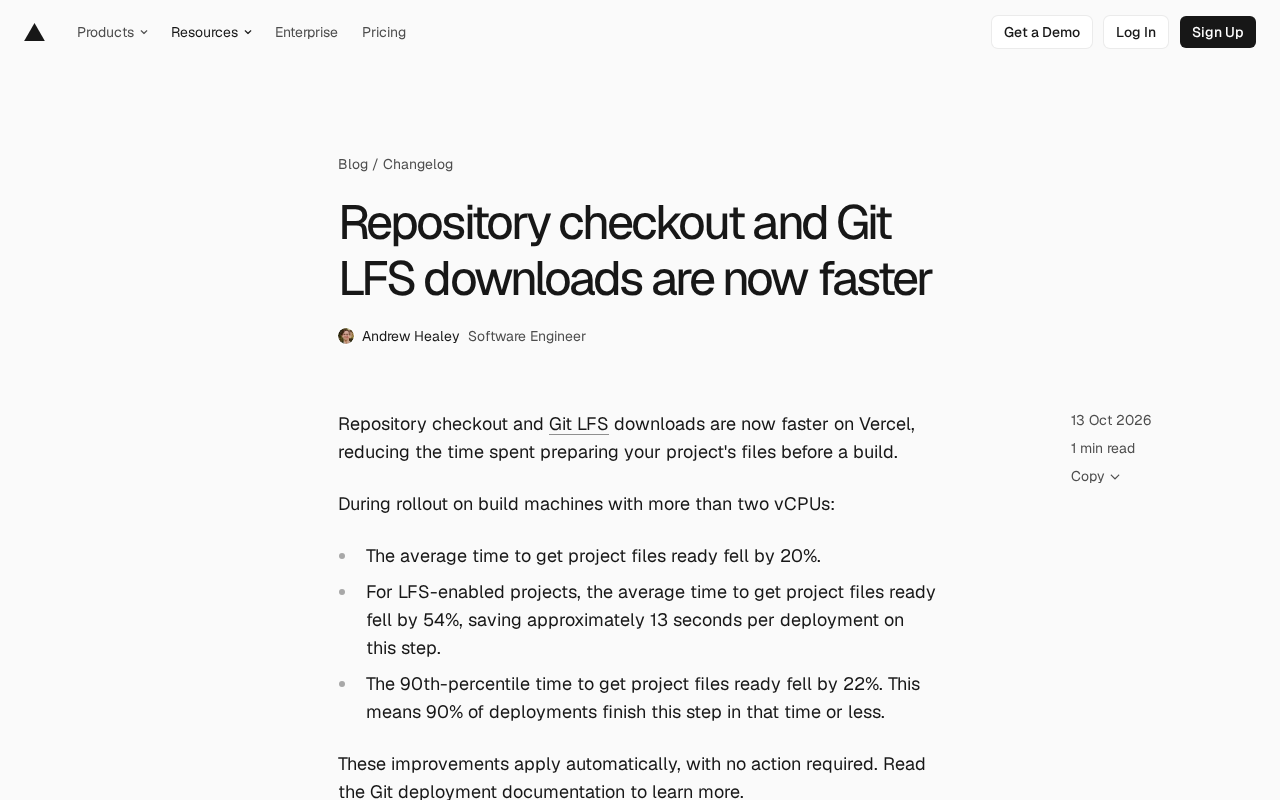
Vercel announced optimizations to repository checkout and Git LFS download on its build machines. On build machines with more than two vCPUs, regular project file preparation time drops by an average of 20%, and LFS-enabled projects drop by 54%, saving about 13 seconds per deployment for LFS projects. The official announcement also reports a 22% overall P90 reduction, showing heavy workloads benefit too. The optimization only activates in multi-core environments, implying its dependence on parallelism, and applies automatically with no configuration changes or migration needed.
Speeding Up the First Mile of the Vercel Build Pipeline
In a CI/CD pipeline, repository checkout is the starting point of every deployment. It may look like a simple code pull, but when a project relies on large amounts of binary assets, LFS objects, or a lengthy commit history, this step can consume tens of seconds. Vercel has announced optimizations to the repository checkout and Git LFS download process on its build machines. On build machines with more than two vCPUs, project file preparation time drops by an average of 20%, and projects with LFS enabled drop by an average of 54%, saving roughly 13 seconds per deployment at this step.
The value of this kind of improvement isn't in the absolute number—it's that it applies to a step every deployment must go through. Compared to optimizing some infrequent build task, shortening checkout time is equivalent to a broad acceleration of the entire team's delivery cadence.
Git LFS (Large File Storage) is a Git extension that solves repository bloat caused by large binary files (such as design assets, videos, datasets, and build artifacts). Its core mechanism is that the repository stores only a lightweight pointer file (containing metadata such as the file hash and size), while the actual large file content is stored on a remote LFS server. As a result, during checkout, Git needs to issue extra object download requests to the LFS server and perform hash verification on the downloaded content, confirming integrity before writing it to the working directory. This process involves network round trips, concurrency scheduling, and local I/O, which is the main reason LFS project checkouts are slower than regular projects. Understanding this makes it clear why transmission optimizations targeting LFS can deliver gains far higher than those for regular projects, and why parallelizing downloads and verification is especially critical in LFS scenarios.
The Engineering Meaning Behind the Numbers
The official announcement provides three sets of comparative data, each corresponding to a different dimension of perceived impact:
- Average time: 20% reduction for regular projects, 54% for LFS projects.
- Tail latency (P90): overall reduction of 22%, meaning 90% of deployments complete preparation within this time or less.
- LFS-specific benefit: roughly 13 seconds per deployment.
The benefit for LFS projects is far greater than for regular projects, which aligns with how Git LFS works—LFS stores large files as pointers, requiring extra object downloads and verification during checkout. When these requests are parallelized or routed through better transmission paths, the gains are naturally amplified. The 22% P90 improvement shows the optimization benefits not only lightweight projects; heavy workloads benefit too, otherwise the tail number wouldn't drop.
Why machines with more than two vCPUs
The announcement limits the improvements to build machines with more than two vCPUs, suggesting the optimization is directly tied to parallel capacity. Higher concurrency, more file handles, and faster decompression and verification all require sufficient compute power. In single-core or dual-core environments, the bottleneck is likely still CPU rather than I/O, so forced parallelization yields limited gains.
vCPU (virtual CPU) is the number of compute cores allocated to a single build instance in a cloud build environment. The "more than two vCPUs" mentioned in the article is a key threshold, directly reflecting the optimization's dependence on parallelism. Repository checkout and LFS downloads are essentially I/O-intensive tasks, but the decompression, hash verification, and pointer parsing within them still require CPU involvement. When downloading multiple objects concurrently and decompressing multiple files simultaneously, each task consumes some CPU time; the fewer the cores, the more tasks queue up against each other, and the parallel gains get eaten by the CPU bottleneck. Only in a multi-core environment can I/O waits and CPU computation be effectively overlapped, allowing parallelization to truly translate into reduced wall-clock time. This also explains why gains are limited on single-core or dual-core instances—the bottleneck has shifted from network to raw compute.
Automatic, no migration needed
The improvements apply automatically, with no need for users to modify configuration or upgrade dependencies. For platform infrastructure, this kind of "silent activation" is the ideal form: users don't perceive the change, but the time numbers in deployment logs shrink on their own.
P90 (90th percentile) is a commonly used statistical measure in latency metrics: sorting all deployment preparation times from fastest to slowest, the value at the 90% position is the P90, meaning 90% of deployments complete within this time. Compared to the average, P90 better reflects "the worse case most users experience," and is therefore often used to measure tail latency. The average is easily skewed by a few extremely fast or extremely slow samples, whereas P90 is relatively robust. The article presents both average and P90 reductions to show that the optimization benefits not only lightweight projects or extreme scenarios, but covers the overall distribution. If only the average dropped while P90 stayed unchanged, it would often mean the optimization only works for a few simple cases; a P90 improvement as well shows that heavy-load projects also benefit.
Takeaways for Development Teams
Checkout time is worth monitoring. Many teams focus only on build and test duration, ignoring the preparation phase. Saving 13 seconds once isn't noticeable in a single deployment, but calculated across dozens of deployments per day, the accumulated time shows up directly in CI bills and developer waiting.
LFS users should prioritize evaluating their LFS strategy. If a project has LFS enabled and the gains reach more than half, that indicates there was significant compressible room in the previous checkout path. Managing LFS objects sensibly and avoiding unnecessary large-file tracking can further amplify the gains.
The difference between platform optimization and self-hosted CI. As a managed platform, Vercel can push out this kind of optimization uniformly, whereas teams with self-hosted CI must handle image layer caching, nearby object storage access, and similar issues themselves. This reminds us that part of the value of managed platforms comes precisely from these hard-to-notice but continuously occurring low-level improvements.
According to the official statement, more details can be found in the Git deployment documentation. For most users, simply observing the preparation time in the logs on their next deployment will verify whether this improvement has landed in their projects.
The cost structure difference between managed CI and self-hosted CI is especially evident in this kind of low-level optimization. A managed platform like Vercel faces a massive number of homogeneous build tasks, so it has the ability to bake optimizations into the platform's default path and push them uniformly to all users, at extremely low marginal cost. Teams with self-hosted CI, however, usually need to maintain image layer caching themselves, configure nearby object storage access, and tune clone parameters (such as shallow clones and partial clones) to achieve similar gains—each requiring additional operational investment and validation. This doesn't mean self-hosted CI can't be sped up, but rather that the correspondence between optimization gains and investment is steeper: every improvement must be discovered, implemented, and maintained by the team itself. So when evaluating platform costs, folding in these "hard-to-notice but continuously occurring low-level improvements" is what yields a more realistic total cost of ownership (TCO) comparison.
One-line Summary
Vercel optimizes build machine repository checkout and Git LFS downloads, cutting preparation time by 20% on average and 54% for LFS projects.
Paragraph Summary
Vercel announced optimizations to the repository checkout and Git LFS download process on its build machines. On build machines with more than two vCPUs, regular project file preparation time drops by an average of 20%, and projects with LFS enabled drop by an average of 54%, saving roughly 13 seconds per deployment for LFS projects. The official announcement also reports a 22% overall P90 reduction, showing heavy workloads benefit too. The optimization only takes effect in multi-core environments, suggesting its dependence on parallelism; additionally, the improvements apply automatically with no configuration changes or migration needed. The article notes that while the checkout phase is often overlooked, as a mandatory step in every deployment, its cumulative impact shows up directly in CI bills and developer waiting, and LFS users in particular should prioritize evaluating their LFS strategy.
Related articles

GPT-Next Leak, Gemini 4 Argon Imminent: AI News Roundup
GPT-Next leak suggests extreme efficiency; OpenAI's 28-day shipping pledge boosts speed 50%; Gemini 4 Argon nears release; Anthropic subscription value report sparks debate.

GPT-Next Leaked, Gemini 4 Argon Speeds Up, Fable 5.5 May Launch Today
OpenAI's GPT-Next model leaks, expected to be extremely low-cost and possibly part of the 28-day release plan; Gemini 4 Argon internal testing accelerates, NanoBanana 2.1 is live; Semi Analysis tests show Claude Max's equivalent API value is about 5 times that of ChatGPT Pro; Fable 5.5 may launch today.

Gemini 4 Argon Launches Globally: Key Highlights from the AI Daily Brief
Google opens Gemini 4 Argon globally across Pro and Ultra subscriptions and the API, and demonstrates robot control. This article rounds up open-source models, Agent infrastructure, cost transparency, and safety governance updates.