Vercel Pro Adds 8 New TLDs to Free Domain Offering, Bringing Total to 16

Vercel Pro adds 8 new TLDs to its free domain offer, bringing the total to 16, free for the first year with renewal afterward.
Vercel announced 8 new top-level domains for free first-year registration for Pro teams, including .co, .studio, .company, .info, .pro, .live, .digital, and .agency, bringing the total available suffixes to 16. Each Pro team can still claim only one free domain, and premium domains are excluded. After the first free year, domains renew automatically at the price shown at checkout when claimed. The new suffixes cover startups, creative work, corporate sites, services, and more, giving developers richer branding options and further lowering the launch barrier for professional teams. The claim entry point is vercel.com/domains.
Vercel recently announced that it has added 8 new top-level domains (TLDs) to its free first-year domain registration service for Pro teams, bringing the total number of available domain suffixes to 16. This change gives developers more branding options when building projects and further lowers the barrier to launch for professional teams.
Eight New TLDs Cover More Use Cases
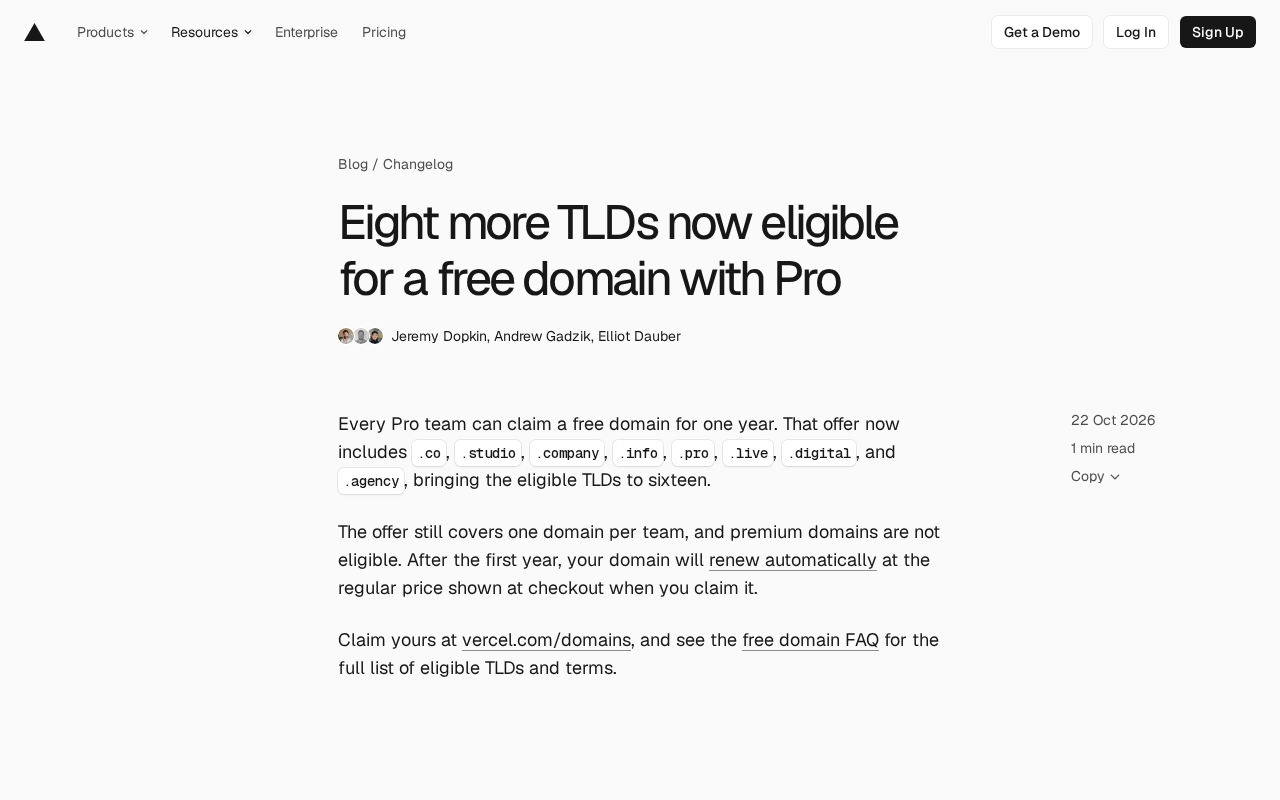
According to the official announcement, the newly added TLDs include .co, .studio, .company, .info, .pro, .live, .digital, and .agency. Together with the previously supported options, Pro teams can now choose one from 16 suffixes and use it free for one year.
Each of these suffixes has its own focus: .co suits startups and tech products, .studio points to creative and design teams, .company and .agency are more aligned with corporate websites and service organizations, and .live and .digital fit scenarios such as livestreaming and digital products. For developers who need to quickly launch an MVP or landing page, being able to get a semantically fitting address without purchasing a domain separately saves a small but bothersome expense.
TLD (top-level domain) is the highest level in the internet domain name system, located at the far right of a domain name, such as .com, .org, .net, and the newly added .co, .studio, and others in this update. TLDs fall into two categories: generic top-level domains (gTLDs) and country-code top-level domains (ccTLDs). .co was originally the country-code domain for Colombia, but because of its association with "company" and "commerce," it is widely used as a generic domain for business and technology; .pro, .info, and others are gTLDs managed by ICANN. Different TLDs have different registration prices, renewal prices, and registry rules, which is one reason Vercel states that premium domains are not included in the free promotion—some high-value short domains already carry high registration costs.
Rules Unchanged: One Domain per Team, Except Premium Domains
The core terms of the free domain offer remain unchanged. Each Pro team can claim only one free domain, and premium domains are not included in the promotion. This means that short, high-commercial-value domains still need to be purchased at normal prices.
After the first free year ends, the domain will automatically renew at the price shown on the checkout page at the time of claiming. The official notice reminds users to pay attention to the renewal price when claiming to avoid unexpected costs later. This "free first year, regular price thereafter" model is common among domain registrars, and by bundling it with the Pro subscription, Vercel effectively adds a practical benefit for paid teams.
Premium domains are domains that registries mark as high-value, with registration and renewal prices far above those of ordinary domains, usually including short strings, common words, and names with high commercial potential. Pricing for such domains is set dynamically by the registry rather than at a uniform standard price. Vercel's free promotion explicitly excludes premium domains, meaning users can only claim one domain for free from those with standard pricing; if they want to use a premium domain, they still need to bear its higher registration cost themselves. In addition, domain registration follows a "first come, first served" principle. If a freely claimed domain is not renewed after the first year, it enters the normal expiration process and may be registered by someone else.
How to Claim and Recommendations
The claim entry point is located at vercel.com/domains, and the full TLD list and terms can be viewed in the free domain FAQ. For teams already using Vercel to deploy projects, it is recommended to complete domain claiming at the project kickoff stage to avoid additional configuration during later migration.
If a team has clear branding needs for a domain suffix—for example, choosing .pro or .digital for developer-facing tools, or .agency or .company for client-facing service businesses—the newly added options can be prioritized. If versatility and memorability matter more, .co and .info remain safe choices. It is worth noting that free domains are tied to the Vercel platform, so the feasibility of domain transfer should be assessed when migrating.
Overall, this TLD expansion is a small enhancement to the value of Vercel's Pro subscription, and its practical help to independent developers and small teams is greater than its marketing significance.
Related articles

Build an AI Super Employee System at Zero Cost: A Full Breakdown of Automated Agent Workflows
A deep breakdown of the AI super employee system demoed on Bilibili: agent orchestration, digital human voiceovers, map and enterprise lead generation, 24/7 customer service, and legal modules. We analyze the business logic and compliance risks behind zero-cost signup to help entrepreneurs judge the real ROI of this AI digital employee system.

The Essential Difference Between Chatbots and AI Agents: Crossing from Conversation to Execution
What's the difference between a chatbot and an AI agent? Based on the MCP series on the Learn Tech channel, this article uses examples like booking flights and summarizing notes to explain: a chatbot only gives answers, while an agent actually completes tasks through a think-act-observe loop. It breaks down the four core components—model, tools, memory, and goal—as well as MCP's role as a bridge, and discusses agents' applicable boundaries and permission risks.

Free GitHub Repo: 342 Hours of AI Courses, from Math to MCP Servers
A free GitHub repo offers 342 hours of AI courses: 523 lessons across 20 phases, from math fundamentals to agent building and MCP servers. Nearly 100,000 learners have started.