Vex: A GitOps Skill Version Manager Built for AI Agents

Vex brings GitOps version control to AI agent context management, making agent memory branchable, rollbackable, and auditable.
Vex (Vex's Skillgit) is an open-source headless cognitive tool that treats agent context and skills as immutable, versioned assets, applying Git's mental model to solve the traceability, rollback, and collaboration challenges of agent memory management. It runs as a background service, ingests code repositories via GitHub Webhooks, and lets agents query context in real time through MCP. By reusing standard Git commit conventions, it automatically branches, updates, or rolls back agent memory state with no manual intervention. The stack combines Tree-sitter for semantic code chunking, SQLite for metadata, Qdrant for vector search, and FastAPI + Huey for async concurrency. The roadmap includes a Rust chunking engine, global GraphRAG, and multi-language support.
When Agent Memory Needs Version Control
As AI agents gradually move from experimental to production environments, a long-overlooked problem is coming into focus: how do you manage an agent's context and skills? Most existing approaches either offload the heavy lifting to the IDE or force the agent itself to bear the burden of loading massive context — resulting in workflows that are hard to trace, impossible to roll back, and ill-suited for team collaboration.
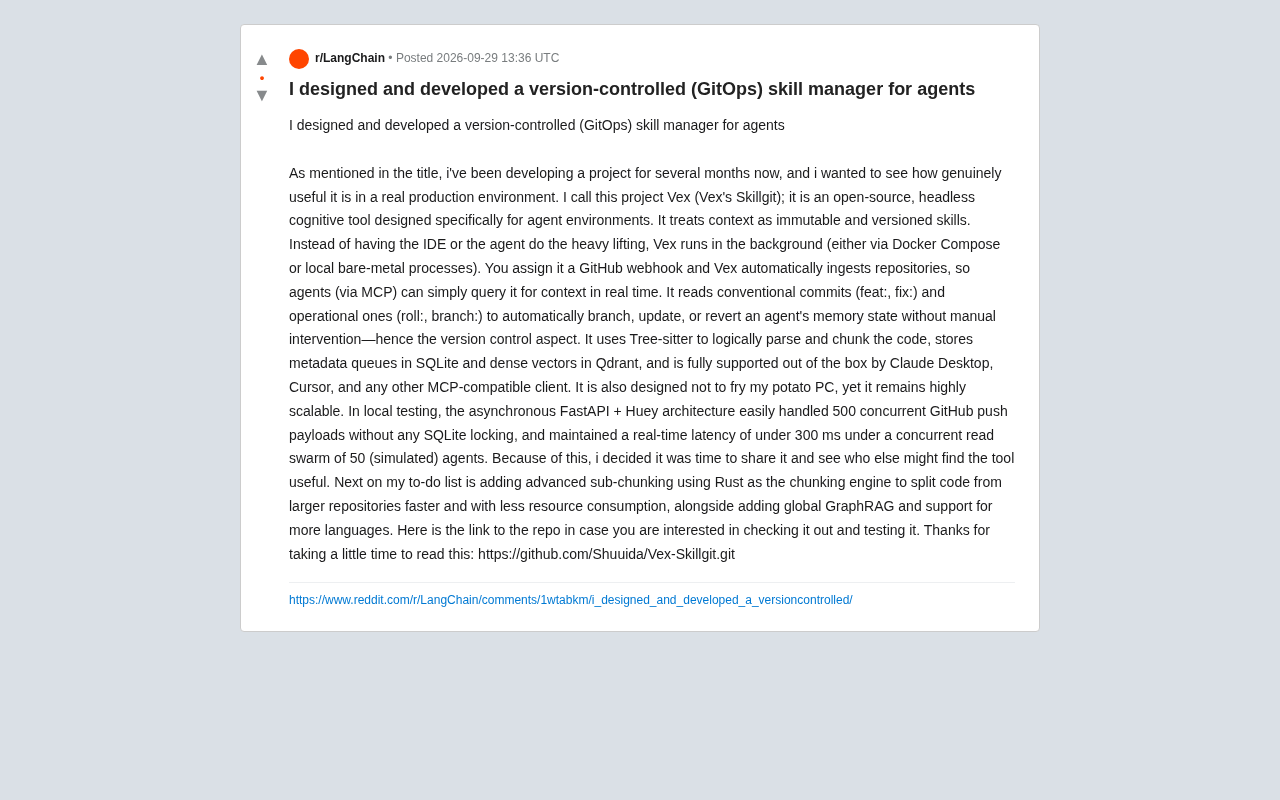
A developer recently shared on Reddit an open-source project he spent months building: Vex (Vex's Skillgit). It applies one of software engineering's most battle-tested paradigms — version control (GitOps) — to solve this problem. The core idea is straightforward: treat context as immutable, versioned skills.
How GitOps Thinking Translates to Agent Memory
Vex is defined as a headless cognitive tool built specifically for agent environments. Rather than embedding itself into an editor like a plugin, it runs as a background service — supporting both Docker Compose and local bare-metal processes.
Setup involves pointing a GitHub Webhook at it, after which Vex automatically ingests your code repositories. Agents then query the context they need in real time via MCP (Model Context Protocol).
The most interesting design choice is how it reuses Git commit conventions. Vex reads both standard commits (like feat: and fix:) and its own operational commit types (like roll: and branch:), then automatically branches, updates, or rolls back the agent's memory state — all without human intervention. This means an agent's "memory" is no longer a black box; like a code repository, it can be branched, reverted, and audited. That's what "version control" actually means here.
Compatibility with Popular Clients
Built on top of MCP, Vex claims out-of-the-box support for Claude Desktop, Cursor, and any MCP-compatible client. For developers already using these tools, the integration overhead is relatively low.
MCP (Model Context Protocol) is an open protocol proposed by Anthropic in 2024, designed to standardize how large language models interact with external tools and data sources. It's been described as "the USB port for AI" — a tool provider implements the MCP server once and becomes instantly callable from any compatible client (such as Claude Desktop or Cursor), with no per-host adaptation required. In Vex's architecture, MCP serves as the unified channel through which agents query skill context: an agent sends a semantic query, and Vex's MCP server retrieves relevant code snippets from the Qdrant vector store and returns them. The process is transparent to the agent and gives Vex natural portability across clients.
Tech Stack Breakdown: Balancing Lightweight and Scalable
Based on what the author has shared, the architecture deliberately balances two goals: "won't melt my potato laptop" and "high scalability":
- Code parsing: Tree-sitter is used for logic-aware parsing and chunking — splitting code along semantic boundaries rather than by character count or line number, preserving syntactic structure.
- Metadata storage: Lightweight SQLite handles the metadata queue.
- Vector storage: Dense vectors are managed by Qdrant to power semantic search.
- Async architecture: A FastAPI + Huey combination handles concurrent task processing.
The tradeoff is clear — minimize local resource consumption while maintaining enough performance headroom, while keeping horizontal scaling as an option.
Performance Numbers
The author reports local test results: the async FastAPI + Huey architecture can "easily handle 500 concurrent GitHub push payloads" without SQLite locking issues; under simulated concurrent reads from 50 agents, real-time latency stays under 300ms.
It's worth noting that these are self-reported benchmarks from the author's local environment and have not been independently validated in real production settings — readers should weigh them accordingly.
Tree-sitter is an incremental parsing library originally designed for real-time syntax highlighting in code editors. Its key strength is parsing source code into a full abstract syntax tree (AST) rather than treating it as a plain text stream. The advantage for code chunking is obvious: split boundaries naturally fall at semantic units like functions, classes, and methods — never mid-expression. This matters a lot for embedding quality downstream: semantically complete code chunks are far more likely to match truly relevant context during retrieval, as opposed to chunks that merely share a few lines of similar characters. Tree-sitter currently supports grammar definitions for over 100 programming languages, which is also why Vex's roadmap item of "support more programming languages" can be achieved at relatively low cost.
A Design Philosophy Worth Noting
Vex's greatest value may not lie in any single technical component, but in how it transplants mature software engineering practices into the emerging field of agent context management. As teams start deploying multiple agents in production, questions like "which version of memory is this agent running?" and "how do we roll back a behavior regression caused by a recent update?" become very real. Addressing them with Git's mental model is an intuitive approach that scales well with team collaboration.
Treating context as immutable, versioned assets also resonates with the broader trend of context engineering gradually superseding pure prompt engineering — an agent's capability ceiling increasingly depends on what kind of well-organized context it can access.
Context Engineering is a concept that has been gaining traction in the AI engineering community, popularized in part by Shopify CEO Tobi Lütke and others. The core claim is that as foundational model capabilities plateau, the key determinant of agent performance has shifted from "how to phrase prompts" to "how to systematically organize, filter, and dynamically inject context." Prompt engineering focuses on linguistic precision within a single interaction; context engineering focuses on the entire information architecture — which memories should appear in the model's attention window, at what moment, and in what form. Vex's design aligns tightly with this trend: version control makes context origins traceable; semantic retrieval makes injected content precisely relevant. In essence, Vex is building "an auditable cognitive infrastructure" for agents.
Roadmap
The author's listed next steps include:
- Introducing Rust as the chunking engine to enable more advanced sub-chunking, handling large repositories faster and with less resource usage;
- Adding global GraphRAG to improve cross-file and cross-module associative retrieval;
- Support for additional programming languages.
The project is open-sourced on GitHub (Shuuida/Vex-Skillgit), and the author has explicitly stated he's looking for more people to try it and provide feedback on real-world production utility. For developers exploring agent context management who already favor GitOps workflows, Vex offers a compelling conceptual prototype worth experimenting with.
Related articles

RAG Getting Started in Practice: From Principles to Building an Enterprise Knowledge Base
Bilibili RAG course highlights: from retrieval-augmented generation principles, document chunking and vectorization, to five accuracy factors and enterprise knowledge base boundaries, with fine-tuning vs RAG selection advice.

AI Model Selection Guide: DeepSeek vs. Qwen3 in Practice
How should AI developers choose models? Based on a Bilibili tutorial, this article breaks down the Function Calling differences between DeepSeek V3 and R1, Qwen3's programmatic thinking mode switching and agent capabilities, and outlines a multi-model learning path and practical selection logic.

Anchoring, Loss Aversion, and Nudges: 5 Psychological Tactics Retailers Use to Make You Spend
Behavioral economics reveals how retailers use anchoring, framing, loss aversion, and nudge theory to manipulate your spending decisions. This article breaks down 5 common psychological tactics and offers counterstrategies like slowing down decisions and setting your own anchors to see through the pricing design behind discounts.