Vibe Coding Complete 80-Episode Practical Course: A Full-Chain Analysis of One-Person Company AI Development
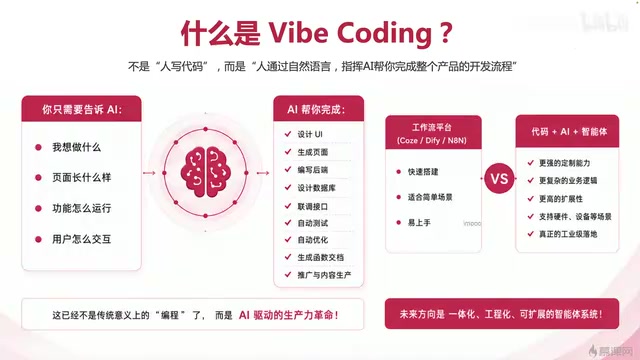
Vibe Coding lets people direct AI to write code, enabling one-person companies in the AI era through full-chain engineering.
The article analyzes Bilibili's 80-episode Vibe Coding course, showing how AI turns software development from team collaboration into solo work. It clarifies that workflow tools are only the basics, while industrial-grade implementation needs AI + code + agents + engineering, and covers the full chain from requirements to operations.
AI is evolving from a tool into an entirely new form of productivity. In the past, developing a product required coordination among multiple roles—product managers, designers, frontend and backend developers, testers, and operations staff—but now one person can do it all. The Bilibili creator 分镜影院's "Vibe Coding: Zero to Practical Mastery" is built on this premise: the future of software development is being completely restructured by AI, and the course aims to bring learners truly into the AI development era.
What Is Vibe Coding: From Writing Code to Directing AI
The core definition of Vibe Coding is simple: people no longer write code—they direct AI to write it. You tell AI what page you want, what it should look like, and how the features should work, and AI can generate the page, write the code, connect the database, automatically test and fix bugs, generate documentation, and even produce promotional copy and short videos.
In the past, one person developing a product needed to understand design, frontend, backend, databases, servers, and even operations. Many people don't lack ideas—they lack the ability to bring those ideas to life. AI is flattening these technical barriers: previously people had to adapt to code; now AI understands human language.
A Common Misconception: Workflow Orchestration Is Not AI Development
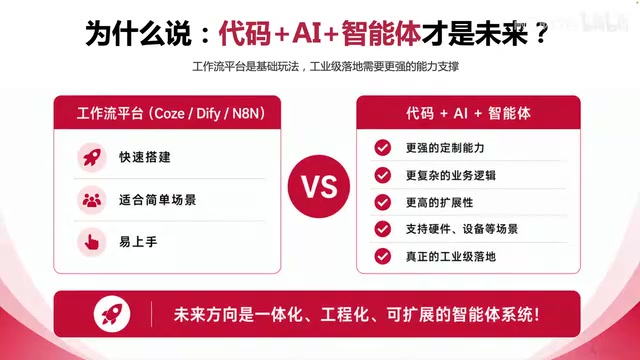
The course specifically points out that many people's understanding of AI development is still stuck on workflow orchestration tools like Coze, Dify, and n8n, believing that connecting a few nodes and running a few flows means they know AI development. But this is only a fairly basic way to use AI. The core direction that can truly achieve industrial-grade implementation, develop complex systems, and build future AI products is the system of "AI + code + agents + engineering." What will be truly valuable in the future is not simple chatbots but AI applications—such as AI e-commerce, digital human automation systems, and AI enterprise platforms—all of which ultimately come back to engineering capability.
MCP (Model Context Protocol) is an open protocol proposed by Anthropic at the end of 2024 to standardize how large models connect to external tools and data sources. You can think of it as the "USB-C interface" of the AI world: previously every AI application had to write separate adapter code to connect to databases, file systems, and third-party APIs, but MCP defines a unified client–server communication specification that lets models discover and invoke external capabilities in a consistent way. For AI engineering, the significance of MCP is that it turns "tool integration" from one-off development into reusable infrastructure; multiple agents can share the same set of MCP Servers, thereby supporting collaborative development of complex systems.
Skills (agent skills) refer to encapsulating the processing flow, prompts, and tool-calling rules for a specific task into reusable capability units. Unlike the fixed nodes of workflow orchestration, Skills place more emphasis on the model autonomously deciding when to invoke which skill, and belong to the capability organization approach within the "AI + code + agents" system. Together, the two are precisely the underlying mechanisms on which the industrial-grade implementation described in the course depends.
Course Positioning: More Than a Tool Course—A Practical Course for One-Person Companies in the AI Era
This course has two clear goals. The first is learning: to help learners truly master AI development and the industrial implementation of AI engineering products, rather than merely knowing how to use a few AI tools. The second is making money: in the future there will be a large number of one-person companies, AI entrepreneurs, and super-individuals. Many people's future may no longer be about finding a job but about using AI to build products. Therefore, the course is more like a "practical course for one-person companies in the AI era" than a mere tool course.
Full-Chain Closed Loop: From Requirements Analysis to Operations and Promotion
A real product is not just about hand-writing code; it must connect requirements analysis, UI design, page development, backend logic, databases, testing, deployment, operations, and promotion—all links in the chain. The course's biggest feature is the full-chain closed loop—not building a simple demo, but guiding everyone to build a complete product.
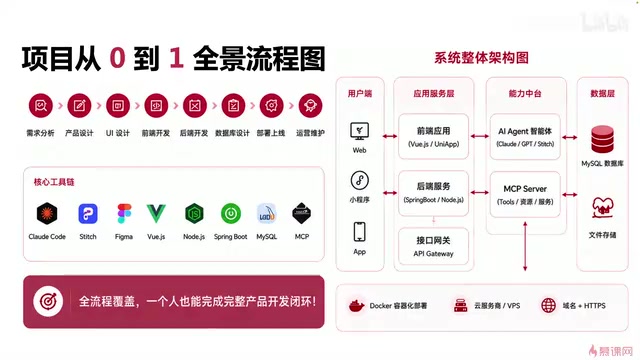
In the architecture of the AI development system, future software development is no longer about single-point capabilities but about AI collaborative development. Tools such as Claude Code, Stitch, MCP, Skills, and Figma will work in coordination; AI will no longer just chat but truly participate in the entire process of design, development, testing, optimization, and operations. This is the direction of future AI engineering.
Claude Code is a command-line AI programming agent launched by Anthropic. Unlike assistants that complete code inside an editor, it can directly read and write project files, execute terminal commands, run tests, and autonomously iterate based on errors. Its way of working is an "agent loop": understand the task → modify the code → run verification → fix errors until the goal is achieved. This is precisely the key to Vibe Coding upgrading from "generating a piece of code" to "completing a functional module."
Stitch is an AI interface design tool launched by Google that can generate usable UI designs and frontend code based on natural language descriptions or sketches, and is often used to quickly turn requirements into page prototypes. Figma is a mainstream collaborative design platform, and today through its AI capabilities and interfaces such as MCP, design files can be directly read by AI and converted into code. Together with MCP and Skills, these three form what the course calls "AI collaborative development": design, coding, and testing are no longer advanced serially by people but carried out in parallel by multiple AI roles collaborating and delivering artifacts to one another.
Multi-Platform Development and AI Operations: The Two Pillars of a One-Person Company
In the past, developing for multiple platforms was very painful: one set for the web, one set for the app, and yet another set for mini-programs. AI is greatly lowering the threshold for multi-platform development. In the course, UniApp is taught, combining AI code generation and component reuse to achieve develop once, run on multiple platforms. This is also an important reason why one-person companies are becoming possible in the future.
Many people think product development is over once it's done, but the real difficulty is promotion. AI has now entered the operations field: automatically generating WeChat official account articles, automatically generating promotional copy, automatically generating video scripts, and even automatically generating product promotional videos. AI can fully handle promotion for you, letting the product promote itself.
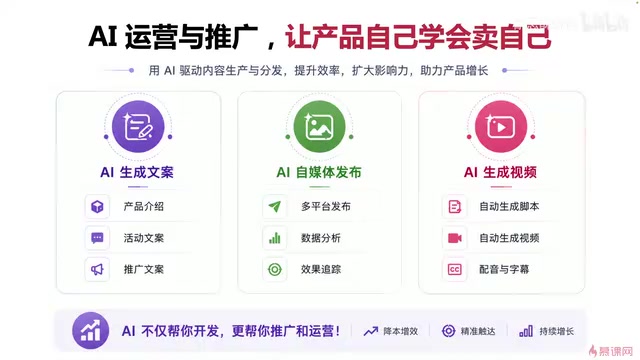
So the truly capable people of the future will definitely be those with dual capabilities in "development + AI operations."
What You Will Gain After Completing the Course
The course promises to help learners acquire five capabilities: the ability to independently develop products, AI full-chain collaboration capability, AI engineering capability, multi-platform development capability, and AI automated operations capability. More importantly, truly having the ability to build products as one person.
In the coming years, AI will certainly eliminate a large amount of repetitive labor, and at the same time will certainly give rise to a large number of super-individuals, one-person companies, and AI entrepreneurs. Opportunities always belong to those who prepare in advance. The core question this 80-episode course tries to answer is: when AI flattens technical barriers, how can individuals use engineering thinking and full-chain capabilities to turn ideas into runnable, promotable products?
UniApp is a cross-platform development framework based on Vue; a single codebase can be compiled and published to WeChat mini-programs, H5, iOS, Android, and multiple mainstream mini-program platforms. Its value lies in turning "multi-platform adaptation" from repetitive labor into a matter of conditional compilation and component reuse. Combined with AI, developers only need to describe pages and interactions in natural language; AI generates code that conforms to UniApp specifications, and then the framework uniformly outputs artifacts for each platform, greatly reducing the labor cost of multi-platform development. This also explains why the course places UniApp alongside AI code generation: the framework provides the engineering foundation for "develop once, run on multiple platforms," while AI is responsible for quickly turning ideas into code that conforms to that foundation. Only when the two are combined does a one-person company become realistically feasible.
One-line Summary
Vibe Coding lets people direct AI to write code, supporting one-person companies in the AI era with full-chain engineering capability.
Paragraph Summary
The article centers on the Bilibili creator 分镜影院's "Vibe Coding: Zero to Practical Mastery" course, noting that AI is changing software development from multi-person collaboration to one-person completion. The core of Vibe Coding is people directing AI to write code; AI can handle page generation, database integration, testing and bug fixing, documentation, and promotional content generation. The article clarifies that workflow orchestration tools are only a basic way to use AI, and that industrial-grade implementation requires an AI + code + agents + engineering system. It emphasizes the course's full-chain closed loop: from requirements analysis, UI design, and development testing to launch and operations. The course also covers the two pillars of UniApp multi-platform development and AI automated operations, with the goal of cultivating five capabilities: independent development, AI full-chain collaboration, AI engineering, multi-platform development, and automated operations, pointing toward practical one-person company implementation.
Related articles
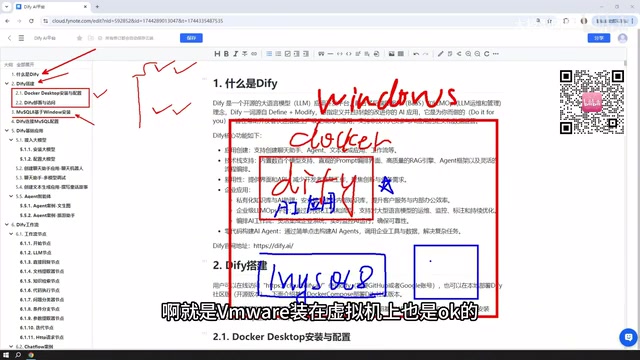
Dify Workflow in Practice: A Guide to Local Deployment and Private Knowledge Base Agents
Based on a Bilibili Dify course: Windows Docker local deployment, MySQL connection setup, five app types and workflow node cases, external LLM integration choices, and the complete path to publishing apps as sites or APIs.
A Complete Guide to Distributed LLM Training: DP/TP/PP/SP Explained
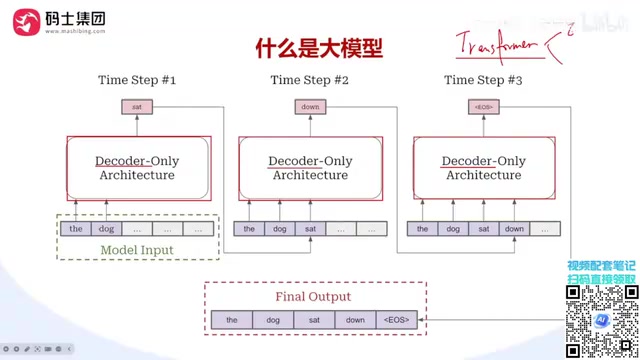
Starting from the single-GPU memory bottleneck, this guide systematically explains DP data parallelism, TP tensor parallelism, PP pipeline parallelism, and SP sequence parallelism in distributed LLM training, covering their splitting dimensions, communication costs, and hybrid parallelism selection logic.

DeepSeek Harness Step-by-Step Guide: From Installation and Setup to Plugin Practice
DeepSeek Harness step-by-step guide: Node.js setup, client installation, and three plugin installation methods to get you started fast with this open-source AI Agent framework.