Vibe Coding for Absolute Beginners: A Complete Path from Concept to Practice

Vibe Coding lets beginners build real projects by describing ideas in natural language to AI — no syntax required.
Vibe Coding is a new programming paradigm that uses natural language to drive AI code generation, offering a friendly entry point for non-technical users. This Bilibili tutorial follows a three-part structure — understand the concept, assess learnability, and build something real — using a mobile webpage project to deliver instant, confidence-building feedback. Its core value lies in lowering the cost of experimentation for product managers, designers, and hobbyists. However, the article also notes that an intro course is only a "literacy" starting point; real development still requires debugging, engineering standards, and technical judgment. Vibe Coding is best seen as a doorway into AI-assisted development, not a shortcut to employment.
What Is Vibe Coding
Vibe Coding is rapidly becoming a new entry point into programming for non-developers. Its core idea is simple: you don't need to master complete programming syntax or low-level principles. Instead, you collaborate with AI tools, describe your requirements in natural language, and let the machine turn your ideas into runnable code. Courses in this space are typically positioned as "literacy courses" — the goal isn't to train you into a professional engineer, but to help you understand what this technology is and what problems it can solve.
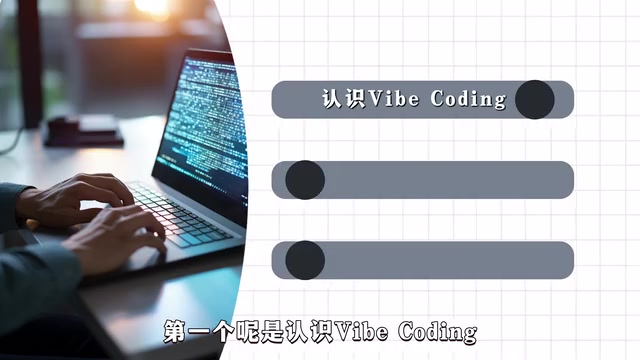
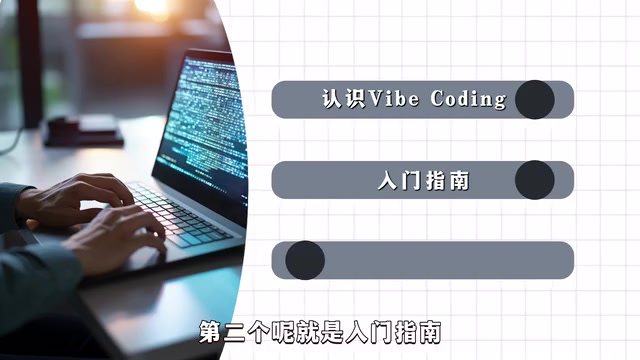
Looking at the structure of this introductory tutorial on Bilibili, the entire learning path is broken into three modules: understanding Vibe Coding, a beginner's guide, and hands-on practice. This three-part "concept → judgment → execution" design maps directly onto the three questions every zero-experience learner cares about: What is this? Can I learn it? What can I actually build?
The term "Vibe Coding" was coined by OpenAI co-founder Andrej Karpathy in early 2025. It originally described a style of programming where the developer is almost entirely immersed in AI-generated code flow, writing virtually no code by hand — acting more like a "director" who continuously describes intent to the AI in natural language, iteratively shaping a final product. This is distinct from traditional Low-code/No-code platforms, which rely on pre-built modules and drag-and-drop interfaces. Vibe Coding, by contrast, is powered by conversational AI (such as Claude or GPT-4o) or AI-native IDEs built specifically for coding (such as Cursor or Windsurf). It generates real, runnable code files and is not, in principle, locked to any single platform. That's why it's regarded as a new programming paradigm rather than just another tool.
Why It's Worth Learning Even Without a Technical Background
Traditional programming has turned away countless creative, idea-driven people who simply lack a technical background. Vibe Coding lowers that barrier to a new level — it doesn't require you to first grind through data structures, algorithms, and syntax rules. You start directly from "what do I want to build?"
The course specifically addresses the question "Can someone with zero technical background learn this?" — which reflects a genuine anxiety among many potential learners. The answer leans toward yes: with AI-assisted coding tools, describing requirements, adjusting details, and iterating on results become the primary workflow, while the code itself is largely generated by AI. This means product managers, designers, operations professionals, and even pure hobbyists all have a real chance of turning ideas into demonstrable products quickly.
What You Can Build After the Course
According to the course, after mastering the foundational skills, learners will understand where Vibe Coding applies and be able to produce a working webpage. For zero-experience users, "being able to build something" is itself the greatest motivator — seeing your own creation actually run is far more confidence-building than abstract syntax exercises.
Recommended Tools and Hands-On Practice
The third part of the course is where everything lands: hands-on practice. This section moves beyond concepts, recommends tools suited for Vibe Coding, and walks learners through building a mobile webpage from scratch.
Choosing a mobile webpage as the first project is deliberate. Once complete, it can be opened and viewed directly on a phone — that kind of instant, "what you see is what you get" feedback lets beginners feel a sense of achievement right away. The course is upfront about this: the goal is to make learners feel a surge of confidence, establishing a positive feedback loop before going deeper.
The Logic Behind Practice-Driven Learning
This project-oriented teaching approach is fundamentally different from the traditional "theory first, application later" model. It compresses a complex technical chain into one minimum viable outcome, allowing learners to naturally absorb tool usage, workflow, and core concepts in the process of completing their first project. For zero-experience learners, this is often far more effective than systematic front-loading of information.
The mainstream Vibe Coding tools today fall into two broad categories. The first is AI-enhanced code editors, led by Cursor and Windsurf — these deeply integrate large language models into a VS Code-style environment, letting users generate, modify, and explain code directly in the editor using natural language. The second is online all-in-one platforms, such as Bolt.new, v0 (by Vercel), and Replit — no local environment setup required; users simply type their requirements in a browser and receive a deployable app prototype. For zero-experience learners, online platforms are generally more beginner-friendly since they eliminate the high-friction step of configuring a local development environment. For users with some background who want more control, AI editors offer greater flexibility. Which category you choose also tends to determine how steep your learning curve will be.
A Realistic Assessment of This Type of Introductory Course
It's worth being clear-eyed here: an introductory course is positioned as a "literacy" exercise and confidence-builder. It can help you cross the first threshold, but it's still a considerable distance from the "job-ready after completion" claims some titles suggest. Real development work requires debugging skills, engineering standards, requirement decomposition, and judgment about technical limitations — none of which can be fully covered by relying on AI generation alone.
From another angle, the real value of Vibe Coding lies in lowering the cost of experimentation. It lets more people validate ideas and build prototypes at low cost, then decide whether to invest in deeper, more systematic development knowledge. For anyone looking to quickly test a product concept, or simply wanting to experience "turning an idea into reality," this type of course genuinely offers a welcoming starting point.
There are also a few limitations of Vibe Coding in practice that deserve attention. First, there's the "hallucination" problem: AI-generated code may look syntactically correct while containing logic errors or referencing APIs that don't exist — beginners often can't tell the difference. Second, there are context window limitations: as a project grows, the AI can no longer "see" all the code at once, and the quality and consistency of generation degrades noticeably. Security is another hidden risk — AI may produce code patterns with known vulnerabilities that learners unfamiliar with security practices won't catch. These limitations don't negate the value of Vibe Coding, but they do mean it's currently best suited for small projects, prototype validation, and personal tools. Using it directly in production-level, team-based professional projects still requires caution, and necessary code review and testing processes should never be skipped.
Summary
Vibe Coding represents a shift in how programming is learned in the AI era: from grinding through syntax, to collaborating with AI in natural language to create things. This introductory tutorial, through its three-part "understand → assess → build" structure paired with a mobile webpage project, lays out a relatively gentle on-ramp for zero-experience users. It works well as a doorway into AI-assisted development, but reaching a true employment-ready level still requires continuous accumulation of engineering experience and technical depth beyond what this starting point provides.
Related articles

Frontend to AI Agent Development: A Frontline Architect Explains Career Paths and Opportunities
A frontline AI architect explains the industry changes and practical paths for frontend developers transitioning to AI Agent development: why pure frontend jobs are disappearing, why Agent + full-stack has become mainstream in hiring, and three transformation routes—Agent development engineer, FDE, and remote contracting—along with corresponding learning strategies.

How to Choose an AI Agent Development Course: Five Pitfall-Avoidance Guidelines
A mechanical-engineering career changer's two-year pitfall-tested checklist for screening AI Agent development courses: complete delivery pipeline, resume-worthy projects, real development perspective, update frequency, and coaching feedback—with concrete judgment methods and pitfall-avoidance tips.

Coze AI Agent Building for Beginners: A Zero-Code AI Agent Development Guide
Coze, ByteDance's one-stop AI application development platform, supports zero-code drag-and-drop AI agent building. This article outlines Coze's core concepts, three advantages, differences between the domestic and international versions, and the distinction between agents and apps, helping beginners quickly get started with AI Agent development.