Vibe Coding for Absolute Beginners: A Full-Stack AI Development Bootcamp

Bilibili's 80-episode course argues Vibe Coding lets people direct AI to write code, using full-pipeline engineering to build a one-person company.
The article introduces Bilibili's *VibeCoding: From Absolute Beginner to Real-World Practice*, whose core thesis is that AI is reshaping software development into "one person plus an AI workflow." It defines Vibe Coding as directing AI—not writing code yourself—to build pages, connect databases, test, and produce docs and marketing content. It also warns that treating AI development as mere workflow orchestration is only the basics; industrial-grade delivery needs AI plus code, agents, and engineering.
AI is evolving from a tool into an entirely new form of productivity. The 80-episode VibeCoding: From Absolute Beginner to Real-World Practice course on Bilibili is built around exactly this idea—where building a product once required a product manager, designer, frontend and backend developers, testers, and operations staff working together, now a single person plus an AI collaboration workflow can run the entire pipeline. The course's central thesis is clear: the future of software development is being fundamentally restructured by AI.
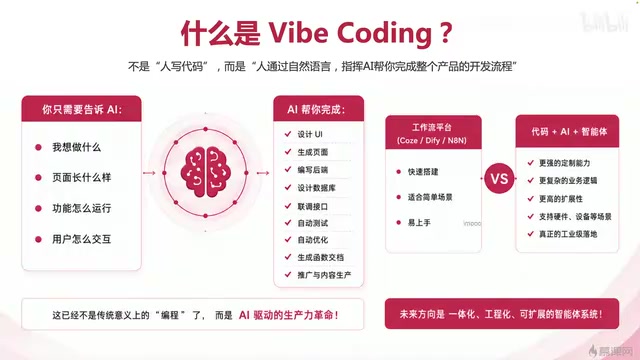
What Is Vibe Coding: From Writing Code to Directing AI
The course offers a crisp definition: it's no longer about humans writing code, but about humans directing AI to write code. You tell AI what page you want, what it should look like, and how the features should work, and AI generates the pages, writes the code, connects the database, automatically tests and fixes bugs, and even produces documentation, marketing copy, and short videos.
Many people's first reaction is "soon everyone will be a developer." The course endorses this direction but also points out a common misconception: equating AI development with workflow orchestration tools like Codesign or N8N—assuming that wiring up a few nodes and running a few flows counts as knowing AI development. The author is blunt about it—that's just the basic tier of AI usage. The real direction that can reach industrial-grade deployment and support complex systems is the combination of AI + code + agents + engineering. What will be valuable in the future isn't simple chatbots, but applications like AI e-commerce, digital humans, automation systems, and enterprise AI platforms—all of which ultimately come back to engineering capability.
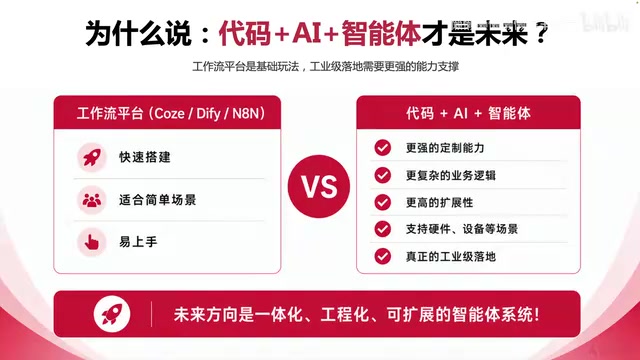
Vibe Coding was coined by AI researcher Andrej Karpathy in early 2025, referring to a way of working where developers describe intent in natural language, fully trust the AI-generated code, and may not even review it line by line. It shifts focus from syntax details to "describing what you want," emphasizing rapid iteration and intuitive debugging. But to use it in production, you must add the engineering layer: version control, type checking, automated testing, CI/CD, and security auditing—otherwise AI-generated code accumulates hidden technical debt that's hard to maintain. This is also why the course emphasizes "AI + code + agents + engineering" rather than relying purely on chat-based generation.
Course Positioning: A Practical Closed Loop for a One-Person Company
The course sets two goals. First, learning: helping students truly master Vibe Coding and AI engineering for real product delivery, rather than just knowing how to use a few AI tools. Second, earning money: the author predicts a surge of one-person companies, AI entrepreneurs, and super-individuals, with many people no longer pursuing jobs but building products with AI. So this isn't just a tools course—it's more like a practical course on running a one-person company in the AI era.
The course emphasizes a complete closed loop. A real product isn't just handwritten code—it's requirements analysis, UI design, page development, backend logic, database, testing, deployment, and marketing all connected together. To give a specific detail, the course explicitly states it's not about building a simple demo, but walking students through the entire zero-to-one product process.
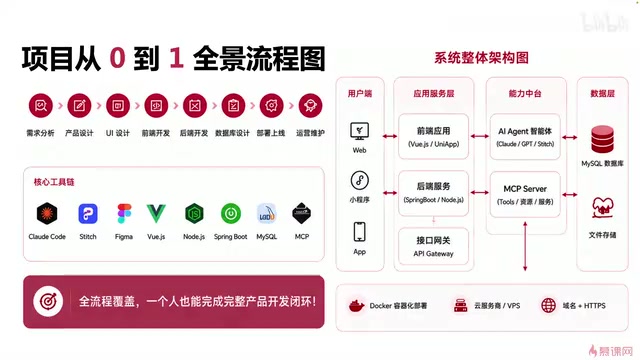
System Architecture: AI Collaboration and Multi-Platform Development
In the AI development architecture presented by the course, Claude Code, Stitch, MCP, Skills, Figma, and other tools work in concert—AI is no longer just chatting, but genuinely participating in design, development, testing, optimization, and operations at every stage. The author sees this as the future direction of AI engineering.
Multi-platform development is another area where AI has dramatically lowered the barrier. In the past, one codebase for web, another for apps, and yet another for mini-programs—extremely costly. The course uses UniApp combined with AI-generated code and component reuse to achieve develop-once, run-anywhere—which the author considers an important prerequisite for the viability of one-person companies.
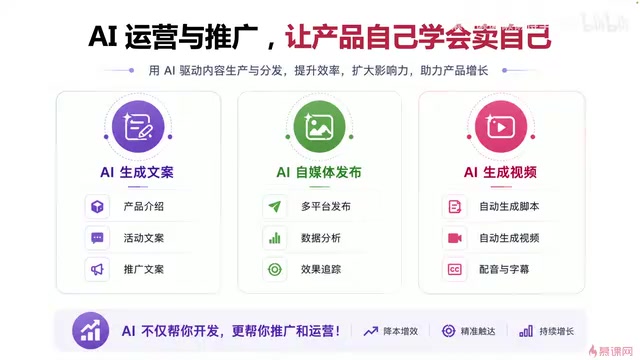
AI Operations: Letting the Product Promote Itself
Many people think product development ends when the build is done, but the course points out that the real difficulty is promotion. AI has already entered the operations domain: automatically generating WeChat public account articles, marketing copy, video scripts, and even product promo videos. From this, the author draws a conclusion—the truly capable people of the future will have dual skills in "development + AI operations."
After completing the course, students are expected to be able to independently develop products, collaborate across the full AI pipeline, apply AI engineering, develop for multiple platforms, and run AI-automated operations—with the ultimate goal of having the ability to build a product alone. The author's judgment on the trend: AI will eliminate massive amounts of repetitive labor while giving rise to large numbers of super-individuals and one-person companies, and the opportunities belong to those who prepare early. This 80-episode course is an attempt to pave the path from "absolute beginner" to "capable of shipping a complete product."
AI operations refers to using large models and automated workflows to handle content production, channel distribution, and data feedback—typical stages include topic selection, copy generation, multi-platform adaptation, asset creation, and performance review. It frees human labor from repetitive daily publishing tasks, but also brings risks of content homogenization, platform throttling, and loss of brand voice control. In practice, humans typically set the topic direction and quality thresholds, while AI produces at scale, runs A/B tests, and iterates based on data. For a one-person company, this means operations is no longer the bottleneck—but "judging what's worth promoting" still depends on human product understanding.
Background Notes
MCP (Model Context Protocol) is an open protocol introduced by Anthropic that lets large models connect to external tools, data sources, and services in a standardized way. It's essentially a universal "plug" for AI, enabling models to read local files, query databases, and call third-party APIs without writing custom adapter code for each tool. Skills, meanwhile, refers to encapsulating reusable operational workflows, domain knowledge, and scripts into AI-callable capability modules, giving agents stable performance on specific tasks. Combined, these transform AI from something that "can chat" into an executor that "can operate real systems"—and this is the technical foundation for the course treating tool collaboration as the direction of engineering.
UniApp is a Vue-based cross-platform framework where a single codebase compiles to iOS, Android, H5, and major mini-program platforms, using conditional compilation to handle platform differences. It reduces the repetitive work of multi-platform adaptation, but component compatibility, platform API differences, and performance tuning still require human judgment. AI makes this process smoother: it can generate page structures, convert platform-specific code, and fill in adaptation logic, with developers mainly responsible for describing requirements and validating results. It's worth noting that "develop once, run anywhere" isn't zero-cost—native capabilities and complex interactions still require targeted debugging.
One-line Summary
The 80-episode Bilibili course argues that Vibe Coding lets people direct AI to write code, using full-pipeline engineering to build a one-person company.
Paragraph Summary
The article introduces the Bilibili course VibeCoding: From Absolute Beginner to Real-World Practice, whose central thesis is that AI is restructuring software development from multi-person collaboration into "one person plus an AI collaboration workflow." The course defines Vibe Coding as no longer humans writing code, but humans directing AI to generate pages, write code, connect databases, test and fix, and produce documentation and marketing content. The author also flags a misconception: equating AI development with workflow orchestration like N8N is only the basic tier—industrial-grade delivery requires AI plus code, agents, and engineering systems. Positioned as a practical course for one-person companies, it covers the complete loop from requirements analysis, UI design, development, database, and testing to deployment and marketing, and uses UniApp to achieve develop-once, run-anywhere, emphasizing the future need for dual skills in "development plus AI operations."
Related articles

ChatGPT Plus Subscription Pitfall Guide: Go/Plus/Pro Tier Comparison and Quick Activation
A complete ChatGPT Plus subscription guide based on a Bilibili tutorial: from registering an account, comparing Go/Plus/Pro tiers, to the practical steps for quickly completing your subscription.

GPT-6.2 Sol/Astra Released! A Step-by-Step ChatGPT Plus Subscription Guide and Tier Comparison
GPT-6.2 Sol/Astra is out—here's a ChatGPT Plus subscription guide: register an account, compare Go/Plus/Pro tiers, and subscribe in a minute.

Comparing Three Channels for Subscribing to GPT Plus in China: Is Website Top-Up the Easiest?
How to subscribe to GPT Plus in China? This article compares website top-up, credit card, and mobile top-up channels—process, cost, and risk—with steps and tips to help you choose wisely.