Vibe Coding for Beginners: Build Real Projects with Natural Language Using Codex and Claude Code

Build a full web project in days using natural language — no coding required, just AI agents and clear goals.
This article introduces a hands-on Vibe Coding tutorial for complete beginners. Its central argument is that software development is shifting from manually writing code ("builder mode") to defining goals in natural language and letting AI handle implementation ("owner mode"), powered by AI agents capable of multi-step execution and feedback loops. The tutorial recommends Codex for Chinese users, with flexible model pairing (DeepSeek, GPT, etc.) based on task complexity. By reusing expert-crafted SOPs, even non-technical product managers can structure their requirements and independently ship a web project from scratch.
From Builder to Owner: A Fundamental Shift in Development Paradigm
Imagine a product manager with zero coding experience building a fully deployable knowledge base system — comparable to Feishu — in just three days, without writing a single line of traditional code, simply by conversing with AI in plain language. This is exactly what Vibe Coding (sometimes translated as "vibe programming" or "ambient programming") makes possible.
The core logic of this hands-on tutorial rests on a clear paradigm contrast: the development model is shifting from "builder mode" to "owner mode."
Builder mode resembles what some now jokingly call "ancient-style programming." Developers must learn complex syntax rules, algorithmic logic, and low-level principles. A typical project requires multiple roles — frontend, backend, database, DevOps — working in concert, with every line of code written from scratch. This remains the standard setup at most companies today.
Owner mode, by contrast, is goal-driven: you define objectives, describe requirements, and set boundaries in natural language, leaving the technical implementation, code writing, and framework setup to AI. You act purely as an evaluator — reviewing results, providing feedback, and iterating until satisfied. It's much like a home renovation: you start with a design blueprint, approve it, watch construction proceed, inspect the result, request revisions if needed, and continue upgrading over time.
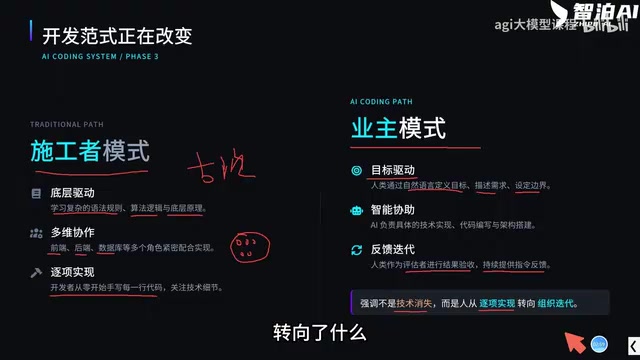
One common misconception deserves clarification: technology hasn't disappeared from this process. You've simply shifted from "line-by-line implementation" to "organizing iteration" — from writing code yourself to orchestrating AI to complete the project for you.
From Chat Tool to Intelligent Agent: A Step-Change in Capability
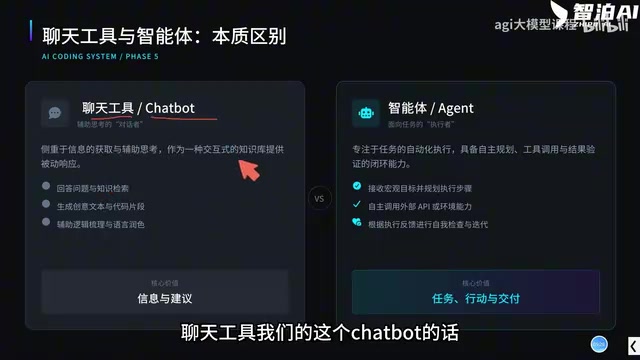
Understanding Vibe Coding requires understanding the evolution of AI from "conversational tool" to "intelligent agent."
When ChatGPT first appeared, most people treated it as a Q&A assistant — answering questions, generating scattered text, supporting thinking. The hot topics of that era were "how to write prompts" and "how to create an account." The interaction stayed at the level of information provision and suggestions.
Agent-stage AI is different. It can participate deeply in concrete work as a production tool — not just answering questions, but acting as an executor that drives tasks to completion.
Take coding tools like Codex and Claude Code as examples. A complete agent workflow involves three steps:
- Understanding the goal: Deep comprehension of complex tasks, not simple semantic matching
- Multi-step execution: Building the frontend first, then backend interfaces, advancing step by step
- Feedback loops: Continuously adjusting based on results and user feedback until delivery
The essential difference here: Vibe Coding isn't about asking AI to write a snippet of code (e.g., "write me a login page") — it's about involving AI in a complete, deliverable task. The entire project is built through AI.
The tutorial uses a fitting analogy: L3 autonomous driving in the automotive world means your hands can temporarily leave the steering wheel. While the auto industry hasn't fully reached L3, today's AI coding has essentially achieved that capability level — it can genuinely do the work for you, moving from conversational assistance to task delivery.
The fundamental difference between an Agent and ordinary conversational AI lies in the ability to act. Traditional conversational models can only generate text within a single interaction; each conversation is independent, with no ability to proactively call external tools or persistently advance a task. Agent architecture adds a "plan-act-observe" loop (the ReAct framework) on top of large language models: the model doesn't just generate answers — it can invoke external tools like code executors, file systems, browsers, and terminal commands, feeding the results back as new context to continue reasoning until the task is complete. In a coding scenario, an Agent can autonomously create files, run tests, read error messages, and fix code, all without manual step-by-step intervention. This upgrades it from a "response tool" to a true "digital worker," and it's the technical foundation that makes Vibe Coding possible.
Tool and Model Selection: Why Codex Is Recommended
On the choice of core tools, the tutorial takes a clear stance: Codex is the recommended option.
The reasoning isn't about raw technical performance — it's about accessibility. The tutorial notes that Anthropic, the company behind Claude Code, is "extremely unfriendly" to users in China, so it's not the recommended first choice for Chinese users. Codex, by comparison, is far more accessible, and DeepSeekAd has officially integrated with Codex, meaning that configuring domestic models requires minimal setup — no complex workarounds needed.
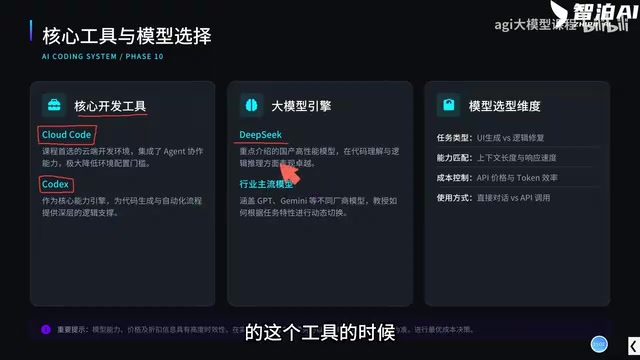
Model selection follows the principle of "matching task complexity and cost." Codex as a tool can connect to multiple models — DeepSeek, GPT, Gemini, Qwen, and others:
- Simple tasks: Use smaller Chat models to control costs
- Complex tasks: Use Reasoning models to ensure quality
This "one tool, multiple models" architecture lets users flexibly balance cost against capability.
Tokens and the context window are two core concepts for understanding the performance boundaries of AI coding tools. A token is the basic unit by which a model processes text — roughly one Chinese character equals 1–2 tokens, and about 3–4 English letters equal one token. The context window is the maximum number of tokens a model can "see" in a single inference pass, directly determining how large a codebase it can handle at once. As a project grows and file count exceeds the context window, the model starts "forgetting" earlier content, leading to inconsistent code or outright errors. This is precisely why the tutorial recommends choosing models based on task complexity — simple tasks use smaller-context Chat models to save costs, while complex tasks require larger-context, higher-reasoning Reasoning models to maintain coherence.
SOPs: Packaging Expert Experience into Reusable Collaboration Patterns
A common problem beginners face when describing requirements is vagueness: descriptions are fuzzy, lack structure, and ignore boundary conditions and technical constraints. The tutorial's solution is to reuse standards distilled by experienced developers — what it calls SOPs (Standard Operating Procedures).
Seasoned developers can provide complete, well-structured, context-rich instructions. Beginners can adopt these directly. The tutorial emphasizes that SOPs aren't meant to replace your thinking — they package mature experience into reusable collaboration patterns. This lowers the barrier for newcomers and makes requirement expression more structured.
In AI coding contexts, SOPs typically take the form of "system prompts" or "rule files" — for example, Cursor's .cursorrules file or Codex's project-level instruction configuration. These files are automatically injected at the start of each conversation, telling the AI: what tech stack the current project uses, code style conventions, directory structure agreements, which files must not be modified, and how to ask clarifying questions rather than guessing when faced with ambiguity. For beginners, reusing community-validated SOP templates is like issuing instructions from the shoulders of experienced developers — significantly reducing AI "misunderstandings" and wasted iterations. For teams, shared SOPs also ensure that different members working with AI produce stylistically consistent code, reducing long-term maintenance costs.
Who This Course Is For and What You'll Learn
The course targets a wide audience:
- Absolute beginners with no coding experience
- Product managers and designers
- Career changers exploring new paths
- Independent developers looking to build websites, mini-programs, or apps on their own
Prerequisites are minimal: basic computer literacy, fundamental English reading ability (or willingness to use an online translator), logical thinking and the ability to articulate requirements, and a computer (a phone is insufficient for full project development).
The complete learning path follows a closed-loop design of "conceptual understanding → tool mastery → experience packaging → practical delivery":
- Environment setup: Getting familiar with the command-line terminal and PowerShell
- Core concepts: Understanding mainstream tools and models, grasping foundational terms like Token and context window
- Tool usage: Hands-on use of Codex
- SOP construction: Packaging reusable collaboration standards
- Project practice: Independently completing a fully functional web project from requirements definition to live deployment
By the end, learners will have deepened their understanding of Vibe Coding, grasped how agent engines work, learned to select the right models, and be able to independently complete a full web project from zero to launch.
Final Thoughts
The core idea this tutorial conveys is worth sitting with: we don't need to become programmers in the traditional sense. What we need to learn first is how to articulate goals clearly, break problems down, and validate results rigorously. As AI becomes a development partner, product creation becomes accessible to a much broader audience.
Of course, as an introductory tutorial, it emphasizes feasibility — the ability to actually ship something — while saying relatively little about production-grade concerns like code quality, security, and maintainability. For users who seriously want to push AI-generated projects into rigorous production environments, those remain gaps to fill. But as a starting point for understanding the Vibe Coding paradigm and getting up to speed quickly, it offers a clear, followable path.
Related articles

Uber Deploys ChatGPT Work Company-Wide: AI in the Workplace Enters the Scaled Implementation Phase
Uber deploys ChatGPT Work to 30,000+ employees, extending it from engineering to all roles. We analyze its expert-engineer pairing, end-to-end automation, and questions of AI control and power concentration—insights for scaling AI in the workplace.

Shift at Midnight Hands-On: When "ID Verification" Becomes Alien Hunting
Shift at Midnight blends ID verification with horror survival in a four-player co-op game. We break down its inspection mechanics and chaotic humor.

Zelensky Recounts the Outbreak of War: I Need Ammunition, Not a Ride
Zelensky recalls the first day of war in a YouTube interview: farewell to family, rejecting Biden's evacuation offer with "I need ammunition, not a ride," and how Bucha shaped his stance on compromise and peace talks.