Vibe Coding for Beginners: Build Software with AI Using Natural Language — No Coding Experience Required

Vibe Coding lets anyone build software by chatting with AI — no programming knowledge required.
Vibe Coding, coined by Andrej Karpathy in 2025, is an AI-assisted development approach where users describe what they want in natural language and let AI handle the code. This beginner-friendly course explains the concept, highlights prompt engineering as the key skill, and guides learners through building a real mobile webpage — no prior coding experience needed.
What Is Vibe Coding?
Recently, an introductory course on "Vibe Coding" has been gaining traction on Bilibili. The course has a clear target audience — it's not an advanced tutorial for professional developers, but rather a "beginner's guide" aimed at helping people with zero technical background understand three things: what Vibe Coding is, what you can build with it, and how to get started.
"Vibe Coding" is a term first coined and popularized by OpenAI co-founder Andrej Karpathy in early 2025 on social media. Karpathy described a new kind of programming experience: fully immersing yourself in creative intent, letting AI generate code automatically — without even needing to read all the generated code. The concept quickly resonated across the global developer community, reflecting the leaps and bounds made in large language model (LLM) code generation capabilities. Tools like GitHub Copilot, Cursor, and Claude have brought "conversational development" from concept to everyday practice.
The core idea is this: let developers stay immersed in their imagination, expressing what they want through conversation with AI, rather than getting bogged down in the technical details of traditional software development. As the course author puts it, you don't need to worry about software architecture, system design, or tech stack selection — the kinds of things that only formally trained engineers typically deal with.

In other words, Vibe Coding lowers the barrier to programming down to "being able to talk and type." You communicate with AI in natural language, developing software like you're having a conversation — tell it what you want, and let it handle the rest.
A Fitting Analogy: Coding Like Writing Poetry or Painting
The course uses a vivid analogy to explain the concept. The author poses a question: when you're painting, do you stop to research what brand your brush is? Do you pause to wonder whether a different type of paper would work better?
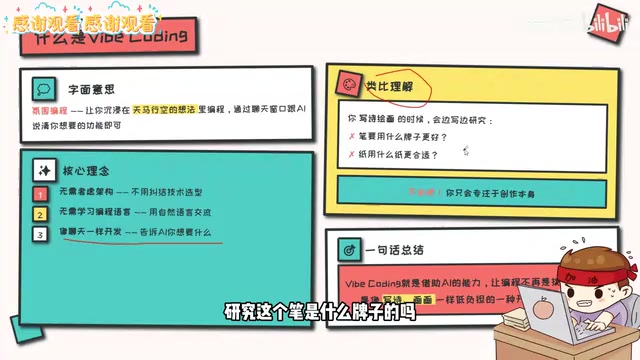
Obviously not. When you're creating, you focus on the creation itself — not on the technical specs of your tools. That's exactly the mindset Vibe Coding aims to cultivate: using AI's capabilities to transform programming from a "technical craft" into a low-friction creative process, as natural as writing poetry or painting.
Behind this analogy lies a deeper paradigm shift brought about by AI-assisted programming. The core technology driving this shift is the code generation capability of large language models (LLMs) — GPT-4, Claude 3.5, Gemini, and others. These models are pre-trained on massive amounts of code, enabling them to understand natural language descriptions and generate corresponding program code. They don't just output syntactically correct code — they understand context, support multi-turn conversational edits, and can automatically debug errors. Tools purpose-built for coding like Cursor (an AI-powered VSCode-based editor), Replit Agent, and Bolt.new further integrate LLM capabilities deeply into the development environment, making "speak to code" a reality.
Traditionally, programming required mastering language syntax, understanding program execution logic, and becoming familiar with various frameworks and tools. In the AI era, much of this "tooling burden" is significantly reduced, allowing creators to focus more on what they want to build rather than how to build it.
Can a Complete Beginner Learn This? What Can You Build?
The second part of the course focuses on a "beginner's guide," answering the question most newcomers care about: can someone with absolutely no technical background learn Vibe Coding?

Based on the course's premise, the answer is yes. Since the core skill is communicating with AI in natural language, anyone who can clearly articulate what they want can theoretically give it a shot. You don't need to learn a programming language or understand underlying architecture — what you do need is the ability to explain your ideas clearly to the AI.
This points to the true key skill in Vibe Coding: clearly describing what you need. This ties directly into the field of Prompt Engineering — the practice of carefully crafting the instructions you give an AI to guide it toward more accurate, desirable outputs. In a coding context, a good prompt should include: a clear functional goal, the use case and constraints, the desired tech stack or output format, and relevant examples where necessary. Research shows that for the same requirement, different ways of phrasing it can lead to dramatically different code quality from the AI. "How you ask the AI" has become a standalone core skill in the AI era, even giving rise to dedicated "Prompt Engineer" roles. While Vibe Coding lowers the entry barrier, getting great results still largely depends on how precisely and specifically you can articulate what you want.

As for what you can build after getting started, the course sets a concrete hands-on goal: guiding learners to build a mobile webpage from scratch that can be opened and viewed directly on a phone. This kind of tangible, visible result is crucial for helping beginners build confidence.
Hands-On Practice: From Idea to Finished Product
The third section of the course is "Hands-On Practice," where the author recommends AI coding tools suited for Vibe Coding and walks learners through completing a real project.
The value of this section is that it turns abstract concepts into something concrete. For beginners, no amount of theory compares to actually building something that runs. By completing a mobile webpage, learners get a first-hand sense of what it actually feels like to "build software with natural language," giving them the motivation to keep going.
How to Think Rationally About the Vibe Coding Trend
Vibe Coding represents an important direction in AI-assisted development — the democratization of programming. This trend didn't appear out of nowhere; it's the latest chapter in the long history of lowering the barrier to software development. From punched cards and mainframes in the 1960s, to BASIC making personal computer programming accessible in the 1980s, to WordPress and Wix enabling no-code website building in the 2000s, and the rise of Low-Code platforms in the 2010s — each wave of technology has expanded the circle of "who can build software." AI-assisted programming is the natural extension of this trajectory, with the breakthrough being that it's the first time natural language alone serves as the interface, eliminating the last barrier of "needing to learn a specific syntax." As LLM capabilities continue to improve, more and more of the work of code generation, debugging, and optimization can be handed off to AI, shifting the human developer's role from "code writer" to "requirements definer" and "quality gatekeeper."
That said, it's worth approaching this trend with clear eyes. AI-generated code has several well-known engineering limitations: first, the "hallucination" problem — models can generate syntactically correct but logically flawed code; second, security vulnerability risks — AI doesn't always proactively account for threats like SQL injection or XSS attacks; third, poor maintainability — auto-generated code often lacks consistent architectural conventions, and technical debt accumulates quickly as projects grow in scale. As a result, Vibe Coding is best suited for rapid prototyping, personal small-scale projects, and learning to get started — it lets non-technical people quickly turn ideas into working products. But for complex, long-term, performance- and security-critical engineering systems (especially in finance, healthcare, and infrastructure), a solid technical foundation and engineering discipline remain indispensable. AI is a powerful assistant, but it cannot fully replace a deep understanding of underlying principles.
For complete beginners, jumping in with Vibe Coding is a great choice — it lets you quickly experience the joy of creation and lowers the psychological barrier to learning programming. From there, supplementing with foundational computer science knowledge will take you further and on firmer ground.
Overall, this course captures a transformation that's actively unfolding: AI is redefining who gets to program. Whether you want to build a small personal tool or simply want to see what development looks like in the AI era, Vibe Coding offers an accessible enough entry point to find out.
Key Takeaways
Related articles
Altman: Taking OpenAI Public This Year Would Be 'Ill-Advised'
OpenAI CEO Sam Altman says going public this year would be 'ill-advised,' even as the company has confidentially filed IPO paperwork. Here's what it means for AI.
An Open Letter to Dario: If AI Safety Is Real, Open the Model Weights
Developer Jacob's open letter to Anthropic CEO Dario Amodei went viral on Hacker News, challenging the contradiction between AI safety rhetoric and closed-source models: if safety truly matters, why not open the weights?
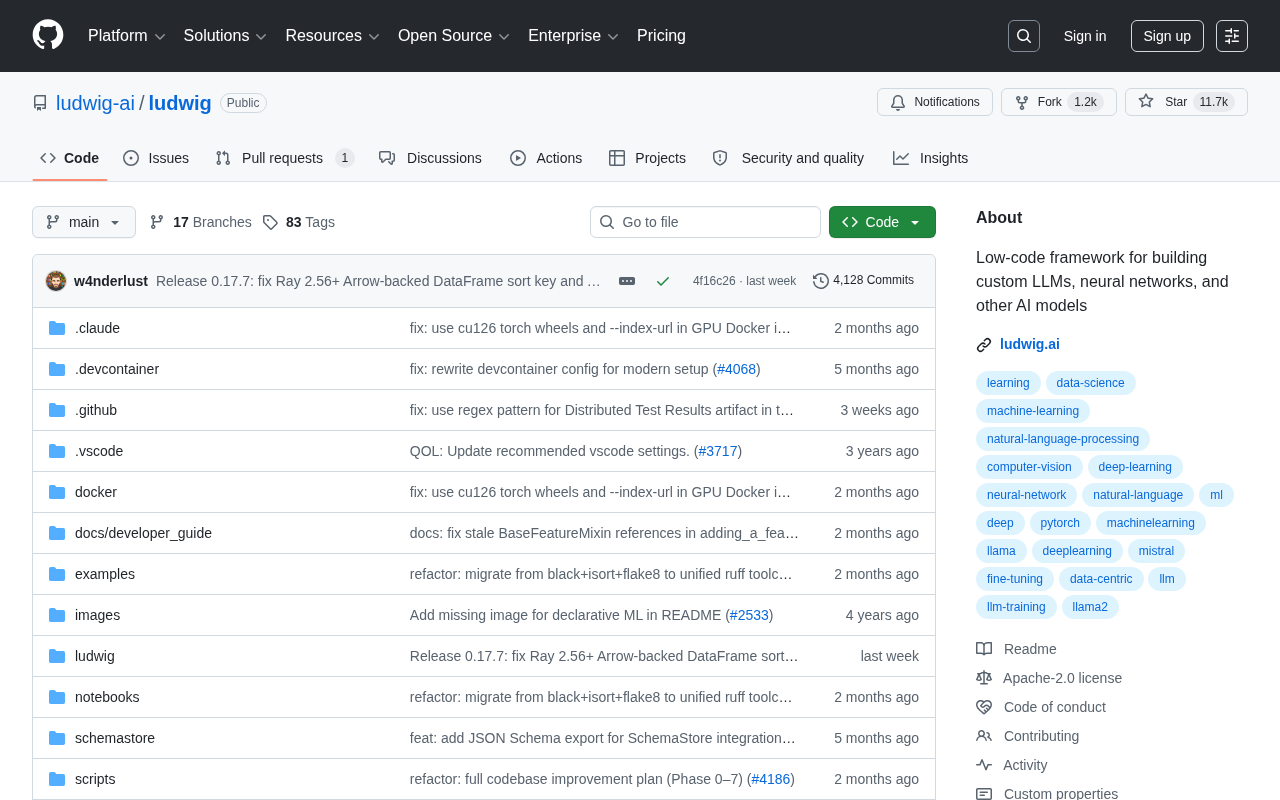
Ludwig: Building Custom LLMs and Neural Networks with Declarative Low-Code Configuration
Ludwig is an open-source low-code ML framework that builds custom LLMs and neural networks via declarative YAML config — no boilerplate training code required.