Vibe Coding for Beginners: Build Your First Software with AI — No Experience Needed
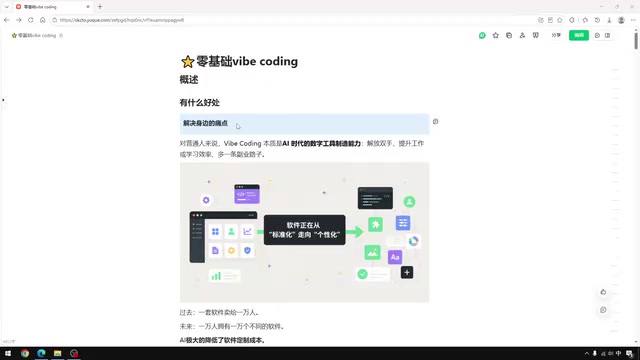
Vibe Coding lets beginners use AI to build personalized small-scale software — no coding background required.
Vibe Coding is an emerging approach that uses AI tools to turn ideas into small-scale software without a traditional coding background. This beginner course targets complete non-developers, centered on the idea that "the most important skill in the AI era is the ability to create digital tools." It encourages ordinary people to solve real everyday problems — like building a custom language-learning app — while staying honest about the limits: AI works best for small tools, side-hustle income is still hard for most people, and you won't become a programmer by the end. It also offers a low-cost way to test whether software development is something you'd want to pursue seriously.
What Is Vibe Coding, and Why Should Non-Developers Care
As AI-powered coding tools become more widespread, a new concept is entering the mainstream — Vibe Coding. Simply put, it refers to using AI to rapidly turn ideas into working software, without the traditional requirement of a solid computer science foundation. This beginner course is explicitly designed for people with zero experience: whether you're a student or a working professional, you can start from scratch and use AI to build your own small-scale software.
The course makes an important distinction: the "software" it refers to means small-scale tools — applications built for personal use or for close friends and family. Mid-to-large-scale software still has a steep barrier to entry, and AI doesn't make all complex development cost-free. This framing matters because it keeps learning goals within a realistic, practical scope.
The term "Vibe Coding" was coined by OpenAI co-founder Andrej Karpathy in early 2025. The original idea: describe what you want in natural language, let AI generate the code entirely, and as a developer you barely write or deeply understand the underlying code — you iterate on the product more by "feel" (vibe) than by technical rigor. This stands in sharp contrast to traditional software development, which demands systematic skills like data structures, algorithms, and debugging. Vibe Coding has taken off thanks to LLM-powered tools like Cursor, GitHub Copilot, and Claude, which can generate runnable code snippets — or even entire application scaffolds — from a single sentence. That said, this approach works best for projects with clear, well-scoped requirements. Once complex system architecture, performance optimization, or security compliance enters the picture, the quality of AI-generated code often falls short, and experienced engineers are still needed to review and intervene.
Why It's Worth Learning: Solving Real Problems Around You
The course doesn't offer vague motivations — it grounds everything in concrete scenarios. Here's one example: say you want to learn English, but the apps on the market feel clunky and don't match how you think. Traditionally, you'd just have to live with it. With Vibe Coding, you can build a small tool tailored exactly to your own needs.
Underpinning this is a core insight: In the age of AI, the most important skill is the ability to create digital tools. Those "digital tools" are small-scale software, and the "ability to create" means using AI to build them quickly. Master this, and you can boost your own productivity — and potentially open up a side income stream.
That said, the course author takes a refreshingly grounded stance on the "side hustle" angle. He's blunt about it: most online claims that "learning AI will earn you side income" are heavily exaggerated. Highly capable people might make it work, but for most people there's still a real barrier. This kind of honest framing — rather than manufactured hype — is far more useful as a guide.
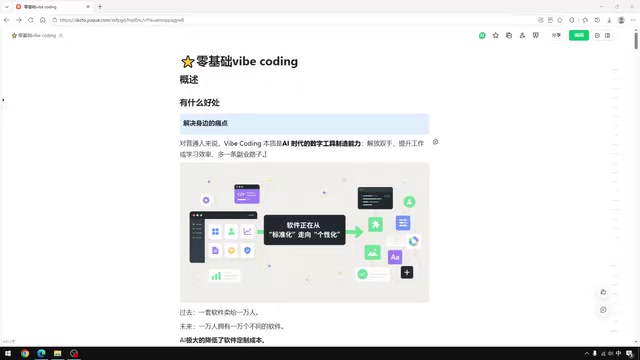
From Standardized to Personalized: How Software Is Changing
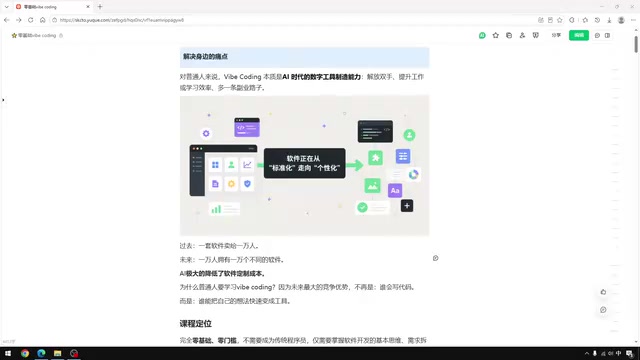
The course raises an interesting observation: software is shifting from standardized to personalized.
In the past, whatever a software company built, users had to accept. One standard product served everyone. If it didn't work for you, there was nothing you could do — ordinary people had no way to build their own. Now, AI has dramatically lowered development costs, making it possible for anyone to generate personalized software.
The author uses a vivid analogy to illustrate the shift: in the past, a software company built one product and sold it to ten thousand people, all sharing the same tool. In the future, ten thousand people might each have ten thousand different versions of that software, because each person can customize their own. While this trend applies primarily to small-scale software, it does highlight how AI is reshaping the economics of software production.
This trend is driven by two converging forces on the technical side. First, the code generation capabilities of large language models (LLMs) have dramatically reduced the cost of turning natural language into runnable programs. Second, the integration of low-code/no-code platforms (like Bubble, Glide, and Webflow) with AI now allows non-technical users to accomplish — through drag-and-drop and conversation — what previously required a professional development team. The extreme end of personalized software is sometimes called the "long tail of software" — analogous to how internet content evolved from portal websites to personal blogs and short-form video, software may undergo a similar shift from big-company products dominating to a flourishing of individual tools. Of course, this trend currently manifests mainly in lightweight use cases: data processing scripts, personal productivity tools, simple information management apps. Core infrastructure and enterprise systems are unlikely to see their landscape disrupted anytime soon.
Course Philosophy: Not About Becoming a Developer — It's About Low-Cost Experimentation
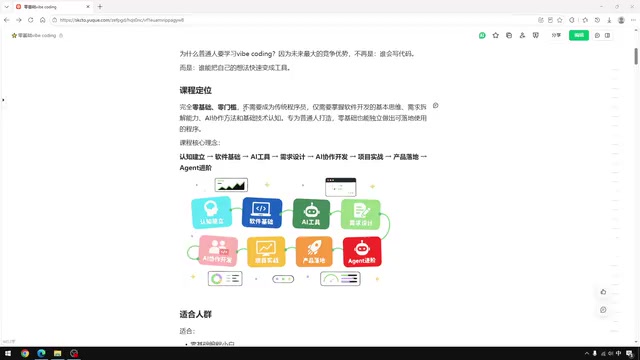
The course has a clear positioning: it's for people with zero background and zero prerequisites. After completing it, you won't become a programmer. The goal is simply to help you use AI to generate software and solve real problems in your life.
But the author adds one more angle: if you've ever thought about becoming a developer, this course offers a low-cost way to test that idea.
Why "Low-Cost Experimentation" Matters
Traditionally, becoming a programmer meant investing massive time and effort into learning before you could even tell if you enjoyed it. Many people discovered only after months of study that programming simply wasn't for them — time and energy wasted. And for those who've never done any development work, there's no way to know in advance whether it clicks.
This course lets you build a basic, holistic understanding of what programming involves in a relatively short time — enough to quickly gauge whether you're genuinely interested. If you finish and find that spark, you can then go deeper into professional software engineering. This "try first, then commit" design is particularly friendly to beginners who are on the fence about pursuing development.
Takeaway: A Grounded Perspective on Getting Started with AI Coding
The defining quality of this course is pragmatism. It doesn't overstate the capabilities of AI coding — it repeatedly emphasizes that the scope is "small-scale software." It doesn't manufacture side-hustle fantasies, honestly acknowledging that monetization remains a real hurdle for most people. And it offers a clear, honest purpose: solve real problems, improve efficiency, experiment at low cost.
For anyone curious about AI-assisted coding but worried their lack of experience will hold them back, this kind of expectation-setting approach is far more trustworthy than courses promising overnight income. The real value of Vibe Coding may not be turning you into the next developer — it's giving every ordinary person the ability to turn their ideas into actual tools.
Related articles
Andrew Ng on Agentic AI: Cutting Through the Hype to Find Real Value in Agent Development
Andrew Ng's Agentic AI course intro: separating hype from real value, exploring agent workflows in customer service, research, law, and healthcare, and why evals and error analysis define expert-level agent development.

The Netflix Microservices Myth: An Architecture Migration Misunderstood by an Entire Industry
The real story behind Netflix's cloud migration and microservices transformation — and why the entire industry copied the solution while missing the actual problem.

Java 27 Deep Dive: How Default Changes Are Quietly Reshaping Production Environments
Java 27 has just 9 JEPs but changes key defaults: compact object headers on by default, G1 as unconditional default GC, Flight Recorder redaction, and built-in post-quantum TLS 1.3.