Vibe Coding vs. AI-Assisted Engineering: An In-Depth Look at Enterprise-Level Development

Why Vibe Coding can't replace professional engineers — and what AI-assisted engineering actually looks like in enterprise projects.
Vibe Coding can produce simple apps, but enterprise-scale systems demand engineering discipline that pure prompt-driven coding can't provide. This article examines the real pain points of AI-generated code — security risks, maintainability collapse, and unresolvable production bugs — and contrasts Vibe Coding with structured AI-assisted software engineering using tools like Claude Code and Codex.
Introduction: The Myths and Realities of AI Programming
With the rapid adoption of AI coding tools like Claude Code, Codex, and Cursor, more and more developers have woven AI into their daily workflows. Yet a seductive claim keeps circulating on social media: "I have zero technical background, I've never written a line of code, but with Vibe Coding I built something incredible — and we don't need programmers anymore."
Vibe Coding is a concept popularized by OpenAI co-founder Andrej Karpathy in early 2025. The core idea is that you describe what you want in plain language, let AI generate all the code, and never need to understand the implementation details — you just "vibe" with the direction of the project. The idea went viral almost instantly, drawing waves of non-technical people eager to try "zero-barrier programming."
It's worth understanding the technical backdrop that gave rise to this trend. Since GPT-4 launched in 2023, AI pass rates on mainstream coding benchmarks like HumanEval have leaped from below 50% to over 90%. That qualitative leap made "natural-language-driven programming" feel suddenly real. When Karpathy introduced the concept, his actual point was that as model capabilities keep improving, the human engineer's role is shifting from "code writer" to "requirements definer" and "outcome reviewer" — a reasonable observation in the context of exploratory prototyping. But as it spread across mainstream media, the original context was largely stripped away. Notably, Karpathy himself emphasized that this approach is better suited to personal projects and proof-of-concept validation, not production systems.
So how much of the hype is real? This article draws on enterprise-level AI programming coursework to explore the enormous gap between entry-level Vibe Coding and genuinely deployable AI-assisted engineering — and to help professional developers build a clearer, more grounded perspective.
The Real Limits of Vibe Coding
Can Non-Technical Users Really Replace Programmers?
Honestly? Pointing a non-technical person at an AI coding tool and having them Vibe Code their way to a simple project — a basic website, a dropshipping storefront, a mini-program, or a casual game with straightforward business logic and low technical complexity — is entirely plausible.
But enterprise-level projects are a completely different story. Enterprise-scale means:
- Highly complex business logic
- Significant technical depth (high concurrency, microservice architectures, distributed systems, massive-data infrastructure)
- Team collaboration, ongoing operations, and long-term maintenance
These are technical challenges that form a natural barrier Vibe Coding simply cannot overcome. High concurrency means a system must handle large numbers of simultaneous user requests, typically requiring multiple layers of support including load balancing, caching strategies, and database connection pools. Microservice architecture decomposes a monolithic application into multiple independently deployed and scaled services, introducing complex coordination mechanisms like service discovery, API gateways, and distributed transactions. Distributed architecture takes this further, addressing cross-node data consistency and network partition tolerance — territory governed by the CAP theorem (Consistency, Availability, Partition Tolerance), which holds that no distributed system can fully satisfy all three properties simultaneously. Engineers must make context-specific trade-offs based on their understanding of the actual business, a decision that requires domain experience and no AI tool can currently substitute for. These architectural choices often require years of accumulated engineering experience. Without engineers who possess that background knowledge reviewing AI-generated code, production environments can easily suffer cascading failures.
"Getting a non-technical person to Vibe Code a large, complex enterprise project is simply not possible — at least, there is no real-world case that proves otherwise."

The Commercial Reality Behind Those "Incredible" Vibe Coding Projects
The "mind-blowing Vibe Coding projects" that influencers love to showcase rarely hold up under scrutiny. Hand them off to a company, ask a team to maintain and operate them long-term, and they almost always fall apart. That ceiling is precisely where Vibe Coding hits its limit.
Four Real Pain Points in AI-Assisted Coding
Developers who've spent serious time with AI coding tools tend to run into the same walls — and these pain points reveal exactly why pure Vibe Coding can't sustain enterprise-level development.
Pain Point 1: No One Is Accountable for Security
"I have no confidence in the security" is consistently the most commonly cited frustration. AI generates code faster than developers can review it line by line — is this safe to deploy? Who knows. And if a serious bug surfaces in production, who's responsible?
This concern is technically well-founded. Stanford research has found that developers using AI coding assistants are more likely to introduce security vulnerabilities — and paradoxically, are more confident that their code is secure. This "overtrust" effect creates a distinct category of risk. Common AI-generated security vulnerabilities include SQL injection (AI tends to generate code that concatenates SQL strings), insecure random number generation, hardcoded sensitive information, and unintentional calls to functions with known CVEs. The root cause is that AI training data contains both secure and insecure code examples. When generating code, the model has no genuine security-auditing awareness — it's performing statistical pattern matching, not reasoning about safety.
The answer is blunt: The LLM won't take the fall for you. Whoever signs off on AI-generated code owns the consequences.
Pain Point 2: Code Quality Is Hard to Guarantee
- Inconsistent coding style: AI-generated code often lacks uniformity and shared standards
- Hidden bugs: Rapid generation frequently comes with quality trade-offs
- Token costs spiral: Long contexts drive up expenses continuously
Pain Point 3: Maintainability Collapses Over Time
"The more you write, the more the project becomes a mountain of garbage by the end — unmaintainable, liable to collapse at any moment." This isn't hyperbole; it's what actually happens to many AI-assisted projects.
In software engineering, this phenomenon maps directly to the concept of Technical Debt, coined by Ward Cunningham in 1992. The metaphor likens substandard implementations made for short-term gain to financial debt — just as financial debt accrues interest, technical debt makes future development progressively harder.
When AI generates large volumes of code, it dramatically accelerates technical debt accumulation, and in ways that differ from traditional technical debt. Traditional technical debt primarily stems from design compromises made under time pressure. AI-accelerated technical debt adds an "context amnesia" problem: because large language models treat each conversation independently, they cannot build a persistent cognitive model of an entire codebase the way a human engineer can. Code generated across different sessions may be systematically inconsistent in architectural style, naming conventions, and error-handling strategies. This inconsistency is easy to miss in early development but tends to explode into a maintenance crisis later — inconsistent naming, duplicated functionality, missing abstraction layers — all are especially prominent in AI-assisted rapid development.
Pain Point 4: Production Incidents Become Unresolvable
If a bug appears in production and the AI model keeps generating fixes that don't work, the entire project can grind to a halt.

AI-Assisted Engineering: A Systematic Solution
From Everyone Swimming Alone to Coordinated Teamwork
Many business leaders without technical backgrounds lack an architect to provide oversight, so they just let employees pick up AI coding tools and run with them — this is essentially "swimming blindfolded," a panic response rather than a strategy.
When everyone uses a different tool and follows their own logic, engineering-grade development becomes impossible, team collaboration breaks down, and long-term project operations are a non-starter.
AI-Assisted Software Engineering as an emerging methodology is fundamentally a development paradigm that combines traditional software engineering discipline with AI tool capabilities. Its core components include: Standardized prompt engineering — using unified prompt templates to ensure consistency in AI outputs; Context management strategies — using carefully designed system prompts and project rules files (e.g., .cursorrules, CLAUDE.md) to pass architectural constraints and coding standards to the AI; Human-AI collaborative review processes — establishing a review checklist for AI-generated code to verify security and maintainability; and Version control and traceability — ensuring every piece of AI-generated code has a corresponding human engineer who signs off on it.
Several reference standards for this methodology have already emerged in industry. Anthropic's official CLAUDE.md specification, the .cursorrules configuration system promoted by the Cursor team, and Google DeepMind's internal AI-assisted development guidelines all point toward the same core principle: through structured project context files, make the implicit engineering knowledge of architectural constraints, coding style, and security rules explicitly available to AI, thereby constraining AI output within controllable engineering boundaries. In essence, this reframes "prompt as documentation" as a new mechanism for transmitting software engineering standards. Companies like Google and Meta have already established similar specification documents internally — a signal that AI-assisted engineering is moving from individual practice to organizational-level standardization.
This is the approach that genuinely professional enterprise teams are actually using today.
A Direct Comparison: Two Real Projects
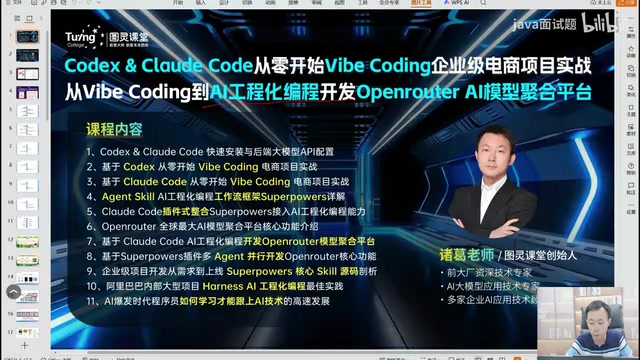
Two real projects illustrate this fundamental difference:
- An e-commerce project — built using traditional Vibe Coding
- An OpenRouter AI model aggregation platform — built using AI-assisted engineering
The gap between the two approaches in code quality, maintainability, and team collaboration efficiency becomes immediately obvious in a side-by-side comparison.
Tool and Model Selection: Practical Recommendations
AI Coding Tools: Claude Code vs. Codex
In enterprise AI programming practice, these two tools each have their strengths — and their underlying architectural designs reflect two distinct philosophies of AI-assisted coding:
-
Claude Code: Developed by Anthropic, it runs as a command-line Agent, capable of autonomously reading and writing files, running tests, and executing terminal commands. Its core advantages are an extremely long context window (up to 200K tokens) and strong comprehension of large codebases, making it especially well-suited for complex refactoring and cross-file engineering tasks. Claude Code centers on an Agentic Loop model — allowing the model to autonomously plan multi-step tasks and execute iteratively, functioning more like an autonomous software engineer with tool-calling capabilities than a simple code generator. Based on Anthropic's publicly described Constitutional AI training approach, the Claude series has stricter alignment constraints around precise instruction-following and refusing to generate harmful code, which carries additional value in enterprise security and compliance contexts. It offers greater professional depth and is the most widely used tool among professional programmers in enterprise settings. The mainstream professional setup is VS Code + the Claude Code extension.
-
Codex: OpenAI's coding model series, deeply integrated into the ChatGPT and GitHub Copilot ecosystem, primarily centered on code completion and conversational generation as interaction paradigms, emphasizing real-time collaboration with developers. It offers excellent usability and accessibility, performs outstandingly when backed by the latest GPT versions, and is better suited for beginners and rapid onboarding. The GPT-4 series has broad community validation for code generation fluency and multilingual support.
There are also many other options — Cursor, ByteDance's Trae, Tencent's AI tools, and more. Which tool you pick isn't the critical question — engineering-first thinking is. Choose whatever tool fits your needs and your team.

Model Selection Strategy
For model selection, the following approach is a reasonable starting point:
- Codex users: For the backend, native GPT version integration is the first choice for best compatibility and stability
- Claude Code users: The Claude series excels at professional programming tasks; if access is restricted, consider alternative routing options
Looking at the developer community in practice, GPT, Claude, DeepSeek (V3/R1), Gemini, Copilot, and a range of domestic Chinese models all have developers using them in production environments — reflecting the genuinely diverse AI coding ecosystem we live in today. DeepSeek V3/R1 has demonstrated near-top-tier commercial model performance on code reasoning tasks at significantly lower API costs, and is becoming an increasingly important alternative for engineering teams in China.
Conclusion: The Clear-Eyed Perspective Professional Developers Need
AI coding tools have genuinely and substantially increased development productivity. But "non-technical users replacing programmers" is largely a marketing narrative manufactured by content creators. Real enterprise project development requires an AI-assisted engineering mindset — harnessing AI through disciplined, collaborative, and maintainable systems, rather than letting it generate heaps of unmanageable code.
Code review ability, architectural judgment, and security awareness have not lost value in the AI era. If anything, they've become the core dividing line between casual users and professional engineers. The boundaries of a tool's capabilities determine how fast it can take you; your engineering fundamentals determine how far you can actually go.
For every developer working with AI-assisted coding, one principle is worth keeping front of mind: Your name is on the code. The responsibility is yours. No matter how powerful the tool, professional judgment and engineering discipline can never be replaced.
Related articles

Buzz Multi-Agent Collaboration in Practice: A Team-Based Development Guide for the 30K-Star Open Source Dark Horse
A deep dive into Buzz, the 30K-star open-source multi-agent framework: three-layer architecture, AI team role design, JSON contract alignment, and human-in-the-loop workflows.
NVIDIA TensorRT Model Connect: Deploy Open-Source Models with Two Commands
NVIDIA TensorRT Model Connect deploys open-source models with just two commands — no ONNX conversion needed. Supports LLMs, diffusion, video generation, and more, with RTX consumer GPU compatibility and new dual DGX Spark multi-device inference.
NVIDIA cuML Accelerates Spectral Clustering: 100x+ Speedup Over Scikit-Learn Benchmarked
NVIDIA cuML lets Scikit-Learn spectral clustering run on GPU without code changes, delivering 200x+ speedups on large datasets. Learn how it works and how to use it.