Vibe-Trading: The Rise and Practice of Open-Source AI Trading Agents

HKUDS's Vibe-Trading brings LLM-powered AI agents to quantitative trading — going viral on GitHub with 17,000+ stars.
Vibe-Trading, an open-source Python project from Hong Kong University's HKUDS lab, has rapidly gained over 17,000 GitHub stars by applying a classic LLM + Tool Calling Agent architecture to quantitative trading. This article breaks down its technical design, core modules (data ingestion, LLM reasoning, execution, risk control), the role of RAG and human-in-the-loop safeguards, and what its viral growth signals about AI Agents entering vertical financial domains.
The Rise of Open-Source Trading Agents
Recently, Vibe-Trading, an open-source project from the University of Hong Kong's Data Science Lab (HKUDS), went viral on GitHub — gaining 939 stars in a single day and accumulating over 17,388 stars and 2,887 forks. Positioned as "Your Personal Trading Agent," this Python project is quickly becoming a landmark work at the intersection of AI Agents and quantitative trading.
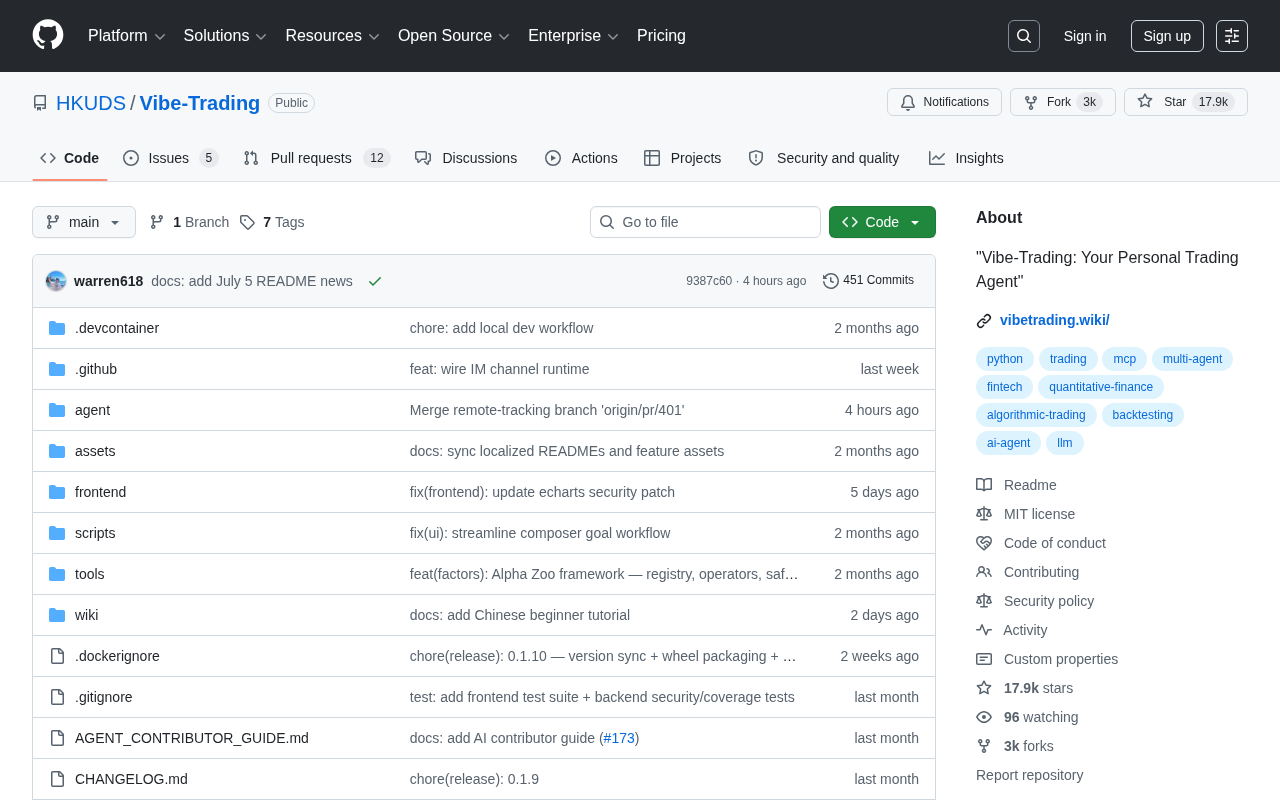
The HKUDS team has a track record of high-star open-source projects — their LightGCN and SGL in the Graph Neural Network (GNN) space have been widely cited in both academic and industrial circles. GNNs are deep learning models designed for graph-structured data, aggregating neighborhood information via message passing — particularly well-suited for modeling relationships between entities. LightGCN, proposed by HKUDS for collaborative filtering, streamlines graph convolution by removing nonlinear transformations and feature transformation matrices, significantly improving computational efficiency. In financial applications, GNNs can model stocks, sector indices, and macro indicators as heterogeneous knowledge graphs, capturing hidden correlations like supply chain linkages and sector co-movements that traditional time-series models struggle to represent. Building on this foundation, HKUDS has expanded its research into the fusion of large language models with structured data, accumulating deep engineering experience in knowledge graphs, time-series forecasting, and financial decision-making. This technical trajectory — from graph learning to LLM applications — is a key reason Vibe-Trading has earned recognition from both academic and engineering communities.
The "Vibe" in the name also cleverly echoes the "Vibe Coding" trend sweeping the tech world. The concept was formally introduced by OpenAI co-founder Andrej Karpathy in February 2025 on X, describing a new programming paradigm where developers rely entirely on AI to generate code — no longer reading through code line by line. Developers simply describe the "feel" and intent of what they want, and AI tools like GitHub Copilot or Claude handle the implementation; when errors arise, developers just paste the error message back to the AI. This is fundamentally different from traditional pair programming where humans remain in control: in Vibe Coding, the AI is the true "driver," and the human shifts from "code writer" to "requirements describer and quality gatekeeper." Vibe-Trading applies this philosophy directly to trading decision-making.
What Is Vibe-Trading?
At its core, Vibe-Trading aims to bring the Vibe Coding philosophy into trading. Traditional quantitative trading demands expertise across programming, financial modeling, and data engineering — an extremely high barrier. Vibe-Trading's central idea is to let users engage with AI Agents in a more natural and intuitive way, covering the entire pipeline from strategy conception to execution.
From Quant to "Agentified" Trading
Quantitative trading's history stretches back to the 1970s, when mathematicians like Edward Thorp pioneered statistical arbitrage and options pricing models. In the 1980s–90s, firms like Renaissance Technologies systematized computer-driven statistical models — Simons' Medallion Fund achieved an annualized return exceeding 66%, becoming industry legend. The 2010s brought deep learning into time-series prediction with LSTM and Transformer architectures, and high-frequency trading peaked during this era.
Against this backdrop, traditional quant trading evolved through three major phases: rule-based strategy engines (e.g., moving average crossovers, momentum strategies) — transparent but lacking adaptability; machine learning models (e.g., random forests, LSTM networks) — capable of learning complex patterns but still dependent on manual feature engineering; and now the emerging "agentification" phase, where LLMs serve as the reasoning core, integrating multimodal information (prices, news, earnings, social sentiment) with contextual understanding, multi-step planning, and dynamic feedback. Research from Stanford, Tsinghua, and others shows significant LLM advantages in financial text comprehension and event-driven decision-making, though robustness in noisy markets remains an open challenge.
It's worth noting that Vibe-Trading's single-LLM architecture presents an interesting contrast with multi-agent collaborative frameworks being explored in academia. In multi-agent systems, specialized agents (e.g., macro analysis, technical analysis, risk control, execution) work in parallel and coordinate via shared memory or message buses — better simulating the division of labor in real investment institutions, much like how a hedge fund's macro strategist, quant researcher, and risk officer each play distinct roles. Frameworks like AutoGen and CrewAI have made deep engineering inroads in this direction. For developers, Vibe-Trading's single-agent architecture is an excellent entry point into "agentified trading," while multi-agent collaboration represents the more engineering-intensive frontier.
As LLM capabilities continue to advance, trading is evolving along this path from "quantitative" to "agentified":
- Intent Understanding: Users describe trading ideas in natural language; the Agent translates them into executable strategies;
- Autonomous Decision-Making: The Agent performs multi-step reasoning combining market data and news, dynamically updating its judgments;
- Continuous Iteration: Feedback loops continuously refine strategy performance, enabling self-improvement.
This paradigm shift opens complex trading decisions to non-specialist users — a key reason Vibe-Trading attracted attention so quickly.
Technical Architecture and Implementation
As a Python project, Vibe-Trading follows the classic AI Agent architecture of LLM + Tool Calling. Tool Calling (also known as Function Calling) refers to a model's ability to recognize when it needs an external function during inference and generate a structured call request. In practice: developers define a set of tools via JSON Schema (including function names, parameter types, and descriptions); when the model determines a tool is needed, it generates a structured JSON call request rather than outputting text directly; the host program executes the function and injects the result back into context for continued reasoning. Common tools in quantitative trading include: yfinance for market data, pandas for technical indicator calculation, Alpaca/Interactive Brokers trading APIs, and news sentiment analysis interfaces. OpenAI formally introduced this capability in GPT-4 in 2023, and it is now supported by Anthropic Claude, Google Gemini, and other major models. This mechanism transforms LLMs from pure language processors into a "cognitive hub" capable of interacting with real-world systems — the foundational technology for building trading agents.
Under this framework, the LLM acts as the "brain" — responsible for understanding, planning, and decision-making — while data retrieval, indicator calculation, and order execution are handled through external tool interfaces.
A Typical Agent Workflow
A complete trading Agent typically comprises four core modules:
- Data Ingestion Layer: Connects market data, earnings data, social media sentiment, and other multi-source information to build an information foundation;
- Reasoning and Planning Layer: LLM-driven, decomposing user intent into sequences of executable subtasks;
- Execution Layer: Calls trading APIs to carry out actual buy/sell operations;
- Risk Control and Monitoring Layer: Real-time monitoring and alerting on key risk metrics such as position size and drawdown.
It's critical to note that applying AI Agents to real-money trading carries extremely high risk. The model hallucination problem is particularly dangerous in financial contexts — models may misquote earnings data, misjudge news sentiment, or produce unrealistic predictions in extreme market conditions, each of which can directly cause financial losses.
The main engineering approaches to mitigate this include Retrieval-Augmented Generation (RAG) — chunking large volumes of earnings reports, research notes, and news into semantic segments, vectorizing them into vector databases (e.g., Pinecone, Chroma, Faiss), and retrieving the most relevant document segments at query time to anchor the model's reasoning in facts rather than training memory. Research from Meta and NVIDIA shows this approach improves accuracy by 20%–40% on knowledge-intensive tasks compared to pure parametric memory.
A deeper note on RAG engineering in financial contexts: text vectorization typically uses finance-domain fine-tuned embedding models like FinBERT or OpenAI's text-embedding-3-large, which more accurately capture semantic distances between financial terms like "revenue beat," "liquidity crisis," and "quantitative easing" — achieving over 15% higher accuracy on earnings Q&A tasks than general-purpose embeddings. Among vector databases, Pinecone suits cloud-native large-scale deployment; Chroma is lightweight and ideal for local debugging; and Meta's open-source Faiss excels at high-performance approximate nearest neighbor (ANN) search, commonly integrated into latency-sensitive live trading systems.
Other key safeguards include confidence calibration — having the model proactively decline to answer when uncertain — and Human-in-the-Loop (HITL) design, typically implemented at three levels: trade instructions exceeding a set dollar amount or position ratio must be routed to human review; automatic circuit-breaker pauses when model confidence falls below a threshold or market volatility exceeds historical extremes; and full logging of each decision's Chain-of-Thought for post-hoc auditing.
This design philosophy aligns not only with engineering best practices but also with regulatory requirements from major financial authorities worldwide. The SEC's Reg BI, EU's MiFID II, and China's CSRC algorithmic trading registration rules all impose explicit requirements for explainability, auditability, and human intervention mechanisms on automated trading systems. This means open-source trading agents pursuing commercialization must embed compliance logic at the system design level — elevating "human-in-the-loop" from an engineering option to a legal obligation. Beyond compliance, the non-stationarity of markets and the risk of runaway behavior in extreme conditions are core challenges that must be taken seriously.
Industry Signals Behind the Viral Growth
Vibe-Trading's near-1,000-star single-day growth reflects several noteworthy industry trends.
AI Agents Are Deeply Penetrating Vertical Domains
Following coding assistants and customer service bots, quantitative trading has become another hot domain for AI Agent deployment. Finance is data-intensive, decision chains are clearly defined, and feedback signals are concrete — naturally suited to Agent technology. Market prices provide immediate, objective feedback, making it far easier to quantitatively evaluate an Agent's decision quality than in language tasks. The developer community's continued enthusiasm for such projects signals active exploration of AI's capabilities at the professional vertical frontier.
Open-Source Projects Are Democratizing FinTech
Historically, mature quantitative trading systems were the domain of hedge funds and top brokerages — requiring expensive data subscriptions and dedicated quant research teams. Institutional players like JP Morgan and BlackRock already use NLP to process alternative data (satellite imagery, credit card transactions, social sentiment) — data sources beyond traditional financial statements and exchange feeds that often contain market-moving information unavailable to most investors. Open-source frameworks like Vibe-Trading bring similar technical capabilities to individual developers, lowering the barrier to entry and advancing the democratization of financial technology.
A Balanced View: Opportunities and Risks
Despite the exciting technical promise of Vibe-Trading, real-world use demands extreme caution.
First, no trading system can guarantee profits. AI Agents can improve efficiency and assist decision-making, but the market's inherent unpredictability means no tool can consistently beat it. Second, entrusting real capital to autonomous AI management requires comprehensive risk controls — RAG data grounding, human-in-the-loop confirmation, strict position limits, and circuit breakers are all essential. Regular users should prioritize thorough testing in simulated environments before considering live deployment.
For developers, Vibe-Trading's greater value may lie in its role as a learning reference — understanding how to integrate large language models with tool calling, data stream processing, and decision loops to build a complete domain-specific Agent. The engineering experience gained from this kind of practice may ultimately be worth far more than any trading returns.
Conclusion
Vibe-Trading's viral rise is a vivid reflection of AI Agents moving from general-purpose to vertical domains, and from assistive to autonomous roles. It showcases the enormous potential of large language models in specialized fields while reminding us to maintain a rational view of AI's application boundaries in high-stakes scenarios. For developers tracking the evolution of AI Agents, this open-source project from HKUDS is unquestionably worth deep study and continued attention.
Related articles
What Is Vibe Coding? The AI Programming Skill Every Developer Needs
What is Vibe Coding? Learn how AI programming is reshaping dev teams, why traditional programmers face displacement, and why Cursor & Claude Code matter.
Making Rocks Think: A Philosophical Exploration of Generative AI and Information Compression
From a viral Reddit post to deep AI theory: why compression equals understanding, the Library of Babel thought experiment, semantic compression, and the Hutter Prize.
Irregular Warns: Four AI Lab Security Breaches Traced to the Same Root Cause
Irregular reveals four AI lab security breaches share a single root cause, exposing systemic risks from technology stack homogeneity across the AI industry.