Virginia Governor Establishes AI Task Force, Tightens Data Center Approvals
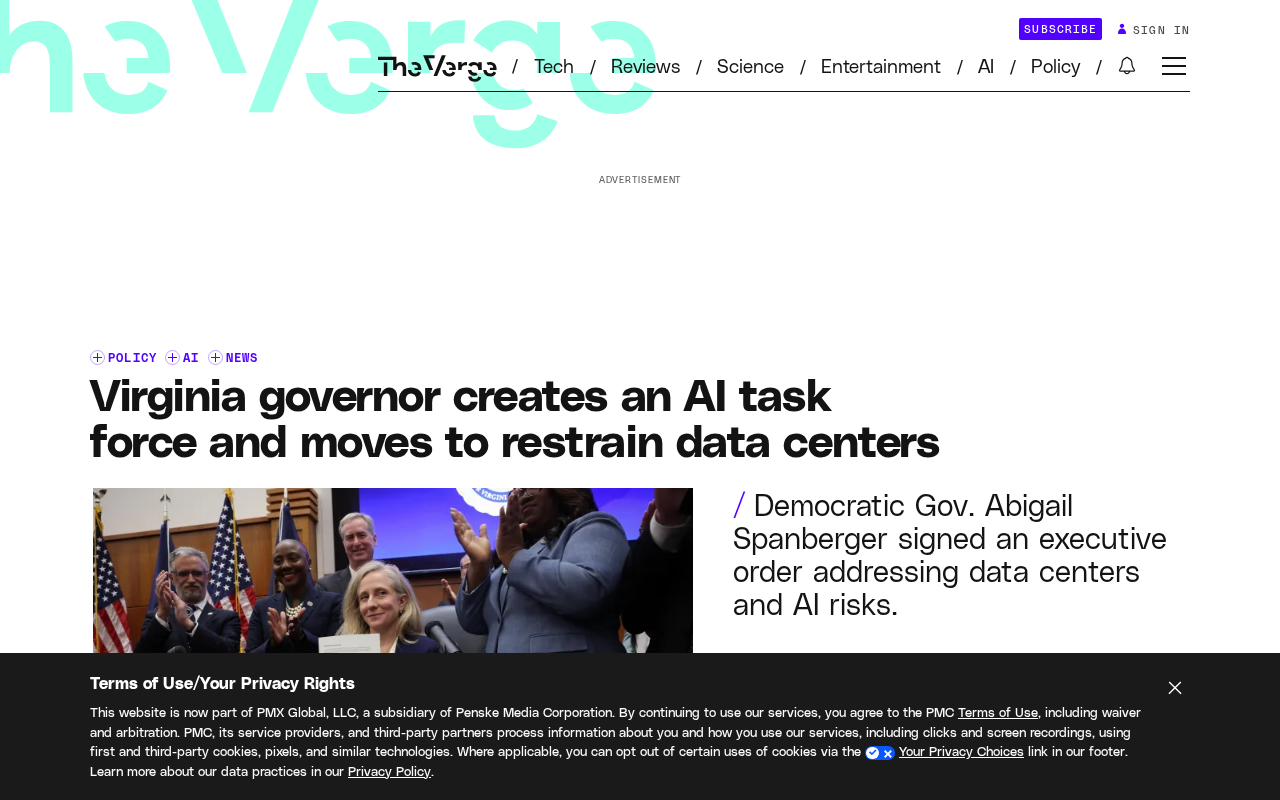
Virginia Governor signs executive order banning NDAs, slowing data center approvals, and creating an AI task force.
Virginia Governor Abigail Spanberger signed Executive Order 22, tightening policy over the world's most densely concentrated data center cluster. Key measures include banning executive officials from signing NDAs in data center project negotiations, giving local communities a greater voice, slowing project approvals, and establishing an AI task force. Northern Virginia's Data Center Corridor handles a significant share of global internet traffic, making its policy direction a bellwether for the entire cloud and data center industry. The NDA ban directly addresses longstanding public concerns about opaque information on power consumption and water usage.
Policy Shift: A Turn for the Data Center Capital of the World
Virginia Governor Abigail Spanberger has signed an executive order directing state agencies to take a series of steps that give local communities a greater voice in data center development while slowing the pace of project approvals. This move carries significant global implications — Virginia is known as the "data center capital of the world," and the Northern Virginia "Data Center Corridor" in particular hosts a substantial share of the world's internet traffic and cloud computing infrastructure.

According to reports, one of the core provisions of Executive Order 22 is a prohibition on executive branch officials signing non-disclosure agreements (NDAs) related to data center development. This may seem like a technical detail, but it strikes at the heart of a controversy that has surrounded the rapid expansion of data centers in recent years.
Northern Virginia's Data Center Corridor is concentrated primarily in Fairfax County, Loudoun County, and Prince William County. Loudoun County, with its especially high density, has been dubbed "Data Center Alley." The region's rise was driven by a confluence of historical factors: the arrival of early internet pioneers like AOL in the 1990s, proximity to Washington D.C. and its federal government demand, early deployment of underground fiber networks, and Virginia's long-standing tax incentive policies. Today, the corridor routes an estimated 70% of the world's internet traffic at any given moment and hosts core facilities for major hyperscale cloud providers including Amazon AWS, Microsoft Azure, and Google Cloud. Given this enormous scale, any policy change in Virginia sends ripple effects through global data center siting and investment decisions.
Why NDAs Became a Flashpoint
As data centers expanded rapidly, non-disclosure agreements between developers and government agencies repeatedly drew transparency concerns. Critics argued that NDAs made it difficult for the public and local legislatures to access sufficient information before projects broke ground — information covering land use, power consumption, water usage, and potential impacts on local electrical grids.
Banning executive officials from signing such agreements means future data center negotiations will be more open, giving local communities an opportunity to weigh in earlier in the decision-making chain. This aligns with the order's broader goal of "giving local communities a greater voice," reflecting a regulatory shift away from a "development-first" mindset toward one that prioritizes community awareness and balanced growth.
The controversy surrounding NDAs in data center projects is longstanding. Developers typically invoke "trade secrets" to justify requiring government agencies to sign NDAs during early-stage negotiations, covering critical details such as site selection, power consumption agreements, tax reduction terms, and cooling water usage. In practice, this creates an information asymmetry: locally elected officials and community residents often don't learn the true scale of grid load and water usage until a project is already under construction or even operational. In recent years, several Virginia counties have seen sudden spikes in local grid capacity pressure due to dense data center construction. Some residents only realized their areas were bearing significant infrastructure costs after receiving notices of rising electricity bills. Prohibiting executive officials from signing NDAs essentially brings previously closed pre-negotiation processes under public scrutiny, providing an institutional basis for communities to have a say during the critical decision window.
The Role of the AI Task Force
Beyond tightening data center approvals, the executive order also establishes an AI task force. Bundling AI governance with data center policy is no coincidence. Training and inference for AI models depends heavily on large-scale compute clusters — the very clusters driving the surge in data center power and cooling demands.
In other words, the pressure to expand data centers is, in large part, the physical manifestation of the AI boom. Virginia's decision to launch the AI task force in tandem with data center restrictions signals that policymakers are trying to understand and manage the infrastructure and energy challenges posed by this technological wave from the ground up. However, based on currently available information, the specific mandate and composition of the AI task force have not been disclosed, and its real-world impact remains to be seen.
Potential Industry Implications
Virginia's moves serve as a bellwether for the entire data center and cloud computing industry. As one of the most heavily concentrated regions for hyperscale data centers, any slowdown in approval timelines or increase in transparency requirements could reshape developers' siting and compliance strategies.
For the tech giants that depend on Virginia's infrastructure, longer approval cycles mean higher time costs and greater planning uncertainty. For local residents, these changes may bring more thorough environmental assessments and more equitable resource distribution. At the core of this tension is the challenge of meeting the explosive compute demands of the AI era while also safeguarding grid stability, water resources, and community interests.
Hyperscale data centers — facilities purpose-built for cloud computing and large-scale AI training, typically exceeding 93,000 square meters in floor area and housing tens of thousands to hundreds of thousands of servers — have staggering power requirements. A single campus can draw hundreds of megawatts, equivalent to the industrial electricity consumption of a mid-sized city. In Virginia, utility provider Dominion Energy has repeatedly warned that surging data center applications are outpacing the grid's ability to expand, with new substations and transmission lines taking five to seven years to build — far behind the pace of data center development. This supply-demand mismatch is precisely the structural backdrop compelling the state government to intervene in the approval process: without slowing approvals, both grid stability and clean energy transition goals face compounding pressure.
Conclusion
Virginia's series of measures represents a microcosm of how U.S. state governments are responding to the expansion of AI infrastructure. As compute demand continues to climb, striking a balance between growth and regulation will become a challenge that more and more regions must confront. Given the limited public information currently available, the on-the-ground effects of the executive order and the substantive role of the AI task force will require continued monitoring.
Related articles

Free Unlimited Claude Code Solution: Agnes AI + CC Switch Setup Guide
No paid subscription needed — pair the free AI platform Agnes AI with the open-source tool CC Switch to provide a backend for Claude Code, enabling unlimited free calls to text, image, and video models. This guide covers the full setup, test results, and usage boundaries.

A Complete Zero-Cost Guide to Getting Started with Claude Code for Beginners in China
A beginner's guide to Claude Code for users in China: two installation methods (command line and IDE plugin), full configuration steps for replacing the official API with the free domestic LongCat model, and a hands-on demo of building a small tool with natural language, plus tips.

When the NSA Gets Involved: The AI Supply Chain Crisis Behind Open-Source CVEs and API Key Hijacking
Multiple open-source projects disclosed severe CVEs in one day, PHP flaws alarmed the FBI, and Railway and OpenCode were breached with API keys stolen. This article breaks down the vulnerability window, AI-accelerated exploitation, and the AI supply chain crisis behind the API key black market, with a developer defense checklist.