Vizard Agent Deep Dive: One AI Agent to Handle All Video Production

Vizard Agent aims to replace fragmented video tools with a single AI agent for the entire production workflow.
Vizard Agent launched on Product Hunt as a universal video AI agent designed to handle the complete video production workflow — from raw footage editing and AI generation to multilingual localization and multi-platform repurposing. It shifts the interaction paradigm from manual tool operation to outcome-oriented collaboration with an autonomous agent, though questions remain about whether a generalist approach can match specialized tools' quality across every stage.
Video Production Is Entering the "Single Agent" Era
The video content production pipeline has always been one of the most complex creative workflows. From asset organization, editing, and generation to redistribution, multilingual localization, and iterative revisions, each step typically requires a dedicated tool. Creators are forced to constantly switch between editing software, subtitle tools, translation platforms, and short-video cropping tools, severely diluting their efficiency.
This complexity is no accident. Behind a seemingly simple short video lies potentially over a dozen independent steps: scriptwriting, footage shooting or sourcing, rough cuts and fine edits, color grading, subtitle creation, audio processing (including voiceovers, music, noise reduction), VFX compositing, multi-platform adaptation (different aspect ratios and duration limits), multilingual translation and dubbing, and more. Each step historically had its own professional tool ecosystem: Adobe Premiere Pro and DaVinci Resolve dominated editing, After Effects handled VFX, and various standalone TTS tools covered voiceovers. This tool fragmentation means creators not only need to learn the operational logic of multiple applications but also perform format conversions and data transfers between different tools, with enormous amounts of time consumed by non-creative "glue work."
Vizard Agent, which recently launched on Product Hunt, aims to change this status quo. With the tagline "One AI agent for every kind of video," it reached #7 on the daily leaderboard with 99 upvotes. Product Hunt, the world's most influential tech product launch platform since its founding in 2013, has become a core channel for startups to acquire early users and market attention. The platform uses a daily ranking mechanism, and reaching the top ten typically indicates initial validation from the tech community. However, it's worth noting that its user base skews toward early tech adopters and product managers, with a significant gap remaining between that and mainstream market acceptance. Vizard Agent's core proposition is straightforward: Stop managing a pile of tools. Instead, give the desired outcome to a single Agent, then collaborate with it until the video is finished.
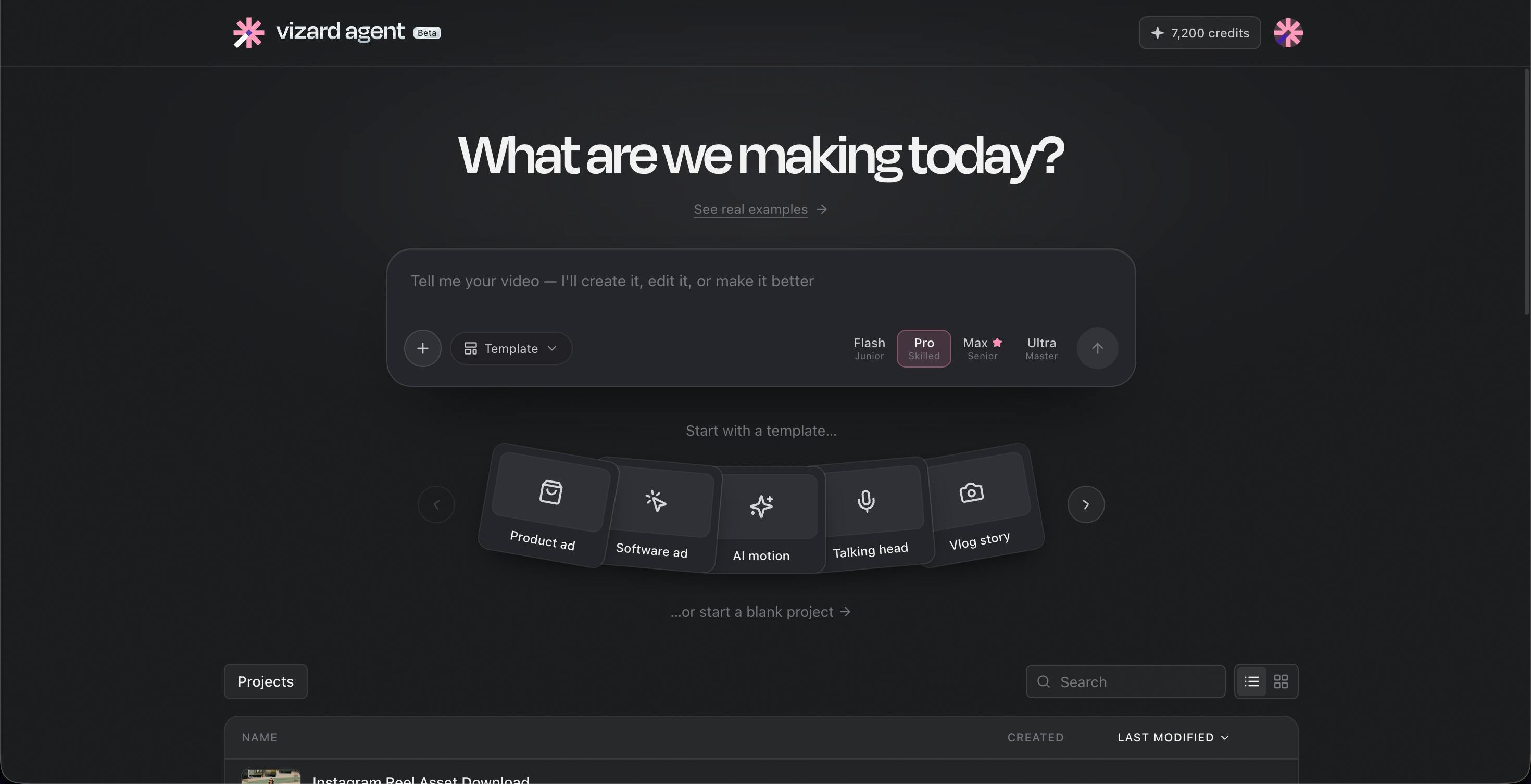
Vizard Agent's Positioning: From "Tool Collection" to "Universal Video Agent"
Traditional AI video products mostly focus on a specific vertical: some specialize in clipping long videos into shorts, others focus on AI dubbing and subtitles, and still others on text-to-video generation. Vizard Agent's positioning is decidedly more "universal" — it's designed as an intelligent agent that handles the entire video workflow.
Here it's important to understand the technical implications of the "Agent" concept. AI Agents represent one of the most important paradigm shifts in artificial intelligence today. Unlike traditional AI tools, Agents possess three core capabilities: goal understanding (converting a user's vague intent into concrete tasks), autonomous planning (decomposing complex tasks into executable step sequences), and tool invocation (independently selecting and using different underlying capability modules during execution). The maturation of this concept stems from breakthroughs in large language model (LLM) reasoning capabilities, giving AI systems the ability to make multi-step, cross-stage decisions for the first time. In terms of technical architecture, a video-domain Agent typically needs to integrate computer vision models, natural language processing models, audio processing models, and video generation models, coordinating their invocation order and parameter passing through an "orchestration layer."
Supporting Diverse Input Starting Points
According to official descriptions, Vizard Agent can begin working from multiple input formats:
- Raw footage: Directly upload shot material
- Existing videos: Reprocess finished videos
- URL links: Extract content from web pages or online videos
- Script text: Generate video from written content
- Images: Expand from static images
- Even just an idea: Conceive from scratch
This "any starting point" design means that regardless of where users are in their creative process, they can hand off the task.
Full-Workflow AI Video Production Capabilities
Vizard Agent claims to handle the following:
- Editing: Splicing, trimming, and optimizing footage
- AI video generation: Automatically creating video content
- Repurposing: Transforming a single piece of content into multiple formats suited for different platforms
- Multilingual localization: Translation and dubbing adaptation
- Revisions: Iterating based on feedback
Among these, repurposing has been one of the most important strategies in content marketing over the past two years. Its core philosophy is "create once, distribute many times" — breaking down a long video (such as a podcast, webinar, or speech) into multiple short pieces adapted for different platforms. This demand explosion stems from social media platform fragmentation: YouTube requires 16:9 landscape video, TikTok and Instagram Reels need 9:16 vertical, X (Twitter) prefers 1:1 square, and LinkedIn favors captioned professional content. Each platform also has different duration limits, algorithm preferences, and audience tones. Previously, this work was handled by specialized tools like Opus Clip and Descript, and manually converting one long video into 10+ short clips could take an editor several hours.
Multilingual localization presents technical challenges far more complex than text translation. It involves not only translation quality at the language level but also lip-sync, speech rate adaptation, cultural context adjustment, subtitle formatting, and multiple other dimensions. In recent years, companies like ElevenLabs and HeyGen have leveraged voice cloning technology to preserve the original speaker's vocal characteristics in the target language while using visual lip-sync technology to match the on-screen person's mouth movements with the new language audio. However, current technology still exhibits clear shortcomings when handling tone, emotional expression, culture-specific humor, and metaphors — the threshold for full AI replacement in this area remains relatively high.
Users only need to tell it "what they want to accomplish," and the Agent plans all intermediate steps autonomously. This is precisely what distinguishes it from traditional single-point tools — upgrading from an execution tool to a decision-making and collaborative intelligent agent.
The "Outcome-Oriented" Interaction Paradigm: How AI Agents Are Changing Video Creation
What's most noteworthy about Vizard Agent is its shift in interaction logic. Previously, we used video tools with a "I operate, the tool executes" approach; the Agent model is "I provide the goal, the Agent plans and executes, I participate in adjustments."
One sentence from the official description crystallizes this paradigm: "you give one agent the outcome you want and work with it until the video is finished."
This echoes the broader AI industry's evolution from "Copilot" to "Agent (autonomous executor)." Copilot and Agent represent two distinct stages of human-AI collaboration. The Copilot model was formally defined when GitHub Copilot launched in 2021, with its core logic being "human-led, AI-assisted" — users still control every step while AI provides suggestions and acceleration. Microsoft subsequently extended the Copilot brand across the Office suite, making it a widely recognized interaction paradigm. The Agent model goes further, emphasizing "humans define objectives, AI executes autonomously." This transition accelerated in the second half of 2024, with leading companies like OpenAI, Anthropic, and Google launching Agent-related products and frameworks.
In the video domain, this means users no longer need to adjust every cut point on the timeline frame by frame. Instead, they describe "I want a fast-paced 30-second short video highlighting product selling points," and the Agent autonomously handles everything from footage selection to final output. This shift impacts professional video editors and amateur creators very differently: the former may be more concerned about loss of fine-grained control, while the latter welcome the dramatic lowering of barriers.
Across programming, office work, design, and other fields, more and more products are emphasizing "delivering outcomes" rather than "providing features." As one of the longest-workflow, highest-barrier creative domains, video production — if it can truly achieve Agent-ification — has enormous potential for value unlocking.
Vizard Agent's Strengths and Challenges
As a newly launched product, Vizard Agent's vision is exciting, but a rational perspective is warranted.
Potential strengths lie in consolidating fragmented video workflows into a single entry point, reducing tool-switching costs and learning curves for creators. It's particularly suited for content marketing, education, social media operations, and other scenarios requiring high-volume, multilingual, multi-platform video output.
Key challenges stem from "universality" itself. Video production demands extremely high attention to detail and aesthetics. Whether an Agent attempting to cover all stages can match specialized tools' quality at each stage remains unverified. Editing rhythm, visual consistency in generated footage, naturalness of localized dubbing — any weak link can compromise the final product. This is a common trade-off in AI: there's often tension between generality and specialization. Models and tools focused on a single task typically achieve higher precision and controllability for that task, while systems trying to "do everything" risk being "adequate but not great" at each stage. Additionally, the Agent's planning capability and controllability under complex requirements need to withstand real-world usage testing — how to efficiently course-correct and fine-tune when the Agent's autonomous decisions diverge from the user's creative intent will directly determine the product's practical usability.
With only 3 comments on Product Hunt, the product is clearly still in its early stages, community feedback remains insufficient, and actual performance awaits validation from more users.
Conclusion: The Agent Era of Video Creation Is Arriving
Vizard Agent represents a clear direction for AI video creation tools: moving from feature stacking to Agent unification. It collapses all the complexity between "give me an idea" and "deliver a finished video" into a single intelligent agent, attempting to redefine the interaction model of video production.
For content creators frustrated by convoluted tool chains, such a product undoubtedly holds appeal. To what extent it can deliver on the promise of "one Agent to handle all video" still requires time and market validation. But one thing is certain: the "Agent era" of video creation is arriving.
Related articles

AI-Powered SRC Vulnerability Hunting: A Hands-On Guide to Building the Hermes Agent Workbench
Based on a hands-on Bilibili video: how to build an AI-powered SRC vulnerability hunting workbench—three-step method, four report elements, Agent mode vs web chat, and tool selection.

CLI-Anything Complete Beginner's Guide: How AI Operates Software — Principles and Practice
A complete beginner's guide to CLI-Anything: how AI Agents operate professional software via the command line, covering the three-layer architecture, CLI Hub installation, DrawIO practice, generator principles, and limits.

Carbon-X: A 14.8B Open-Source Model That Handles DNA and Text Simultaneously
Carbon-X is a 14.8B open-source multimodal model on Hugging Face where DNA and text share a token stream. 6-mer tokenization, 302B token mid-training, deployable on a single 80GB GPU, 66.7% average on five DNA benchmarks, Apache 2.0 license.