vLLM Day-0 Support: One Model for Generation, Editing, and Transparent Output

One model covers generation, editing, and transparent output — with vLLM day-0 support for instant production deployment.
A brief tweet from a model team highlights a growing trend in open-source LLM deployment: through early coordination with the vLLM inference framework, the model is ready for production use on its release day (day-0 support), dramatically shrinking the gap between open-sourcing and real-world deployment. More notably, the model consolidates generation, editing, and transparent output into a single set of weights — no need to stitch together multiple specialized models. The "transparent output" capability stands out in particular, emphasizing interpretability and traceability in model reasoning, aligning with the rising demand for trustworthiness and auditability in enterprise AI applications.
A Tweet That Reveals a New Trend in Model Deployment
Recently, a tweet from a model team caught the attention of the AI community: a thank-you to the vLLM project for its day-0 support, along with a highlight that the model delivers "generation, editing, and transparent output" all in one — a single model, ready to serve.
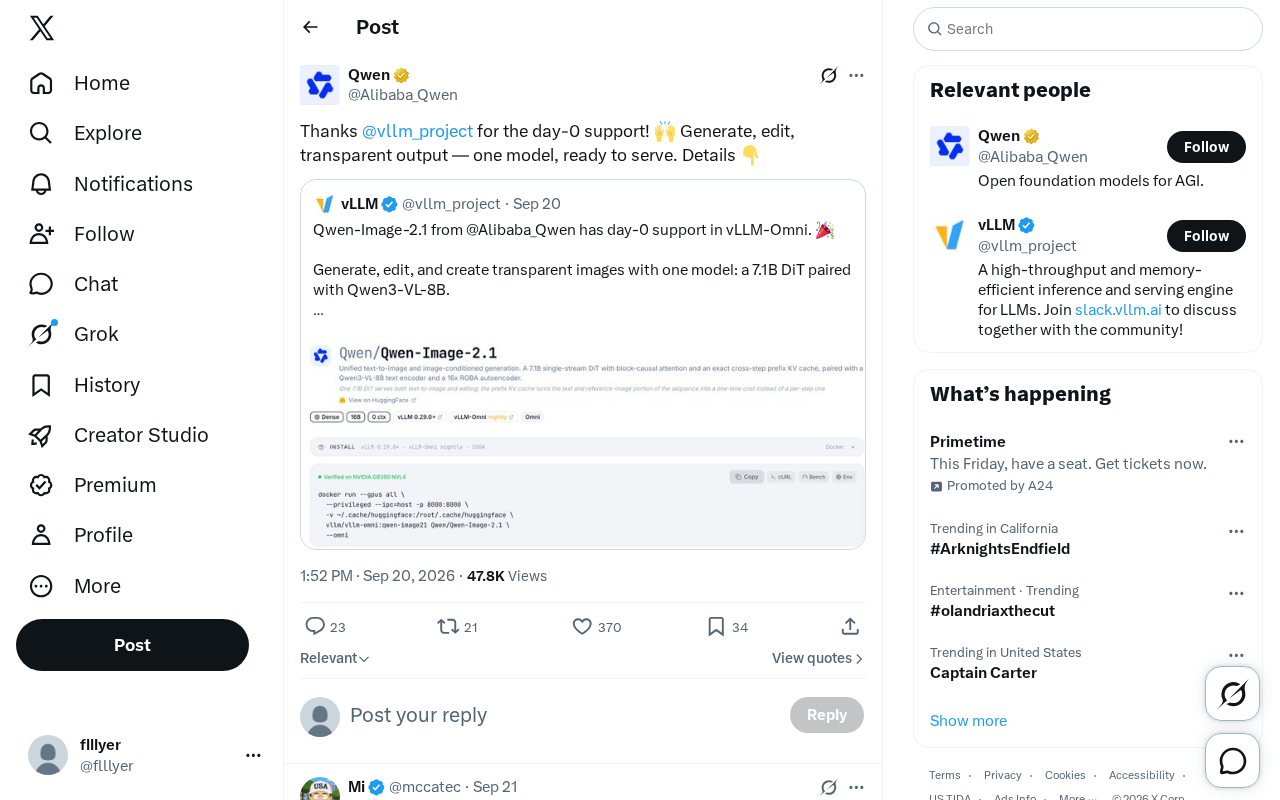
The tweet itself is brief, but several key terms it contains are worth unpacking: day-0 support, multi-capability integration, and transparent output. These three points reflect the broader trajectory of open-source LLMs toward more efficient deployment and tighter capability consolidation.
What vLLM Day-0 Support Actually Means
For readers less familiar with inference frameworks: vLLM is one of the most popular LLM inference and serving engines available today, known for its high throughput and PagedAttention memory management mechanism.
Day-0 support means that on the very day a new model is released, the inference framework has already been adapted to support it — no waiting for a future update, no manual workarounds. This matters for both model developers and end users:
- For model teams, day-0 support means the model can be widely adopted at low friction the moment it goes open-source, accelerating community uptake.
- For developers, it eliminates the time cost of rewriting inference code or waiting for compatibility fixes — the model is truly ready to use out of the box.
This "ready to serve on release" pattern is fast becoming the standard for collaboration between mainstream open-source models and inference frameworks.
PagedAttention is vLLM's core technical innovation, inspired by virtual memory paging in operating systems. It divides the GPU memory used for attention key-value cache (KV Cache) storage into fixed-size "pages" that are dynamically allocated on demand, rather than reserving large contiguous blocks of memory upfront for each request. This significantly reduces memory fragmentation, allowing the same GPU to handle more concurrent requests — and dramatically improving inference throughput. In production environments serving large numbers of users, this translates to lower per-inference hardware costs. It is precisely this kind of engineering optimization that makes vLLM one of the most common inference framework choices in both the open-source community and enterprise deployments, and why securing its day-0 support carries real practical value rather than being merely symbolic.
Generate, Edit, Transparent Output: Three Capabilities in One Model
The core selling point in the tweet is "Generate, edit, transparent output — one model." These words describe three categories of capability unified within a single set of model weights:
Generation
This is the most fundamental LLM capability — producing text, code, or other content from a prompt.
Editing
Editing means the model doesn't just generate from scratch — it can also revise, refine, or adjust existing content based on instructions. This capability has traditionally required specially fine-tuned models or additional pipeline components. Merging it with generation into a single model can significantly simplify application architecture.
Transparent Output
"Transparent output" is a relatively uncommon term in this context. It likely refers to the model providing interpretable, traceable results during inference — such as exposing reasoning chains, source attribution, or structured output formats. This characteristic is especially valuable for enterprise-grade applications that require trustworthiness and auditability.
Unifying all three capabilities within a single model, rather than stitching together multiple specialized ones, lowers deployment complexity and operational overhead — and reflects the current design philosophy of pursuing greater model generality.
In the AI field, "Explainability" and "Traceability" are two related but distinct concepts. Explainability focuses on helping users understand why a model produced a given result — for example, by showing reasoning steps via Chain-of-Thought. Traceability is more concerned with where a result came from — such as citing retrieved document passages or annotating data sources. "Transparent output" as a term may encompass both dimensions, or it may specifically refer to structured, fixed-format outputs that downstream systems can parse directly without additional processing. In strictly regulated industries such as finance, law, and healthcare, regulators and end users increasingly require that AI system decision-making processes leave an auditable trail — making transparent output not just an engineering convenience, but a compliance necessity.
Why This Matters
From what looks like an ordinary release tweet, several trends in the open-source LLM ecosystem come into focus:
Deeper collaboration between inference frameworks and models. Model teams coordinate with frameworks like vLLM in advance to ensure the model is immediately usable on launch day — compressing the window between "model release" and "production deployment."
Capability consolidation over model stacking. Covering generation, editing, and other use cases within a single model reduces the number of models that application layers need to maintain — a significant advantage for small and mid-sized teams.
Growing emphasis on transparency. As AI applications expand into higher-stakes domains, output interpretability and traceability are shifting from "nice to have" to "must have."
A Final Note
It's worth noting that this tweet provides limited technical detail on its own — the specific model name, parameter scale, and implementation mechanism behind transparent output all require reference to the official documentation (the tweet hints "Details 👇"). But even with minimal information, the signal it sends — day-0 deployment + multi-capability integration — clearly outlines the path that open-source models are taking toward greater practicality and engineering maturity.
For developers looking to rapidly move open-source LLMs into production, paying attention to whether a model has day-0 support from mainstream inference frameworks may become an increasingly important factor in model selection.
Related articles

OpenAI Cracks Math Problems, Why Are Mathematicians Losing Sleep?
OpenAI claims to solve math problems — why are mathematicians anxious? Vergecast reveals the Eye of Sauron dilemma and the tension between AI answers and human understanding.

CSS Conditional Border-Radius Trick: Auto-Square Corners When Elements Touch the Edge
Pure CSS conditional border-radius: auto-square corners when elements touch the edge, rounded while floating. Use calc(100vw-100%) with clamp() to kill the transition band, and container query units cqi for non-fullscreen containers, plus a scrollbar offset workaround.

Google TimesFM 3.0 Hands-On: Is Zero-Shot Forecasting Good Enough?
Hands-on test of Google TimesFM 3.0: zero-shot error cut by ~25% with second-level results, but the two versions give opposite answers in business what-if planning. A deep dive into model internals, version differences, and four key production limitations.