vLLM Releases proto-v0.3.0: Another Iteration of the High-Performance Inference Framework
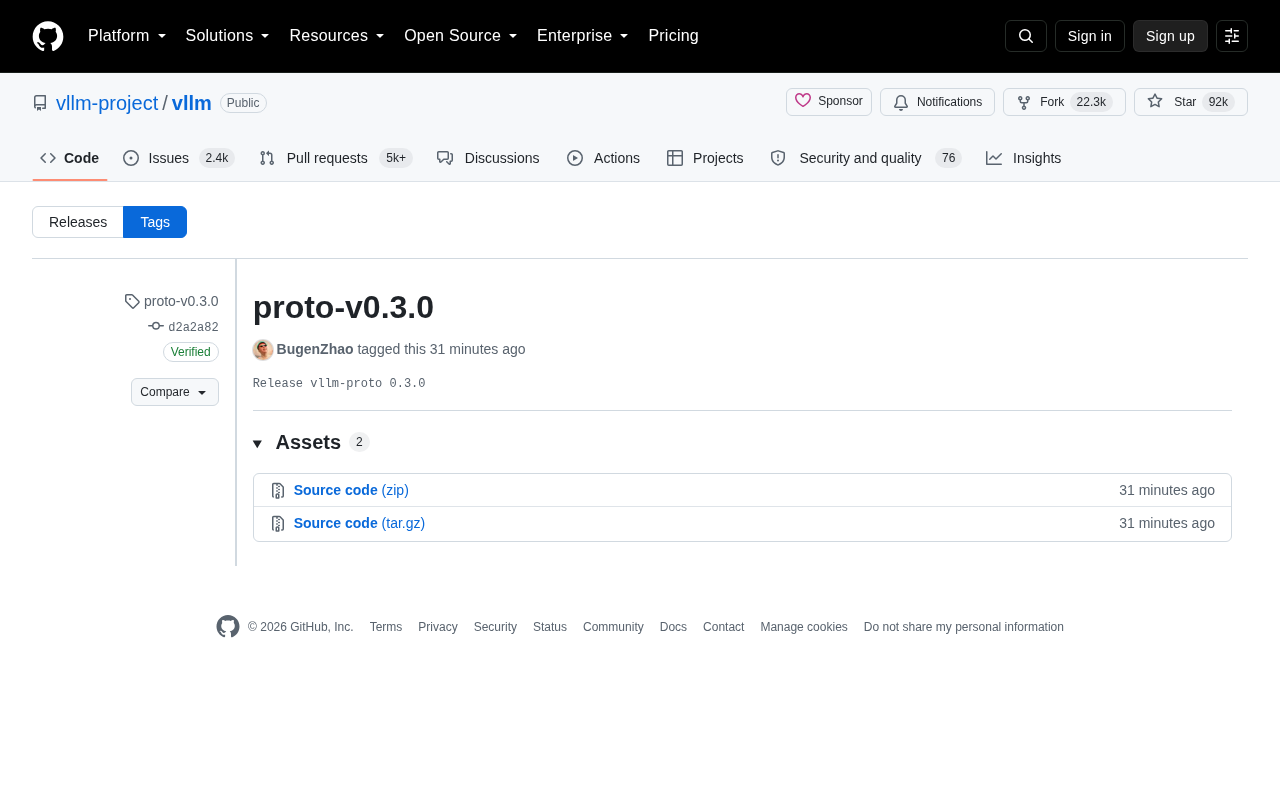
vLLM releases proto-v0.3.0, independently versioning its protocol layer with verified signing for improved supply chain security.
vLLM has released the `proto-v0.3.0` tag, corresponding to the 0.3.0 iteration of the internal `vllm-proto` component. Published by maintainer Bugen Zhao with a verified SSH signature, this release reflects vLLM's approach of decoupling the protocol layer from the main version number and managing it as an independently versioned dependency. The proto module handles inter-process communication, request serialization, and distributed scheduling — making stable versioning essential for downstream teams to pin dependencies and avoid compatibility issues as multi-node and tensor-parallel capabilities expand. The signature verification also addresses the growing supply chain security concerns in the open-source community.
vLLM proto-v0.3.0 Released
The open-source large model inference engine vLLM has released a new tagged version: proto-v0.3.0. This release was published by maintainer Bugen Zhao using a verified signature, corresponding to the 0.3.0 release of the internal vllm-proto component. As one of the most actively developed inference frameworks in the community — with over 92,000 GitHub stars and 22,300 forks — any new release from vLLM draws close attention from both deployment teams and researchers.
Based on the release information, proto-v0.3.0 represents an independent versioning iteration of the protocol (proto) submodule within the vLLM project, using a naming scheme separate from the main version number. This approach is common in large open-source projects — packaging protocol definitions, serialization interfaces, and other foundational components as standalone releases allows the upper-level framework and the lower-level communication protocol to evolve at their own pace, making cross-version compatibility management much more straightforward.
The Role of the proto Component in vLLM
Within vLLM's overall architecture, proto-related modules are typically responsible for inter-process communication, distributed scheduling, and request serialization. As vLLM has progressively added support for multi-node distributed inference, Tensor Parallelism, and Pipeline Parallelism, having a stable and extensible protocol definition has become increasingly critical.
Publishing vllm-proto independently under the proto-v0.3.0 tag signals that the development team is treating the protocol layer as a separately referenceable and versioned dependency. For teams building on top of vLLM or developing custom inference services, an explicit protocol version number makes it easier to pin dependencies and avoid compatibility issues caused by interface changes.
Signature-Verified Release
One noteworthy detail is that the tag was signed and verified using the committer's SSH key, along with an attached key fingerprint. With supply chain security receiving ever-greater attention, signature verification helps downstream users confirm the authenticity and integrity of a release artifact, reducing the risk of tampered or forged versions. This also reflects the engineering maturity of the vLLM project.
The proto format used by vLLM is typically based on Protocol Buffers (protobuf) — Google's open-source, language-agnostic, platform-independent structured data serialization format, commonly used alongside the gRPC framework. In vLLM's distributed deployment scenarios, proto-defined message structures underpin request dispatch between the scheduler, inference workers, and the frontend service, as well as KV Cache state synchronization and sampling parameter passing. Compared to JSON, protobuf offers smaller serialized payloads and faster parsing — both particularly valuable when transferring large numbers of concurrent requests between processes in high-throughput inference settings. If message fields are added, removed, or have their types changed, components that haven't been updated accordingly may encounter parsing failures or silently drop fields. This is precisely why versioning the protocol layer independently and requiring downstream consumers to explicitly declare their dependency version is so important.
Software supply chain security has garnered widespread attention in recent years — landmark incidents like the 2020 SolarWinds attack and the 2024 XZ Utils backdoor both compromised downstream users by poisoning upstream release artifacts. Signing Git tags or commits with SSH/GPG keys is one of the foundational defenses against such attacks: signatures are bound to the publisher's private key, meaning any tampering with the artifact will cause signature verification to fail. Downstream users or CI/CD pipelines can automatically validate the signature after pulling code, establishing a trust anchor at the very beginning of the chain. Since 2022, GitHub has displayed a "Verified" badge in its UI and added support for SSH key signing (previously only GPG was supported), lowering the barrier for developers to participate in supply chain security. The fact that vLLM consistently enforces a signing process even for routine iterations of a subcomponent demonstrates the project's commitment to this security baseline.
What This Means for Users
For teams running vLLM in production, it is advisable to review the full changelog before upgrading, and to assess whether any proto-layer interface changes affect your existing distributed deployments or custom clients. Protocol version upgrades often involve adjustments to serialization formats or RPC interfaces, and mixing versions across components can introduce subtle, hard-to-diagnose issues.
From a broader perspective, vLLM's continued high-frequency iteration is a reflection of the vitality of the entire large model inference ecosystem. Core technologies like PagedAttention and Continuous Batching have made vLLM one of the de facto standards for high-throughput inference, and the careful management of foundational infrastructure like the protocol layer is a key engineering practice that sustains its long-term evolution.
PagedAttention is one of vLLM's core innovations, proposed by the UC Berkeley team. The central idea draws from the paging mechanism of virtual memory in operating systems: it allocates the KV Cache (Key-Value Cache) — which consumes large amounts of GPU memory during Transformer inference — in fixed-size "blocks" using non-contiguous allocation, thereby eliminating the memory fragmentation and waste caused by inaccurate sequence length estimates in traditional pre-allocation schemes. Continuous Batching is another key technology: unlike traditional static batching, which requires waiting for all requests in a batch to complete simultaneously, Continuous Batching dynamically removes completed requests and adds new ones after each inference step, significantly improving GPU utilization and overall throughput. Working in tandem, these two techniques enable vLLM to achieve throughput improvements of several to tens of times compared to naive implementations in serving scenarios.
Summary
Given the information currently available on the official release page, the specific change details for this proto-v0.3.0 release are not yet complete. Developers who want to learn more can visit vLLM's GitHub Releases page to view the full asset files and commit history for more accurate upgrade guidance. Overall, this is a routine iteration of a foundational component that reflects the project's ongoing investment in the stability and security of its protocol layer.
Related articles

The Open Source Dilemma: A Non-Autoregressive Architecture Pioneer Overshadowed by Frontier Labs
An indie developer claims a frontier lab repackaged his year-old open-source non-autoregressive RL architecture as a breakthrough. We compare PPO sequence embeddings vs. RLCD parallel sampling and examine open source attribution gaps.
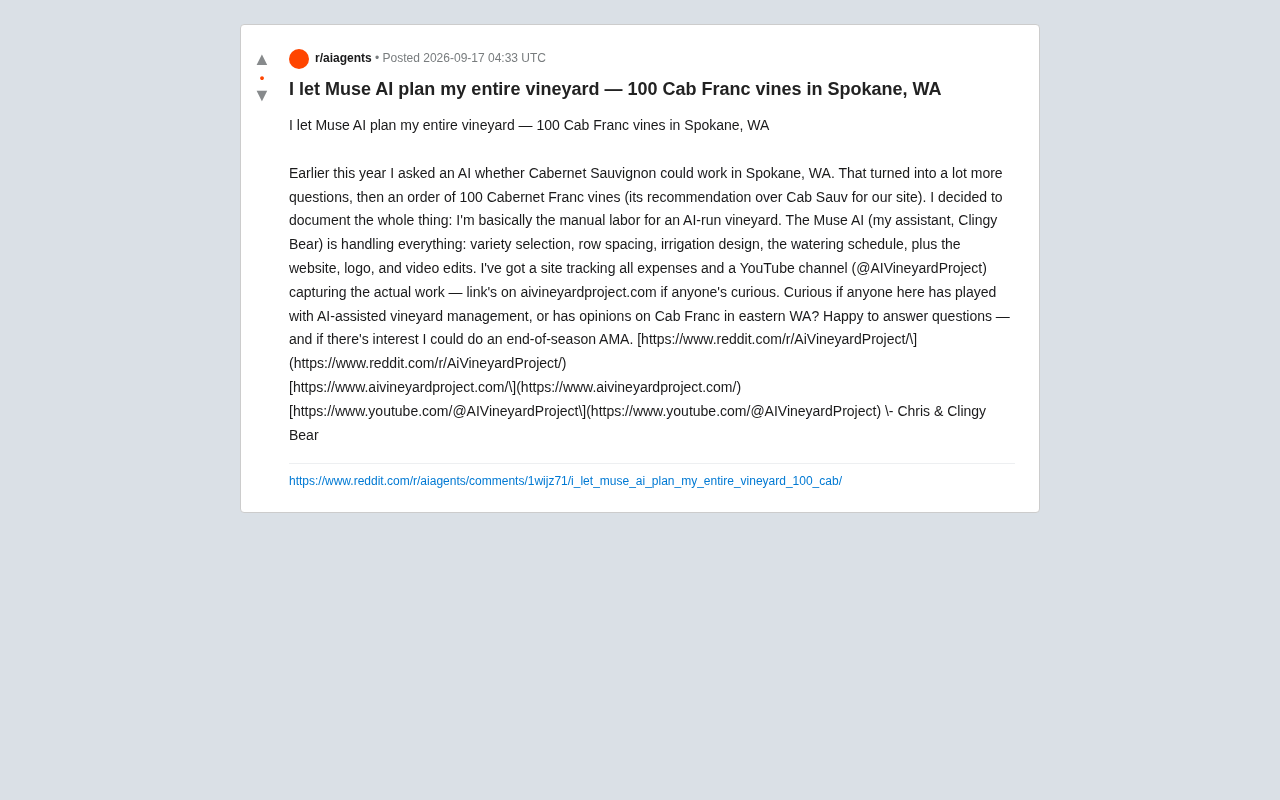
AI Plans an Entire Vineyard: A Real-World Experiment with 100 Grapevines
A Spokane hobbyist let Muse AI plan his entire vineyard — variety, spacing, irrigation, even the logo. He planted 100 Cabernet Franc vines and is documenting everything publicly.

Iceland's Treble Raises $18M to Bet on Voice Simulation Platform
Iceland-based voice simulation company Treble raises $18M. Its platform serves voice AI developers, AI wearables, and robotics firms. A deep dive into the technology and what the funding signals.