vLLM Releases v0.32.0rc2: DeepSeek-V4.1-Flash Evaluation Pinned to FP8-Engram Revision
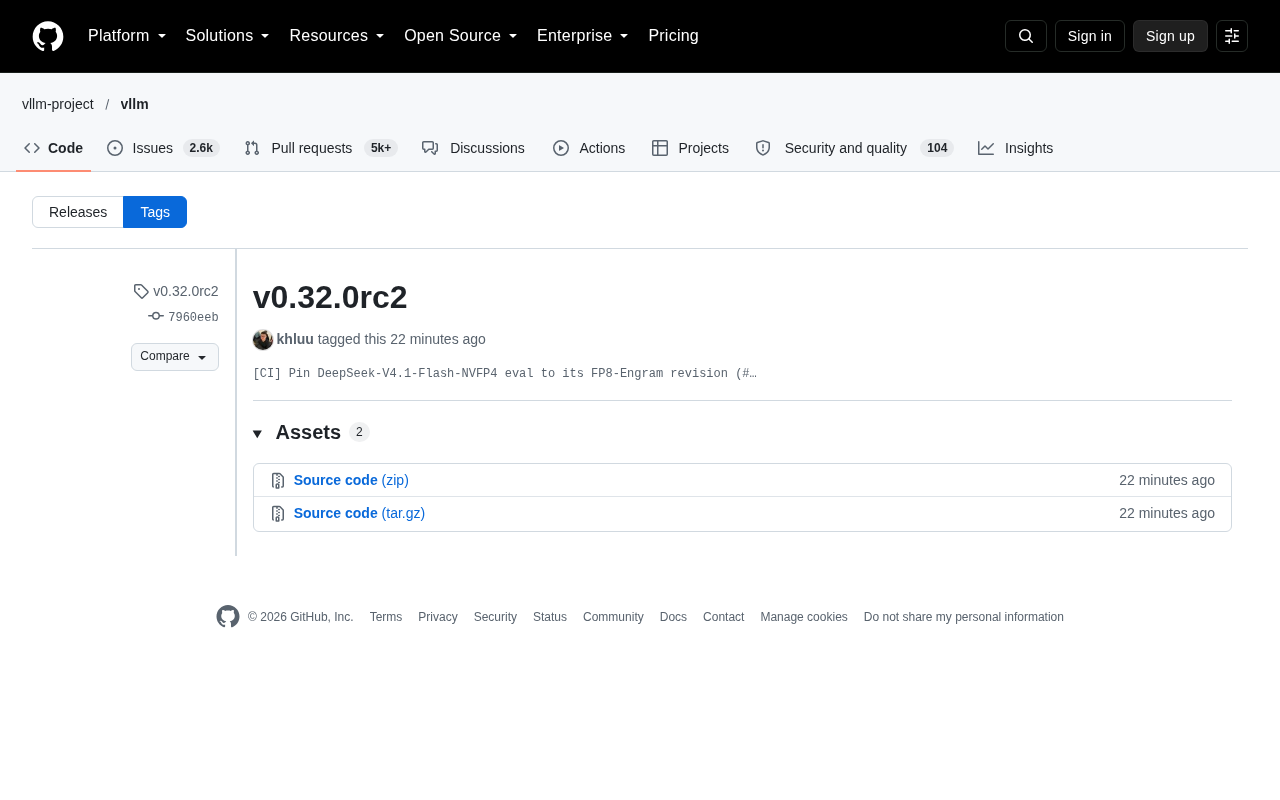
vLLM v0.32.0rc2 pins DeepSeek-V4.1-Flash evaluation to the FP8-Engram revision to build a reproducible baseline.
vLLM released v0.32.0rc2. Though it lacks detailed release notes, one CI change stands out: contributor khluu pinned the DeepSeek-V4.1-Flash-NVFP4 evaluation to a specific FP8-Engram revision. The article notes that the same model exists in multiple precision formats—NVFP4 and FP8-Engram—reflecting quantization fragmentation in inference deployment; if evaluation targets float, historical data loses comparability. Pinning a version is engineering quality control, not a feature update, signaling vLLM's effort to provide a reproducible performance and accuracy baseline. Such CI adjustments reveal more about stability priorities than feature PRs and suggest continued DeepSeek optimization.
A "minor version" update that carries a signal worth pondering
The vLLM project has tagged v0.32.0rc2 on GitHub. As a release candidate, it doesn't come with lengthy release notes. But one entry in the commit history carries a fair amount of information: pinning the DeepSeekAd-V4.1-Flash-NVFP4 evaluation to its FP8-Engram revision.
This change was submitted by contributor khluu on October 15 and is a CI-level adjustment. Placed within the broader evolution of inference frameworks, it reveals more than what's on the surface.
Why "pinning the evaluation revision" is a serious matter
Precision format fragmentation is becoming the norm
DeepSeek-V4.1-Flash exists in two precision/quantization forms simultaneously: NVFP4 and FP8-Engram. NVFP4 is a relatively new 4-bit floating-point format in the NVIDIA ecosystem, focused on squeezing memory and bandwidth on the Blackwell architecture; FP8-Engram leans toward FP8 precision paired with an Engram-related implementation path.
Having multiple numerical formats under the same model name is no longer unusual in current inference deployments. But for evaluation systems, the trouble is this: if CI runs a "floating" target every time, historical data loses comparability. Today you're testing NVFP4 weights; tomorrow the upstream repo changes its default branch, and the numbers you measure could quietly shift.
So the essence of this "Pin to FP8-Engram revision" is to nail the evaluation baseline to a specific commit. This isn't a feature update—it's engineering quality control.
NVFP4 is a 4-bit floating-point quantization format that NVIDIA is pushing on the Blackwell architecture. It uses block scaling: weights are grouped into small blocks, each sharing a scaling factor, preserving numerical dynamic range as much as possible at extremely low bit widths. Compared to similar formats like MXFP4, it's been adapted at the instruction level for Blackwell's Tensor Cores, aiming to cut memory footprint and bandwidth to roughly a quarter of FP16 with nearly no precision loss.
FP8-Engram is another route: weights stored in FP8 (8-bit floating point), paired with an implementation or checkpoint variant called Engram. FP8's precision is clearly higher than 4-bit, at the cost of doubled memory and bandwidth overhead. The two aren't a simple "good vs. better" relationship, but rather a trade-off among precision, throughput, and memory—which is precisely why multiple formats coexist under the same model name.
Multi-precision support is a must-answer question for inference frameworks
As a mainstream high-throughput inference engine, vLLM needs to serve models from different hardware platforms and different quantization schemes simultaneously. How fast a model runs under NVFP4, and how much precision it loses under FP8, directly determines which path users should choose.
Pinning down the evaluation target means vLLM is trying to provide a reproducible performance and accuracy baseline, not a one-off benchmark run. For teams planning to select models for production environments, this kind of baseline is far more valuable than the peak numbers from a single benchmark.
Weight format (checkpoint precision) and runtime compute precision are two concepts that need to be distinguished. Quantized weights determine how much memory the model occupies after loading and how much bandwidth is consumed during reads; whereas the inference framework may still accumulate in BF16/FP16 at the operator level, or use FP8 tensor cores for multiply-add. The reason vLLM needs to cover both NVFP4 and FP8 checkpoints is that they may trigger different kernel paths, KV Cache strategies, and even parallel partitioning schemes.
This also explains why "pinning evaluation to a specific revision" has practical significance: different revisions may correspond to different weight files, different tokenizer configurations, or even different quantization calibration data. Any one change could shift throughput numbers and accuracy metrics, and once the CI's historical curve is polluted by such drift, it loses its value for cross-comparison.
Changes like this in CI often reveal more about a project's state than features do
Feature PRs attract attention; CI adjustments tend to be overlooked. But the care a project puts into its CI usually reflects its true attitude toward stability.
This change introduced no new kernels and didn't touch scheduling logic—it simply shifted the evaluation anchor from "following upstream" to "pinning a version." A small move, but with a clear direction: the vLLM team is treating DeepSeek-V4.1-Flash as an evaluation target requiring long-term tracking, not something to adapt once and then abandon.
Given that v0.32.0rc2 is still a candidate release, the full changes for the official version will need to wait for the release notes. But judging by the orientation of this commit, inference optimization around the DeepSeek series will likely continue to ramp up in subsequent versions.
In the collaborative workflow of open-source projects, CI (Continuous Integration) handles not just "running tests to completion" but also performance regression detection. A common industry practice is to maintain a nightly benchmark suite that runs fixed workloads on fixed hardware with fixed models, comparing against historical baselines and triggering alerts when thresholds are exceeded.
The precondition for this mechanism to work is that the evaluation target itself remains stable. What's called pinning means having CI reference an immutable commit hash rather than main or some moving branch name. This sacrifices the convenience of "automatically following upstream improvements" in exchange for data reproducibility—and for performance baselines, the latter is clearly more important. When a team is willing to take this step specifically for a model, it usually means that model has entered the list of objects requiring long-term observation.
What it means in practice for users
If you're deploying DeepSeek-V4.1-Flash with vLLM, the direct value here is: the performance data vLLM officially provides for this model in the future will be more trustworthy and comparable. The indirect value is that the more complete the multi-precision format evaluation coverage, the stronger the basis you'll have when choosing between NVFP4 and FP8.
As for whether v0.32.0rc2 itself is production-ready, the usual advice for rc versions still applies: hold off and evaluate once the official tag lands.
One-line Summary
vLLM v0.32.0rc2 pins DeepSeek-V4.1-Flash evaluation to the FP8-Engram revision, aiming to establish a reproducible baseline.
Paragraph Summary
vLLM released the v0.32.0rc2 release candidate. Though it lacks detailed release notes, one CI change stands out: contributor khluu pinned the DeepSeek-V4.1-Flash-NVFP4 evaluation to a specific FP8-Engram revision. The article notes that the same model exists in multiple precision formats—NVFP4 and FP8-Engram—reflecting the trend of quantization fragmentation in inference deployment; if evaluation targets float, historical data loses comparability. Pinning a version is essentially engineering quality control, not a feature update, signaling that vLLM is trying to provide a reproducible performance and accuracy baseline. The article argues that such CI adjustments reveal more about a project's true attitude toward stability than feature PRs do, and foreshadow continued investment in DeepSeek series inference optimization in future versions.
Related articles

M&M's Spent Millions Replacing Artificial Blue Dye — Why Is It So Hard?
Mars spent millions trying to replace artificial blue dye in M&M's with spirulina, but thick material clogs pipes and residue risks mold, forcing a full production-line rebuild. Here's the engineering behind the reformulation.

Teammate Wanted for Meta Global AI Developer Hackathon: Computer Vision & Medical AI
A Reddit developer seeks teammates for the Meta Global AI Developer Hackathon, focusing on computer vision and medical AI. This article analyzes the track logic, skills-complementarity needs, and topic selection strategy behind this teaming signal.
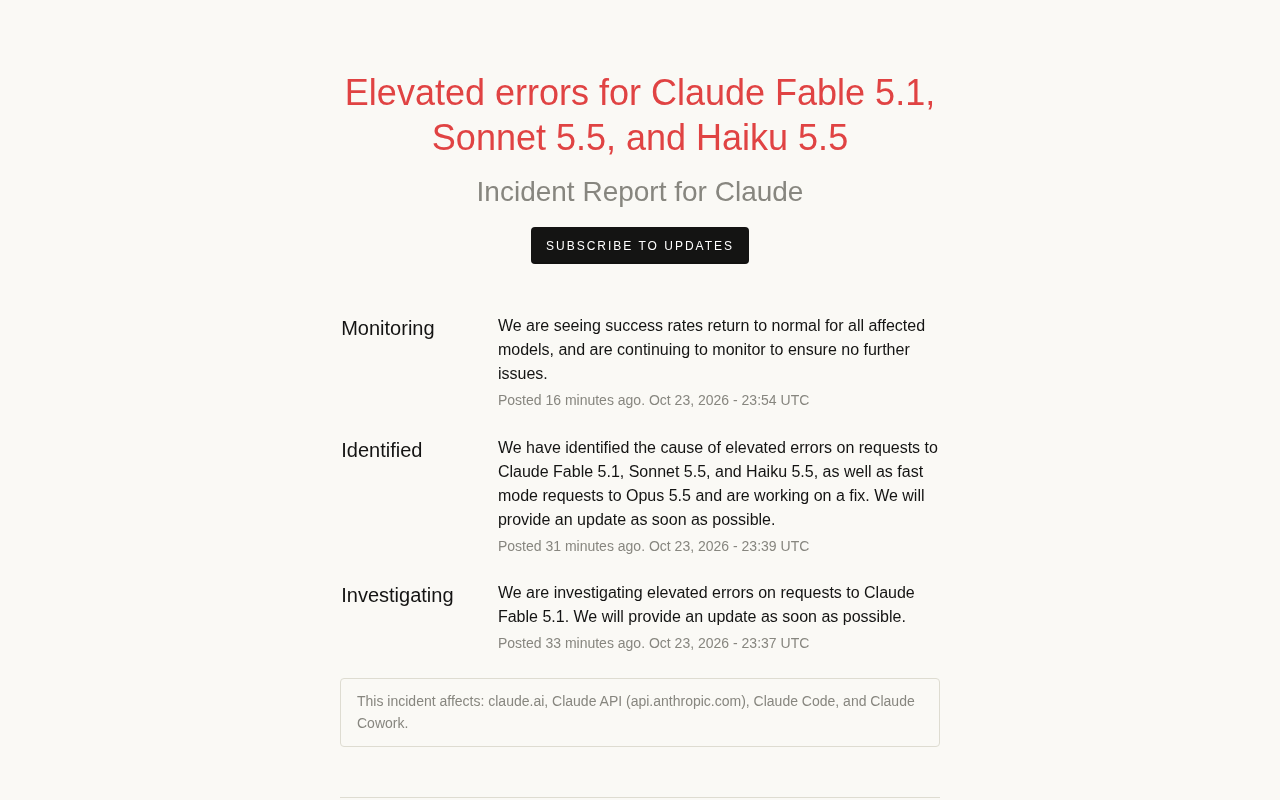
Multiple Claude Models Hit by Errors: A Postmortem of Fable 5.1, Sonnet 5.5, and Haiku 5.5
Claude Fable 5.1, Sonnet 5.5, Haiku 5.5, and Opus 5.5 fast mode saw elevated errors; Anthropic identified and resolved the issue in 17 minutes. This postmortem covers the timeline, the technical reasons for the multi-model cascading failure, and practical lessons for retry and degradation strategies.