vLLM Takes the Stage at PyTorchCon: A Collective Voice for Open-Source Inference Infrastructure

vLLM core maintainers made a rare group appearance at PyTorchCon, covering inference scaling, agentic inference, and attention mechanisms.
At PyTorchCon North America, the open-source LLM inference engine vLLM made a rare multi-speaker appearance spanning a keynote, developer meetup, and technical sessions. Inferact co-founder Simon Mo focused on scaling open-source frontier inference infrastructure, while the Red Hat AI team dove into agentic inference and attention mechanism engineering. The event highlighted three key signals: vLLM has matured into a cross-organizational open-source project; it is evolving from an inference accelerator into a full inference platform for complex Agent workflows; and the open-source inference stack is gaining strategic importance within the mainstream deep learning ecosystem.
vLLM's Concentrated Presence at PyTorchCon
At this year's PyTorchCon North America conference, vLLM — the open-source high-performance LLM inference engine — made a rare and prominent group appearance. This wasn't a simple product pitch, but rather a multi-dimensional technical showcase by vLLM's core community maintainers, centered on the theme of "open-source frontier inference infrastructure." The presence spanned a keynote address, a developer meet-and-greet, and dedicated technical sessions.
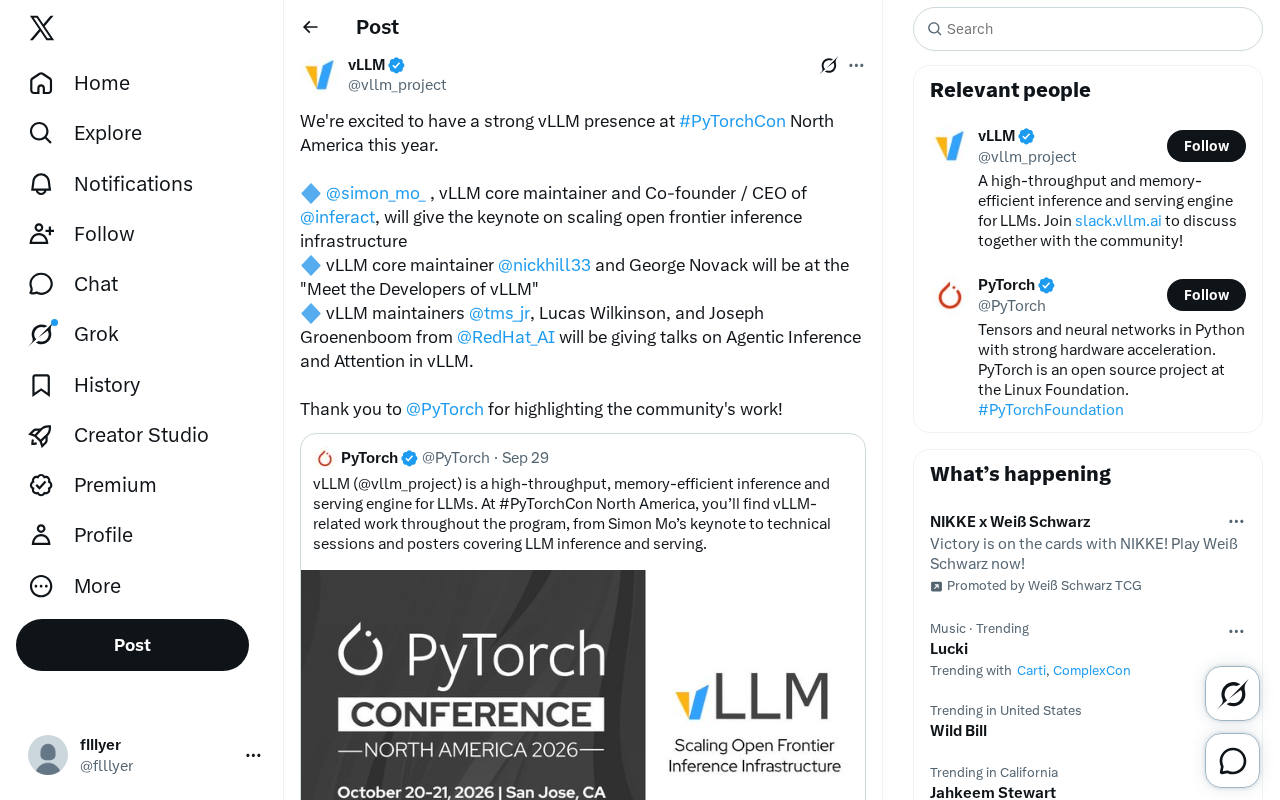
The fact that vLLM has secured such a visible position at a mainstream community event speaks volumes about the growing weight of open-source inference stacks within the broader AI engineering ecosystem. Beyond model training, efficiently and cost-effectively running large models in production has become a critical industry bottleneck — and vLLM sits squarely at the center of that challenge.
Three Tracks: From High-Level Architecture to Low-Level Attention
Based on the official agenda, the vLLM team's presentations can be organized into three tiers, covering a complete spectrum from strategic vision to concrete implementation.
Keynote: Scaling Open Frontier Inference Infrastructure
Simon Mo, a core vLLM maintainer and co-founder & CEO of Inferact, delivered a keynote focused on "scaling open frontier inference infrastructure." This topic cuts to one of the most pressing challenges in the field today — how to keep open-source inference systems high-throughput, low-latency, and cost-efficient at scale. As model parameter counts and context lengths continue to grow, the scalability of inference infrastructure is gradually displacing training compute as the new competitive frontier.
vLLM (Virtual Large Language Model) was released by UC Berkeley in 2023. Its core innovation is PagedAttention — inspired by the concept of virtual memory paging in operating systems, it partitions the KV Cache (key-value cache) used in attention computation into fixed-size "pages" for dynamic management. This dramatically reduces GPU memory fragmentation and improves memory utilization. Traditional inference frameworks typically pre-allocate contiguous maximum-length memory for each request, leading to significant waste. PagedAttention allows multiple requests to share and reuse cache pages, substantially increasing the number of concurrent requests that can be handled on the same hardware — yielding throughput improvements of several times to over ten times compared to native HuggingFace Transformers inference. This is the foundational technical underpinning that makes "scaling inference infrastructure" a viable proposition: handling the pressures of large-scale deployment through software-level memory scheduling optimizations, without additional hardware investment.
Developer Meet-and-Greet: Meet the Developers of vLLM
vLLM core maintainers Nick Hill and George Novack appeared in the "Meet the Developers of vLLM" session. This type of face-to-face format is especially valuable for open-source projects — it gives engineers who actually deploy vLLM the chance to speak directly with maintainers about deployment challenges, performance tuning insights, and roadmap direction. It's a direct expression of community-driven collaboration.
Technical Sessions: Agentic Inference and Attention Mechanisms
Tyler Michael Smith, Lucas Wilkinson, and Joseph Groenenboom — vLLM maintainers from Red Hat AI — presented technical sessions on "Agentic Inference" and "Attention in vLLM." The former addresses the new demands that Agent applications place on inference systems — multi-turn calls, dynamic workflows, state management, and more. The latter dives deep into the engineering implementation and optimization of attention computation within vLLM, which is often where the core of inference performance lives.
Agentic Inference refers to the shift in what an inference engine must support in LLM-driven Agent systems. Rather than stateless single-shot "input → output" calls, the engine must now support complex workflows including multi-turn conversations, tool/function calling, concurrent subtask decomposition, and intermediate state caching and replay. This places entirely different demands on inference frameworks compared to traditional batch inference: request lifecycles are longer, KV Caches need to persist across turns, and scheduling strategies must be aware of task priorities and dependencies. Features that vLLM has recently introduced — such as prefix caching and speculative decoding — are specifically designed to reduce time-to-first-token (TTFT) and improve overall response efficiency in these scenarios. As Agent frameworks like AutoGPT and LangGraph see widespread adoption, Agentic Inference has become the central battleground for the next phase of inference engine evolution.
Why This Appearance Matters
This concentrated showing sends several noteworthy signals.
First, vLLM's maintenance base reflects a multi-organization collaborative structure. Contributors include the founder of a startup (Inferact) alongside an engineering team from Red Hat AI. This kind of cross-organizational maintenance is a hallmark of a mature open-source project, and it means the project won't become overly dependent on any single commercial entity.
Second, the topics covered both ends of the spectrum — from macro-level scalability discussions to low-level attention computation details, with "Agentic Inference" as a standalone topic representing the cutting edge of applied use cases. This reflects vLLM's evolution from a pure inference acceleration library into an inference platform capable of supporting complex Agent workflows.
Third, PyTorch's high-profile acknowledgment of the community's contributions signals that the open-source inference stack is now regarded as an essential component of the mainstream deep learning framework ecosystem. The tight technical dependency between vLLM and PyTorch means that their co-development carries cascading implications for the entire open-source AI toolchain.
Closing Thoughts
For developers focused on bringing large models into production, the vLLM agenda at this year's PyTorchCon serves as a reliable technical compass worth following. Whether it's strategies for scaling inference infrastructure or the engineering details behind agentic inference and attention mechanisms, these topics reflect the most real and immediate technical priorities in the open-source inference ecosystem today. As conference materials are made publicly available, these sessions are poised to become the foundation for further community discussion and practice.
Related articles

The Chaotic Aesthetics of Apple's HomeView Ad: A Marketing Code Only Parents Can Read
Apple's HomeView smart display ad ditches minimalist style for chaotic family mornings to win over parents. We analyze why it confuses most viewers but resonates instantly with families — and the trade-offs and risks of Apple's targeted marketing.

Cerebras CEO Pushes Back on AI Doomerism: Stop Spreading Panic
Cerebras CEO Andrew Feldman publicly pushes back on AI doomerism at TechCrunch Disrupt, arguing excessive risk focus drowns out AI's real opportunities.

Retooling in Minutes: Industrial Next Redefines Factory Robot Flexibility
Industrial Next aims to let factory robots retool in minutes instead of weeks, automating complex delicate tasks and advancing flexible manufacturing and small-batch production.