vLLM v0.34.0 Released: The Inference Engine Levels Up Again
vLLM releases v0.34.0, but public info only shows the tag; check the official repo for changes.
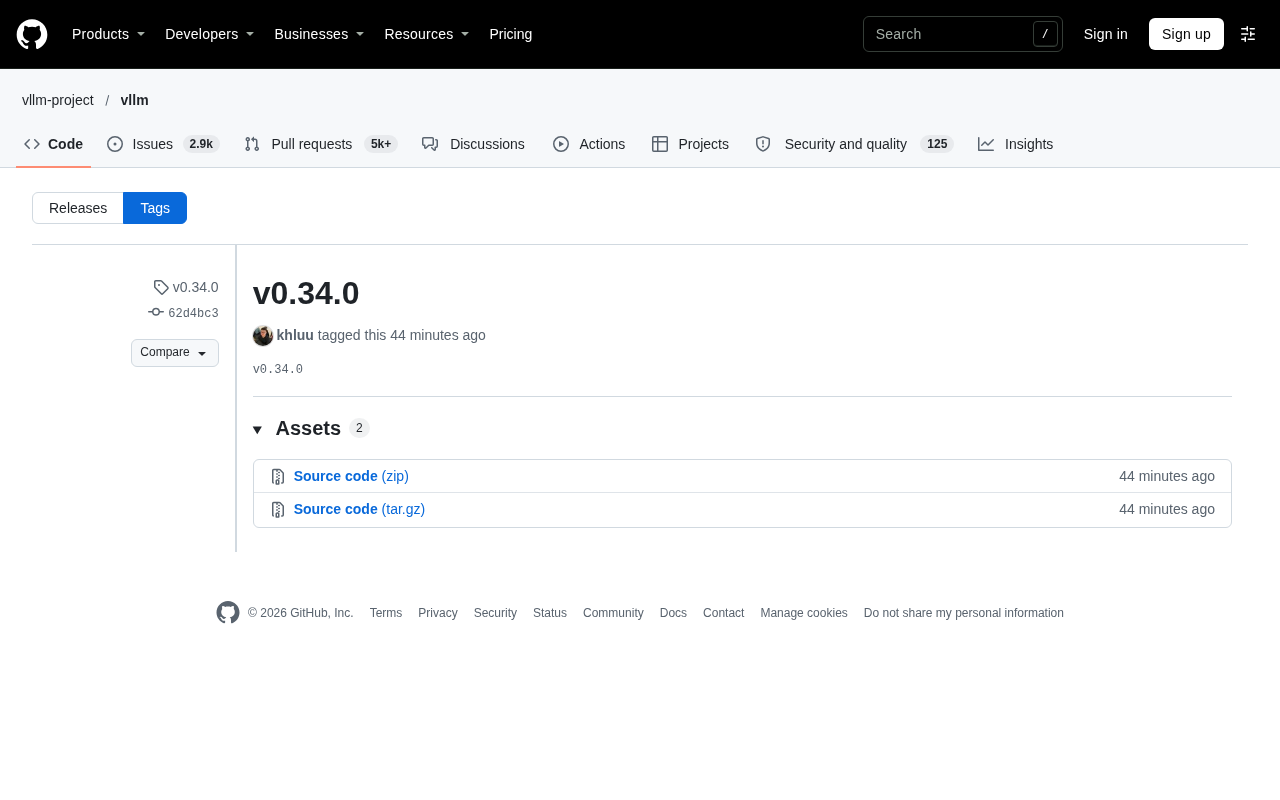
The vLLM project recently released v0.34.0, tagged by khluu on November 16 with two asset files. However, the material obtained consists only of GitHub Releases page tag info and loading status, with no updates, commit records, or release notes, so new features, performance gains, and breaking changes cannot be confirmed. The article notes the 0.x version climb indicates rapid feature accumulation rather than 1.0 stability. High-frequency releases speed up access to optimizations and hardware support but require careful production version locking. Developers should check the repo's Release page or commit history and verify correctness and throughput in a test environment before upgrading.
Release Overview
According to the GitHub repository tag information, the vLLM project recently released version v0.34.0 (tag created by khluu on 16 Nov at 04:27). This release comes with two asset files, but further details on the release page have not yet fully loaded.
As a major open-source project in the large model inference space, every release iteration of vLLM captures the attention of developers on the deployment side. The release of v0.34.0 signals that the project continues to evolve, and although public information is limited this time, some signals can still be read from the release cadence and community conventions.
vLLM is an open-source large language model inference and serving engine led by a team at UC Berkeley. Its core innovation is PagedAttention — an attention algorithm that manages the KV Cache by borrowing the idea of virtual memory paging from operating systems, reducing memory waste to near zero and thereby significantly boosting throughput. vLLM also provides a server interface compatible with the OpenAI API, supports continuous batching, tensor parallelism, quantized inference, and a variety of mainstream model architectures, and is widely used for model deployment in production environments. Its version number is still in the 0.x stage, meaning the API and internal implementation are still evolving rapidly, and long-term stability in the semantic versioning sense has not yet been promised.
Release Cadence and Project Vitality
Judging from the tag creation time and the version number span, vLLM maintains a relatively steady iteration frequency. The version number continues to climb through the 0.x sequence, indicating that the project is still in a phase of rapid feature accumulation and has not yet entered the 1.0 era focused on stability.
This high-frequency release model is a double-edged sword for users: on one hand, they gain access to performance optimizations and new hardware support more quickly; on the other hand, it means version locking in production environments needs to be managed more carefully. For teams pursuing stability, it is advisable to review the changelog before deciding whether to upgrade.
Cautious Interpretation Amid Missing Information
It is worth noting that the raw material captured this time consists only of the tag information and loading status of the GitHub Releases page, and does not include specific update contents, commit records, or release notes. Therefore, key questions such as exactly what new features v0.34.0 includes, the magnitude of performance improvements, and whether there are breaking changes cannot be answered from the available information.
For developers following this version, it is recommended to visit the project repository's Release page directly or compare the commit history to obtain accurate change details. In the absence of official notes, any speculation about specific features lacks a basis.
Impact on Inference Deployment
As a high-throughput inference engine, vLLM's version updates typically affect memory management, batching strategies, and model compatibility. Although the specific changes in v0.34.0 cannot be confirmed this time, following the project's past iteration patterns, you should focus on verifying the inference correctness and throughput performance of your own models under this version before upgrading.
If your team is using containerized deployment, it is recommended to first pull the new version image in a test environment, observe its compatibility with existing inference services, and then roll it out to production.
In actual vLLM deployments, the memory footprint of the KV Cache is typically one of the main bottlenecks in large model inference. PagedAttention divides the KV Cache of each sequence into fixed-size blocks and allocates non-contiguous memory on demand; combined with a block-level sharing mechanism, requests with the same prefix can reuse the cache, thereby supporting higher concurrent batch sizes. As a result, version updates often involve adjustments to memory allocation strategies, scheduler logic, and CUDA kernel implementations, and these changes directly affect metrics such as first-token latency, throughput, and maximum concurrency. When upgrading, you should also pay attention to the matching relationships among the CUDA driver, the PyTorch version, and the base environment of the inference image; version incompatibilities may manifest as startup errors or performance regressions.
Conclusion
The release of v0.34.0 is itself a reflection of the project's activity, but the information available this time is fairly limited. Developers should rely on the complete release notes in the official repository and assess the necessity of upgrading in light of their own business scenarios.
One-line Summary
vLLM releases v0.34.0, but public information contains only the tag; specific changes require checking the official repository.
Paragraph Summary
The vLLM project recently released version v0.34.0, with the tag created by khluu on November 16 and two asset files attached. However, the material obtained this time consists only of the tag information and loading status of the GitHub Releases page, and does not include update contents, commit records, or release notes, so it is impossible to confirm new features, the magnitude of performance improvements, or whether there are breaking changes. The article notes that the version number continues to climb through 0.x, indicating that the project is still in a phase of rapid feature accumulation and has not yet entered the 1.0 era focused on stability. High-frequency releases allow users to gain performance optimizations and new hardware support more quickly, but also require more careful version locking in production environments. The author recommends that developers visit the project repository's Release page directly or compare the commit history to obtain change details, and verify inference correctness and throughput performance in a test environment before upgrading.
Related articles

AI Abuse Alert: Reports of Child Sexual Abuse Material Surge 8,400% in Two Years
Hacker News reports show AI-related child sexual abuse material reports rose 8,400% in two years. This article analyzes how generative AI lowers the barrier to producing illegal content, the dilemma facing platform detection and legal regulation, and feasible directions for technical countermeasures.

Can Task-Specific 4B Models Replace Large Models?
A developer training Qwen3.5-4B-3D-Coder and LFM2.5-350M finds task-specific small models exceed expectations on 3D scene generation. Insights on epochs, SFT vs RL cost, and full fine-tuning on consumer hardware.

AI Employee Tools Are Everywhere — How Can a 35-Person Startup Pick the Ones That Actually Work?
A 35-person startup struggles with too many AI employee tools. Drawing on real community experience, this article distills three hard criteria—unattended operation, integration depth, and verifiability—to help you pick tools that actually work and avoid shelfware.