Voice AI Agent Latency Optimization: Staged Measurement and Streaming to Reduce Response Time

Break a voice turn into five stages, instrument each, and cut latency with p50/p95 and streaming.
Based on a technical share from the VRM AI Technology team, this article splits a voice conversational turn into five stages—endpointing, ASR finalization, LLM first token, tool calls, and TTS first byte—advocating per-stage measurement rather than only end-to-end totals. The solution is a lightweight Python tracer using defaultdict and time.monotonic that skips reports under 20 samples; streaming stages stop the clock at the first token. Compare p50 vs p95—high tails signal cold connections, long prompts, retries, or jitter—and prioritize the biggest stage. Inter-stage streaming is the most effective lever; barge-in should count in the budget, and CI replay asserts p95 per stage.
In voice conversations, response latency directly determines how natural the experience feels. A one- or two-second pause in text chat is no big deal, but in a phone call, the same pause makes users think the line has dropped. Based on a technical share from the VRM AI Technology team, this article breaks down the stages of a single conversational turn, explains how to instrument and measure each stage, and summarizes common techniques for reducing latency.
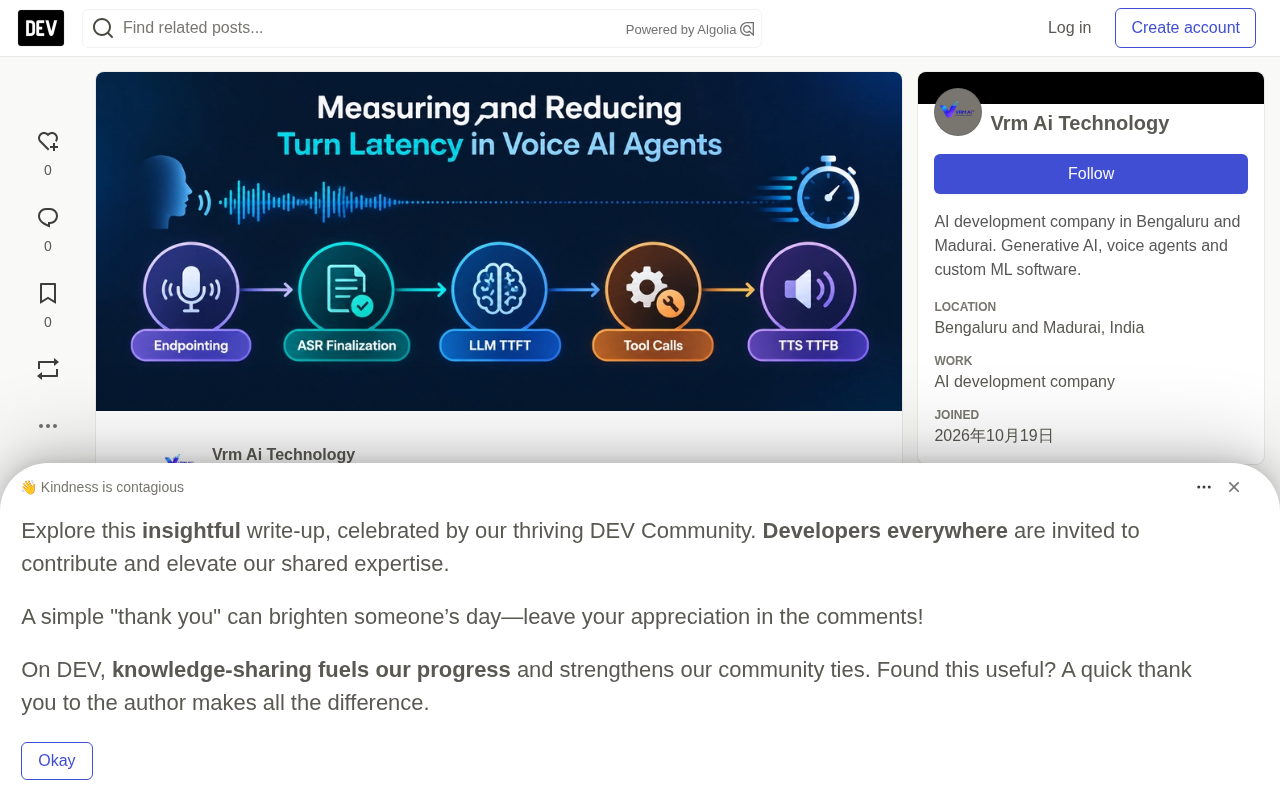
Where the Time in a Conversational Turn Goes
A turn begins when the caller stops speaking and ends when the first chunk of the reply's audio plays out. This interval can be split into five main stages:
- Endpointing: Determining whether the user has finished speaking.
- ASR Finalization: Generating the final transcript after the last audio frame.
- LLM Time to First Token (TTFT): The wait before the model starts generating.
- Tool calls: External requests such as CRM, calendar, or database queries.
- TTS Time to First Byte (TTFB): The latency before the speech synthesis outputs the first chunk of audio.
Without streaming, total latency is roughly the sum of these stages. With streaming enabled, some stages can overlap—the specifics are covered below. In either case, before you start optimizing, each stage needs its own measurement data. Averages mask the slow turns users actually perceive, so the team emphasizes watching both p50 and p95 percentiles.
Instrumenting Turns: A Lightweight Tracer Is Enough
You don't need a heavyweight APM system to get started with measurement. The solution from the VRM team is a small Python tracer that collects millisecond-level durations per stage and outputs a percentile report. The core design has three points:
- Use
defaultdict(list)to accumulate samples by stage; - Use
time.monotonic()for timing to avoid errors from system clock adjustments; - Skip reporting when fewer than 20 samples are collected, since p95 has no statistical meaning with too few samples.
For one-shot stages (such as tool queries), wrapping them in a record context manager handles timing automatically. For streaming stages (such as LLM TTFT), the key is to stop the clock when the first token appears, then continue consuming the rest of the stream rather than waiting for the entire response to finish. This detail determines the accuracy of TTFT measurement—many teams mistakenly treat total generation time as first-token latency.
start = time.monotonic()
first_token_seen = False

for token in llm_stream(prompt):
    if not first_token_seen:
        tracer.add("llm_ttft", (time.monotonic() - start) * 1000)
        first_token_seen = True
    # Pass each token to the next stage (e.g., TTS) here
time.monotonic() is a monotonic clock function from the Python standard library whose return value is only guaranteed to increase monotonically, unaffected by system time adjustments (NTP sync, manual clock changes, daylight saving time shifts). By contrast, time.time() returns wall-clock time; when measuring durations, if the system clock rolls back or jumps, you can get negative or abnormally inflated intervals, distorting latency statistics. That's why the industry convention for measuring stage durations is to call time.monotonic() twice and subtract. Note that its absolute value has no real meaning (the starting point is determined by the operating system) and can only be used for differences; when comparing timestamps across processes or machines, use a scheme with synchronized clocks instead.
Reading the Data: The Gap Between p95 and p50 Is the Key Signal
Once you have the percentile report, the first step is to compare p95 with p50. If p50 is normal but p95 is high, the problem is usually intermittent: cold connections, overly long prompts, retries, or network jitter. These problems don't show up in the average, yet they are exactly the most jarring part of the user experience.
The second step is to compare stages side by side to find the one taking the largest share of turn time and address it first. For example, if LLM TTFT accounts for 60% of latency, then optimizing tool calls is a waste of effort.
p50 (the median) means half of turns take less time than that value; p95 means 95% of turns take less time, with the remaining 5% of slow turns falling in the tail. Averages are insensitive to the tail: a small number of very slow turns get diluted by the many normal turns, masking the real experience. Percentiles directly characterize "what the worst-off users experienced." Sample size heavily affects the reliability of percentile estimates—with too few samples, p95 is effectively determined by a few outliers and fluctuates wildly, which is why the article earlier requires skipping reports under 20 samples. In engineering practice, p99 is usually also monitored, and long-tail turns exceeding thresholds get separately instrumented for attribution.
Streaming Between Stages: Overlapping the Waits
Waiting serially for each stage to finish before starting the next makes latency pile up quickly. The VRM team lists stage overlap as one of the most effective ways to reduce perceived latency. Specific approaches include:
- Streaming partial ASR results: Have the final transcript ready as soon as speech ends, rather than waiting for the entire segment to be processed;
- Coupling the LLM token stream with TTS: Start speech synthesis as soon as the first complete sentence or clause is ready;
- Chunked TTS audio delivery: Don't wait for the entire audio file to be synthesized before playing—push it to the user in chunks.
The effect is that users hear the beginning of the reply while the rest is still being generated. Perceived latency drops dramatically, even though end-to-end total duration may not shrink.
Streaming means data is produced chunk by chunk during generation rather than returned all at once when complete. For LLMs, streaming output means each token the model generates is immediately pushed downstream, allowing downstream to start processing earlier; for TTS, streaming synthesis allows the first chunk to start playing before all audio is generated. The key to pipelining is that stages hand off at the granularity of "chunks" rather than "complete results." The trade-off is that downstream must make decisions with incomplete information—for example, TTS must start synthesis before sentence boundaries are certain, so engineering practice often uses punctuation or clause boundaries as split triggers to balance responsiveness and speech naturalness.
Barge-in Handling Is Part of the Latency Budget
In real calls, users interrupt. When voice activity is detected during playback, the system needs to stop audio output, cancel in-progress generation, and return to listening. The VRM team specifically notes that the responsiveness of the barge-in path should count toward the latency budget—being slow to react to an interruption is just as unnatural as being slow to answer. This is easily overlooked in engineering because barge-in is an "abnormal" path, but its frequency in real conversations is not low.
Barge-in means the user starts speaking while the AI is playing back its reply. After detecting user speech via voice activity detection (VAD), the system must do three things: immediately stop the audio currently playing, issue cancellation to the in-progress LLM and TTS, and switch back to listening and endpointing state. The "cancel" requires downstream streaming interfaces to support an abort signal; otherwise queued tokens and audio chunks continue to consume resources and cause crosstalk. Barge-in path duration is usually measured from detection of user speech to when the audio is actually silenced, and like the normal reply path, it should have its own measurement and budget threshold.
Guard the Latency Budget with Replay Tests
Latency silently degrades as prompts, tools, and models evolve. The VRM team recommends keeping a fixed set of recorded test utterances, replaying them in CI, and asserting that each stage's p95 stays within budget:
def test_turn_latency_budget():
    report = run_replay_suite()
    assert report["llm_ttft"]["p95_ms"] < 800
    assert report["tool_call"]["p95_ms"] < 300
The 800ms and 300ms in the article are just placeholder thresholds; actual budgets should be set based on your own measurements and product requirements. The value of this approach is turning latency from something you "discover after launch from user complaints" into an engineering metric "verifiable on every commit."
Key Practices
Distilling the VRM team's approach into actionable points:
- Split each turn into five stages and measure each one—don't just measure end-to-end total duration;
- Track p50 and p95, not averages;
- Enable streaming between stages so they overlap;
- Treat the barge-in path as a first-class citizen;
- Set latency budgets for each stage via CI replay tests to prevent degradation.
This approach doesn't depend on any specific vendor or framework and is directly relevant to teams building their own voice agents. The prerequisite for latency optimization is always first seeing where the time goes—and staged instrumentation is that act of "seeing."
One-line Summary
Breaking down a voice turn into five stages, instrumenting each, and cutting latency with p50/p95 and streaming.
Paragraph Summary
Based on a technical share from the VRM AI Technology team, this article splits a voice conversational turn into five stages—endpointing, ASR finalization, LLM first token, tool calls, and TTS first byte—arguing for per-stage measurement rather than only end-to-end total duration. The measurement solution is a lightweight Python tracer that accumulates samples via defaultdict, times with time.monotonic, and skips reports under 20 samples; streaming stages should stop the clock when the first token arrives, not when generation finishes. Data analysis should compare p50 and p95—a high tail usually points to cold connections, long prompts, retries, or network jitter—and prioritize the largest-share stage. The most effective way to reduce perceived latency is inter-stage streaming; the barge-in path should also count toward the latency budget, and CI replay of recordings should assert p95 budgets per stage to prevent degradation.
Related articles

Free Unlimited Claude Code Solution: Agnes AI + CC Switch Setup Guide
No paid subscription needed — pair the free AI platform Agnes AI with the open-source tool CC Switch to provide a backend for Claude Code, enabling unlimited free calls to text, image, and video models. This guide covers the full setup, test results, and usage boundaries.

A Complete Zero-Cost Guide to Getting Started with Claude Code for Beginners in China
A beginner's guide to Claude Code for users in China: two installation methods (command line and IDE plugin), full configuration steps for replacing the official API with the free domestic LongCat model, and a hands-on demo of building a small tool with natural language, plus tips.

When the NSA Gets Involved: The AI Supply Chain Crisis Behind Open-Source CVEs and API Key Hijacking
Multiple open-source projects disclosed severe CVEs in one day, PHP flaws alarmed the FBI, and Railway and OpenCode were breached with API keys stolen. This article breaks down the vulnerability window, AI-accelerated exploitation, and the AI supply chain crisis behind the API key black market, with a developer defense checklist.