Voice AI Migration Pitfall Guide: Handoff Failures and Solutions During Parallel Operation

A practical guide to solving handoff failures during voice AI system migration parallel operation periods.
Enterprise voice AI migrations face critical challenges during parallel operation periods, particularly around context loss during AI-to-human handoffs and routing instability. This article analyzes a real-world case where a team at 60% migration completion encountered unreliable handoffs, and provides actionable strategies including complexity-based traffic splitting, treating handoff as an independent module, and implementing graceful degradation mechanisms.
A Real Voice AI Migration Dilemma
When enterprises replace core business systems, the hardest part isn't the decision-making phase—it's the "transition period" when old and new systems run in parallel. A Reddit user recently shared their real experience migrating outbound follow-up call operations from a platform they'd used for about 18 months to a new voice AI system, exposing a widely underestimated problem in voice AI deployment—reliability and context handoff during migration.
This user's situation is quite representative: the old system wasn't completely unusable—it still handled simple confirmation calls fine—but whenever customers raised slightly complex follow-up questions, the entire conversation flow would stall or even loop back to the starting point. In their own words, "it's honestly embarrassing." It was precisely this frequent failure in long-conversation scenarios that drove them to migrate.
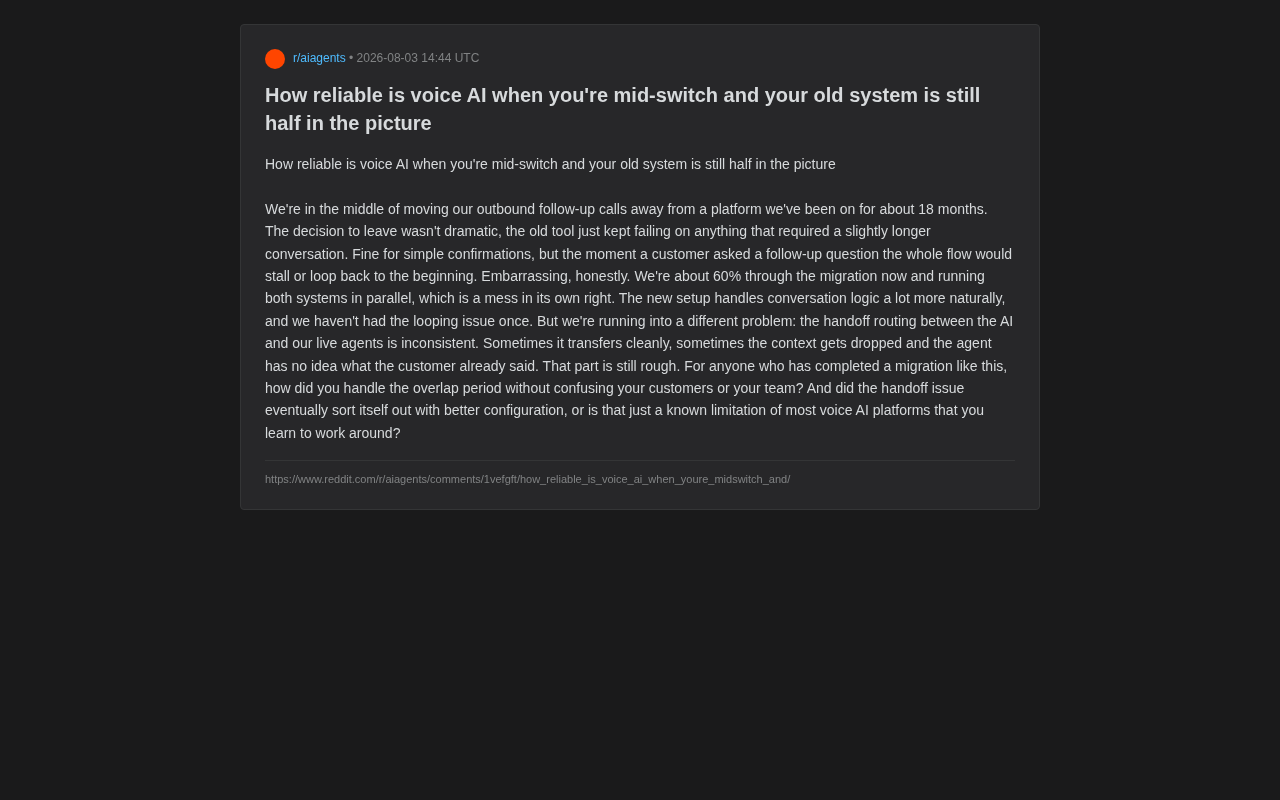
They've currently completed about 60% of the migration and are in the phase where both systems run simultaneously. The new system handles conversation logic much more naturally, and the persistent "loop-back" problem hasn't occurred once. But new troubles have emerged—the handoff routing between AI and human agents is unstable.
The Core Pain Point: Not Conversation Ability, But Handoff
Interestingly, the key issue isn't the voice AI's comprehension or conversation quality—it's context handoff consistency.
Context Loss During Handoffs
According to the description, handoffs sometimes work cleanly but other times lose context—human agents pick up the phone with no idea what the customer has already said. This means customers may need to repeat their issues, drastically degrading the experience. This type of problem is extremely common in voice AI deployments, and its root causes include:
-
Incomplete state transfer mechanisms: Structured data accumulated during conversations—intents, entities, dialogue history—fails to transfer completely and reliably to the agent side at the moment of handoff. Voice AI systems maintain a data structure called "Dialog State" during conversations, containing recognized user intents, extracted entity information (such as names, order numbers, dates, and other slot values), conversation turn history, and the current business process node. Ideally, when the AI determines a human handoff is needed, this structured data should be transmitted synchronously with the voice channel via CTI (Computer Telephony Integration) protocols, SIP header information, WebSocket events, or similar mechanisms. However, in practice, many platforms' handoff implementations only complete call transfer at the signaling level, while application-layer context data relies on independent API calls. Without atomicity guarantees between the two, you get the "call arrived, data didn't" disconnect.
-
Weak inter-system integration: If the API connections between the voice AI platform, CRM, and agent desktop lack transactional guarantees, you get situations where "the call transferred over, but the data didn't follow."
-
Real-time challenges: A handoff is a real-time action—any millisecond-level delay or async processing failure can result in the agent not having complete context when the customer starts speaking.
Parallel Operation Is Inherently Chaotic
The user admits that running two systems simultaneously "is a mess in itself." This is a universal pain point in all system migrations: customers might be reached by different systems with different scripts and different workflows, while internal teams must maintain two sets of logic, monitoring, and troubleshooting approaches. The longer the transition period, the higher the error probability.
In software engineering, running old and new systems in parallel is typically a variant of "blue-green deployment" or "canary release" strategies. For real-time interactive systems like voice AI, the complexity of parallel operation far exceeds that of web services: every phone call is a stateful, non-retriable real-time session—once something goes wrong, you can't transparently redirect it like an HTTP request. Additionally, phone number resources are limited, and the switching granularity of call routing rules (usually controlled by IVR or SBC devices) is far less flexible than internet traffic scheduling. This means migration teams need to maintain complex routing matrices at the telecom infrastructure level while ensuring logs, recordings, and quality inspection data from both systems can be consolidated for unified analysis.
Management Strategies for Voice AI Migration Transition Periods
While the original post was framed as a question, we can extract several migration management approaches worth adopting.
Split Traffic by Scenario, Not by Percentage
Many teams default to rough percentage-based splits like "60% of traffic goes to the new system," but a more reliable approach is splitting by conversation complexity. Since the old system remains reliable for simple confirmation scenarios, let it continue handling these low-risk calls while prioritizing migration of complex multi-turn scenarios to the new system. This leverages the new system's strengths while reducing the blast radius of errors.
Splitting by conversation complexity technically relies on "pre-classifier" design. In outbound scenarios, the system can determine the expected complexity of a call based on CRM customer tags, historical ticket status, and the purpose of the current outbound call before dialing, routing it to the corresponding AI engine. This approach borrows from the "intelligent routing" concept in microservices architecture—not simple load balancing, but traffic scheduling based on business semantics. Compared to random percentage-based splitting, it more precisely assigns each system the scenarios it handles best, while also facilitating subsequent A/B testing to quantify performance differences between the two systems on similar scenarios.
Treat Handoff as an Independent Module for Focused Development
As the case demonstrates, conversation capability and handoff capability are two different things. Teams should treat AI-to-human handoff as an independent technical module rather than assuming it will "just work." Specific actions include:
- Mandate structured conversation summaries in the handoff protocol (customer intent + confirmed information + unresolved issues);
- Provide agents with a real-time conversation record dashboard so they can manually review even if data transfer fails;
- Establish handoff success rate monitoring metrics and include "context completeness rate" as a core KPI.
Maintain Experience Consistency on the Customer Side
The biggest mistake during transition periods is letting customers perceive system fragmentation. Regardless of which system ultimately handles the call, external scripts, identity verification, and business processes should remain unified to avoid customer confusion or distrust from "this time was different from last time."
Context Loss During Handoff: Configuration Issue or Industry-Wide Problem?
At the end of the post, the user raised a critical question: is context loss during handoffs something that can be resolved with better configuration, or is it a "known limitation" that exists across most voice AI platforms and needs to be worked around?
From an industry perspective, the answer lies somewhere in between:
On one hand, most context loss issues can indeed be significantly improved through more rigorous integration configuration and data pipeline design. The key is not to rely on the platform's default handoff behavior, but to proactively design the complete chain of context serialization, transmission, and agent-side consumption.
On the other hand, real-time voice handoffs involve coordination among telephone networks, AI platforms, and agent systems—an inherently fragile arrangement. Even with proper configuration, you still need to establish graceful degradation mechanisms—when context transfer fails, the system should enable agents to quickly pull up history records rather than making customers start over.
Graceful Degradation is one of the core principles in distributed systems design. Its fundamental idea is: when a system component fails, the overall service should degrade in a controlled manner rather than completely collapse. In voice AI handoff scenarios, specific implementations of graceful degradation might include: the agent interface automatically displaying a "context loading failed" prompt with a one-click button to pull historical records; the system automatically playing the last 30 seconds of the AI-customer conversation summary to the agent; or having the AI proactively confirm with the customer before transfer—"I'll connect you with a human agent, please hold"—buying the agent a few seconds of data loading time. These designs seem simple but are often overlooked in actual deployments, only to be urgently patched when production environments generate massive customer complaints.
Conclusion: The True Measure of Voice AI Maturity
This firsthand account from a frontline operator serves as a reminder for enterprises evaluating or advancing voice AI: Voice AI maturity shouldn't be measured only by how smoothly it handles standalone conversations—it must also be judged by its reliability when embedded in existing business workflows and collaborating with human agents. Conversation logic naturalness can be solved by switching platforms, but the engineering capabilities at these "seams"—inter-system handoffs, migration-period order, customer experience consistency—are the real thresholds that determine project success or failure.
From a broader perspective, this case reflects a structural contradiction in the current voice AI industry: platform vendors tend to differentiate on Conversational Intelligence—more natural voices, more accurate intent recognition, smoother multi-turn dialogues—but enterprise customers' real pain points often emerge in system integration, process orchestration, and operational observability—"non-core but critical" engineering domains. When selecting a voice AI platform, beyond conversation performance in demos, you should deeply evaluate the openness of its handoff protocols, pre-built integration depth with mainstream CCaaS (Contact Center as a Service) platforms, and whether it provides parallel operation tooling support for migration periods.
Key Takeaways
Related articles

Apple HomeView Hands-On Review: Is the $300 Smart Home Hub Worth It?
Apple HomeView hands-on: a $300 smart home hub with facial recognition for quick account switching, but no App Store or voice recognition. Is the wall-mounted version worth it? Should you buy the first generation?

Meta Muse Wonder Launch: What It Means for Meta's Return to the Frontier AI Race
Meta releases Muse Wonder and WonderFull, benchmarks reach the frontier, community feedback is polarized. An in-depth look at Meta's return to the frontier AI race, its personal agent strategy, and Zuckerberg's different path.

Apple Home Smart Home Lineup Leaked: LG and Schneider Team Up, UWB Door Lock on Board
Apple Home ecosystem gains new LG and Schneider devices: UWB smart lock with proximity unlock, 2.5K dual-camera doorbell, privacy indoor camera, and AirPods-like seamless pairing.