VoiceCap: An AI Meeting Recorder That Supports 100+ Languages

VoiceCap is an AI meeting recorder built for non-English teams, with multilingual notes, MCP integration, and EU data compliance.
VoiceCap is a European AI meeting tool designed specifically for non-English meetings. It supports transcription in 100+ languages and generates summaries, action items, and decision logs in the same language — avoiding the common pitfall of forcing non-English content into English output. It records via a native app, bots for Zoom/Meet/Teams, or uploaded audio files. Via MCP, users can query past meetings through Claude or ChatGPT. As an EU company, data is stored in Frankfurt and never used for model training, meeting GDPR requirements. It offers 300 free minutes with no credit card needed, though early user feedback is still limited.
Most AI meeting note-takers share a common weakness: they handle English beautifully, but struggle with everything else. For teams whose native language isn't English, or for cross-border meetings, this translates to transcription errors, distorted summaries, and missed action items. VoiceCap, a product out of Europe, puts "multilingual support" at the center of its pitch — aiming to solve a pain point that has long been overlooked.
Multilingual Isn't Just Transcription — It's End-to-End Localization
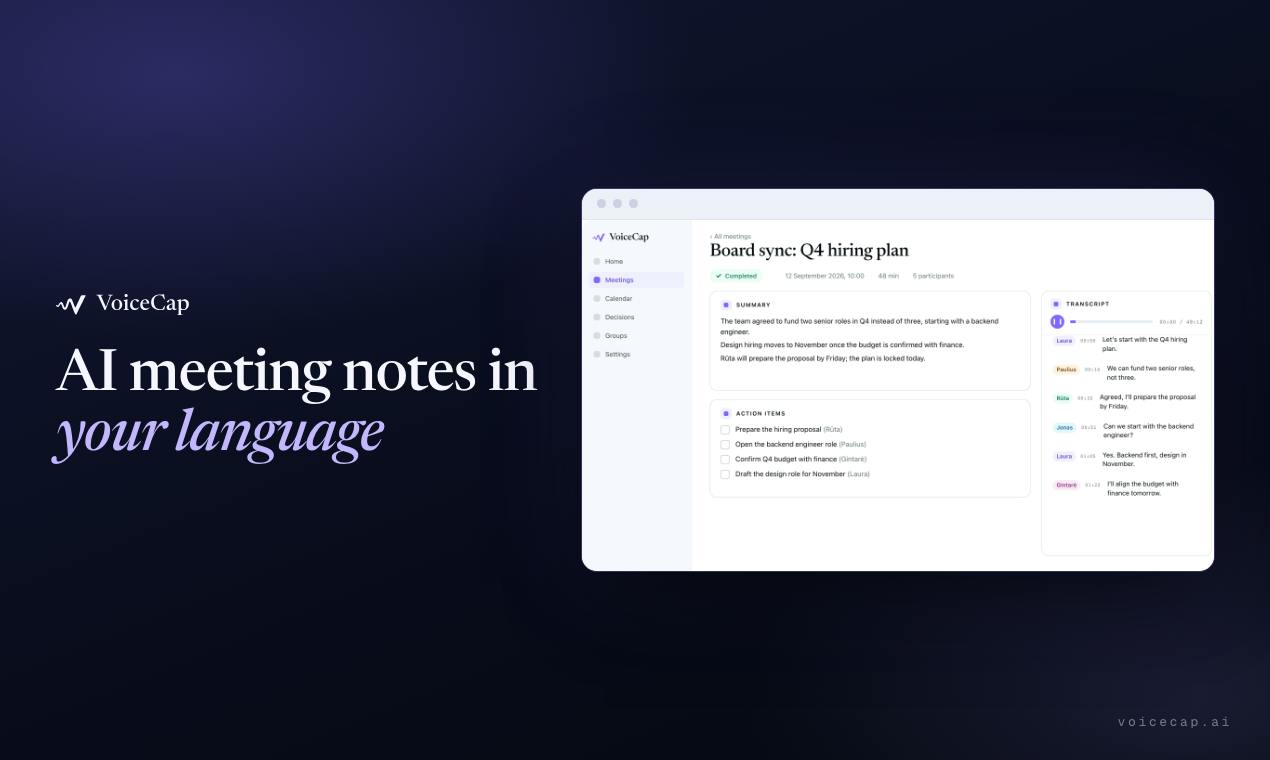
VoiceCap claims to support transcription in over 100 languages, which on its own isn't particularly remarkable — many tools can recognize multilingual audio. What sets it apart is this: it doesn't just transcribe in the original language, it also generates meeting summaries, action items, and decision logs in that same language.
This detail matters. Many tools, even if they can recognize German or Spanish audio, still default to outputting summaries in English — or produce output riddled with translation artifacts. VoiceCap maintains language consistency, meaning a French meeting ends with the team receiving a structured set of minutes entirely in French, with no need for re-translation or proofreading. For a market as linguistically diverse as Europe, this design far better fits real-world working conditions.
Multiple Recording Modes for Every Meeting Type
VoiceCap offers three recording paths, covering the most common meeting formats:
- In-person meetings: Record directly in a conference room using the native app;
- Online meetings: Deploy a bot to join Zoom, Google Meet, or Microsoft Teams;
- Existing recordings: Upload an audio file for processing.
This "room + bot + upload" tri-mode approach means the tool isn't limited to any single meeting type. Whether it's a face-to-face team discussion or a distributed remote collaboration, everything feeds into the same recording system. Every meeting becomes a searchable record, clearly indicating what decisions were made and who is responsible for follow-up — which is exactly the core value of meeting minutes.
Connect to Claude and ChatGPT via MCP
One technically noteworthy choice VoiceCap makes is supporting MCP (Model Context Protocol). Users can ask questions about meeting content directly through Claude or ChatGPT — for example, "What priorities were decided in last week's product review?"
This means VoiceCap doesn't position itself as a closed note-taking tool. Instead, it treats meeting data as a context source that large language models can query. As MCP gradually becomes the standard interface for connecting AI assistants to external data, this kind of integration extends the tool's value from "recording" to "knowledge retrieval and Q&A," seamlessly fitting into users' existing AI workflows.
MCP (Model Context Protocol) is an open protocol introduced by Anthropic in late 2024, designed to give large language models a standardized way to connect to external data sources and tools. The core idea is similar to a universal USB standard: developers expose data interfaces according to the MCP specification, and AI assistants like Claude and ChatGPT that support the protocol can directly read and query that data — no need to build separate integrations for each AI platform. For meeting note-taking tools, MCP integration means historical meeting content can become real-time context for AI conversations. Users don't need to manually copy and paste meeting notes; the AI assistant can directly "see" all meeting records from the past few weeks, enabling complex queries like cross-meeting information retrieval, decision tracing, and task summarization.
Data Compliance as a Differentiator for European Products
As an EU-based company, VoiceCap puts data privacy front and center: recordings are stored in data centers in Frankfurt, with an explicit commitment that the data will not be used to train models.
As enterprise AI tool procurement increasingly prioritizes data sovereignty and GDPR compliance, this is a genuine differentiator. Meeting content often involves sensitive business decisions, personnel matters, and strategic information. The promise that "data stays within the EU and won't be used for training" holds clear appeal for European companies and compliance-conscious teams.
GDPR (General Data Protection Regulation) is the EU's data protection framework that came into full effect in 2018, imposing strict rules on the collection, storage, processing, and cross-border transfer of personal data. For enterprise SaaS procurement, one of the core GDPR concerns is the "data processing location" — data must be stored within the EU or in countries with data protection agreements with the EU, and users retain rights to access, correct, and delete their own data. Meeting recordings fall into a highly sensitive data category, as they may contain personally identifiable voice data and discussions involving trade secrets. Locking the data center explicitly to Frankfurt and committing not to use data for model training is the most direct evidence for satisfying GDPR audit requirements — and therefore becomes a core competitive advantage against US-dominated alternatives.
Getting Started and Market Traction
In terms of onboarding friction, VoiceCap offers 300 minutes free with no credit card required. This lowers the barrier to entry, letting teams run a few real meetings to evaluate the product before committing to a paid plan.
Based on Product Hunt data, the product was built by Rokas Jurkenas and received 86 upvotes and a #6 ranking after launch, listed under categories including Android, Productivity, Meetings, and Artificial Intelligence. The vote count shows a respectable level of interest, but with only 1 comment, early user feedback remains sparse. Real-world multilingual accuracy, bot stability, and other performance factors still need more usage data to validate.
Summary
VoiceCap has a clear positioning: rather than going head-to-head with dominant English-focused tools, it targets the well-defined pain point of poor non-English meeting note quality, layering on MCP integration and EU data compliance to form a differentiated meeting solution built for multilingual use and privacy-first teams. For multinational teams, non-English-speaking organizations, and European enterprises sensitive to data sovereignty, this is a product worth watching. The real test still lies in whether the 100+ languages it claims to support can deliver on transcription and summarization quality in actual meetings.
Related articles

Cursor AI Programming in Practice: Build a Student Management System from Scratch in 30 Minutes
A Bilibili creator demonstrates Cursor AI programming: generating a student management system in 30 minutes with natural language. Details on Agent mode, Claude selection, prompt techniques, and thresholds.

Top 20 AI Coding Tools Ranking: From Rock-Solid to Lackluster, a Scored Matrix
Bilibili creator releases top 20 AI coding tools ranking, tiered T0–T4 from rock-solid to lackluster, with Claude Code and Codex tied at T0. This article details the scoring dimensions (capability, reliability, robustness, durability, cost, domestic availability) and tool performances to help developers choose the right AI coding assistant.

Vibe Coding Systematic Tutorial: Master AI-Assisted Programming from Zero
A three-month Vibe Coding tutorial from a Bilibili creator covering Codex, ClaudeCode, and Cursor, from core logic to commercial project practice for beginners.